Rocket Rob — Deep Dive

Everything behind the story. Full character profiles, three-act structure, world-building, series expansion, and the children's book universe. This is the room version — the full picture for anyone who wants to build it.

Full Character Profiles

Every character argues a different position on the same question. Who they are underneath is what makes the audience stay.
Rocket Rob
Protagonist — The Center

Rob Lavoie / Rocket Rob

"A dad who accidentally became a superhero."

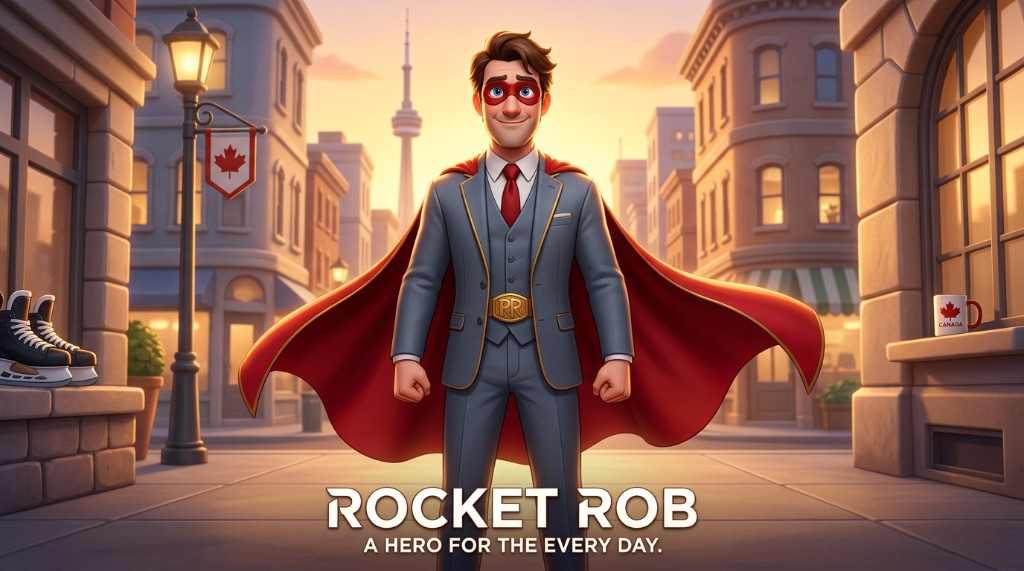
Late 20s–early 30s. Canadian. Works at Titan Sports Tech. Trying to balance career demands with being the father Max deserves. In Max's eyes, Rob is already Rocket Rob — the greatest superhero ever. The film's central question is whether Rob can be a hero without powers. The superhero layer is Max's imagination. Rob's Act 3 heroism comes from his own choice to be present — not from powers returning.

Rocket Red cape Gray suit RR belt buckle Maple leaf pin Team Canada mug
Core Tension
Wants to be the hero Max sees. When Max stops believing, Rob must find his own courage — not from powers, but from choice.
Source of Power
Phase 1: Max's belief (imagination). Phase 2: Silence (confidence lost). Phase 3: Self-belief (the choice to be present, not powerful).
Running Gag
Solves everything with dad logic. "Have you tried turning it off and on again?"
Canadian Identity
He brought it with him. Maple syrup, hockey jersey, reflexive "sorry."
Constellation Role
The Question — powered from below by Max, challenged from above by Watt.
Arc Resolution
Max's belief started him. His own choice finishes it. He races to the arena and arrives during the game — as Rob, not Rocket Rob. The golden seat fills.
"Barely." — when Claire asks if the city survived
"Have you tried turning it off and on again?"
"You already know why." — to Watt, on the rooftop
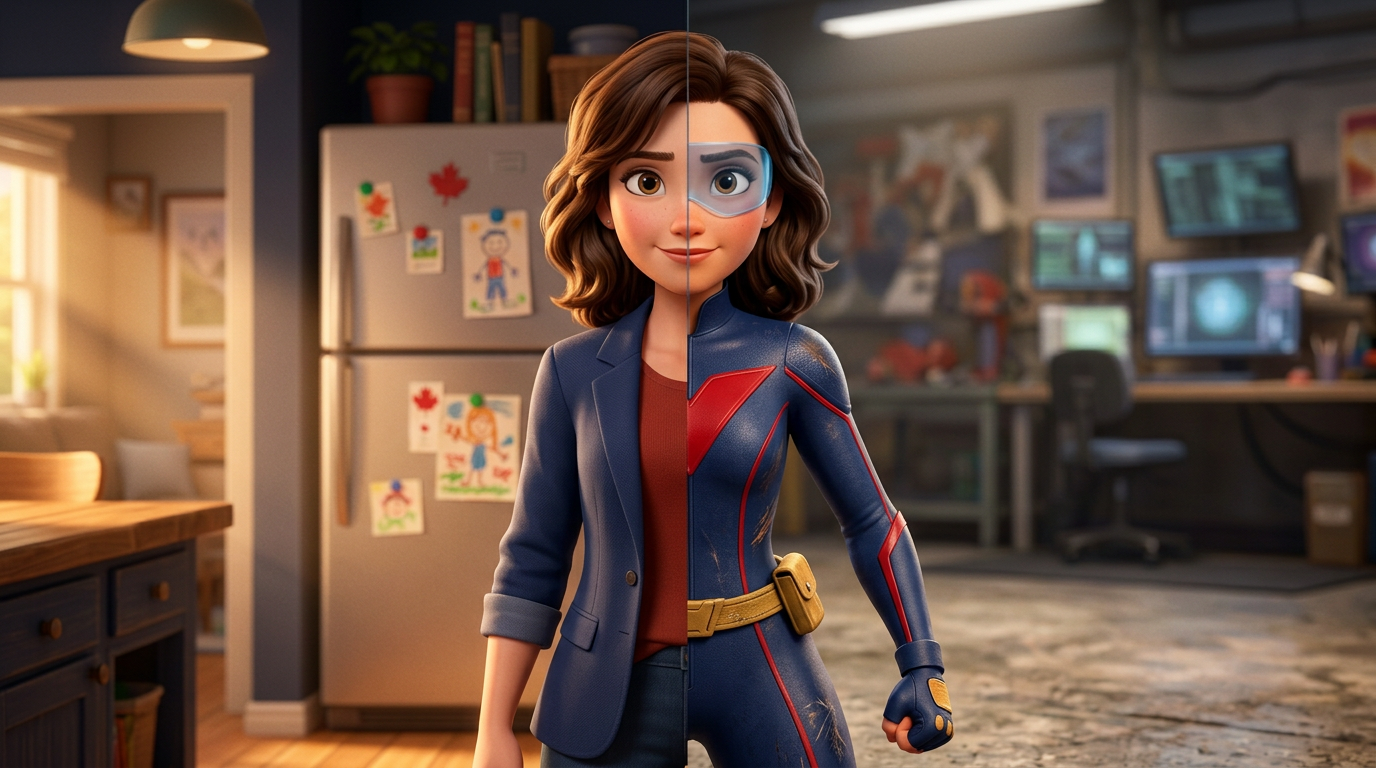
Claire Lavoie / Vela
The Grounding Force — With Her Own Arc

Claire Lavoie / Vela

"I was Vela before you were Rocket Rob."

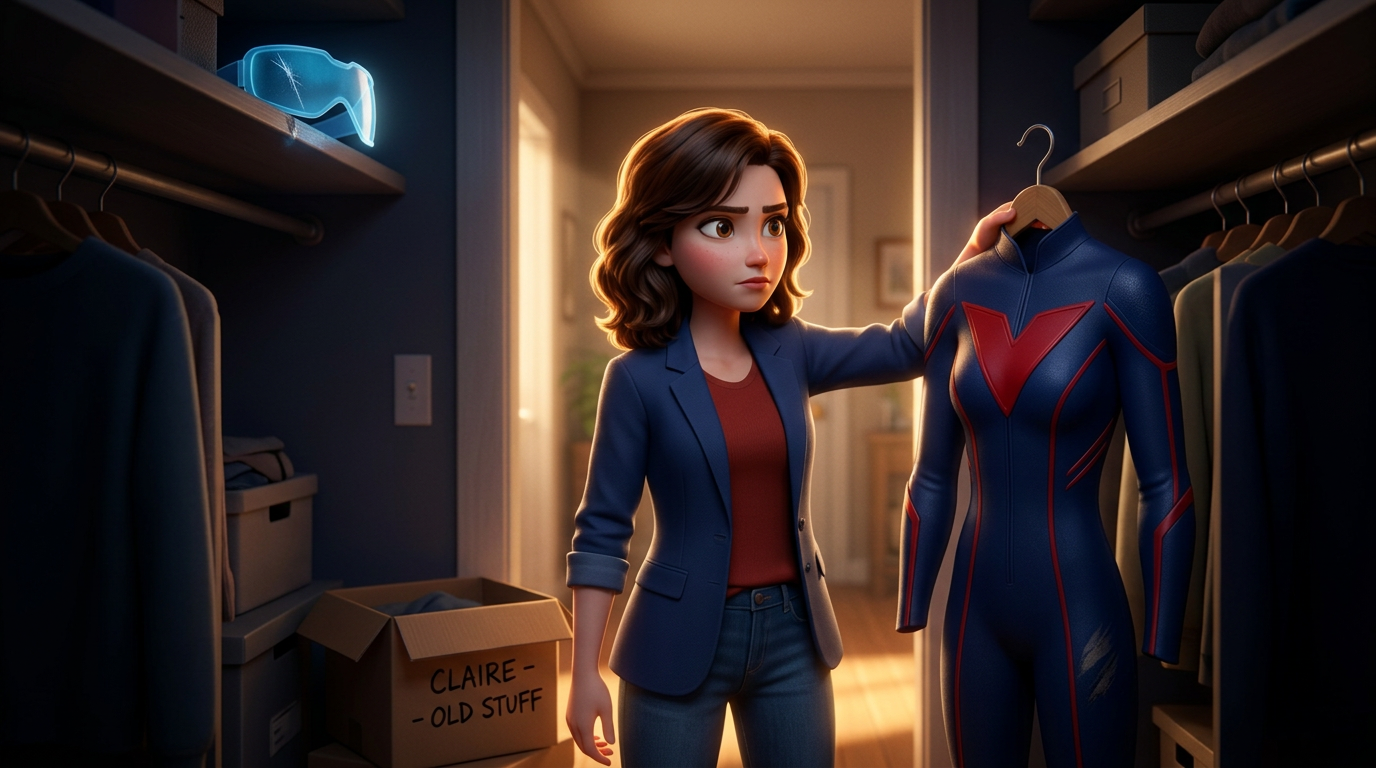
In Max's imagination, a retired superhero. In reality, a woman who was extraordinary in her own right and chose family over that life. Has been carrying the weight of that choice — and her secret — alone ever since. Her mid-film reveal recontextualizes everything. In Act 3, she doesn't suit up because the family needs her — she chooses to stop hiding who she is. On her terms. B-theme: "Being strong doesn't mean doing it alone."

Deep navy Vela suit Speed-line accents Scratched left boot No cape — by choice
BeatWhat Happens
Act OneCalm, competent, subtly too capable. Deadpan humor. Catches things she shouldn't. The audience doesn't notice yet.
Rising LoadRob's double life means Claire carries more. Drives Max. Handles the house. The invisible load becomes visible.
The CrackSharp where she used to be warm. A flash of frustration she immediately buries.
Confrontation"You're trying to save everyone except the people in this house." Then: "I know what you're trying to do. I've done it."
The Reveal (~65 min)Watt attacks the neighborhood. Claire moves like someone who's done this before. "I was Vela before you were Rocket Rob."
ResolutionShe chose to stop carrying it alone. She let Rob in. Rob, for the first time, let her lead. They stand together. Equal. Present. Partnership as mutual choice.
"Did the city survive?" — deadpan, Act One
"Max doesn't need a perfect hero. He needs his dad."
"I was Vela before you were Rocket Rob."
"Because I chose something harder." — why she stopped
"About time." — Before the Storm, the first real smile
Claire reaches for the Vela suit — her choice
Claire's Choice — Nobody asked her. She just decided to stop pretending she was ordinary.
Max Lavoie
The Power Source — Tested by Silence

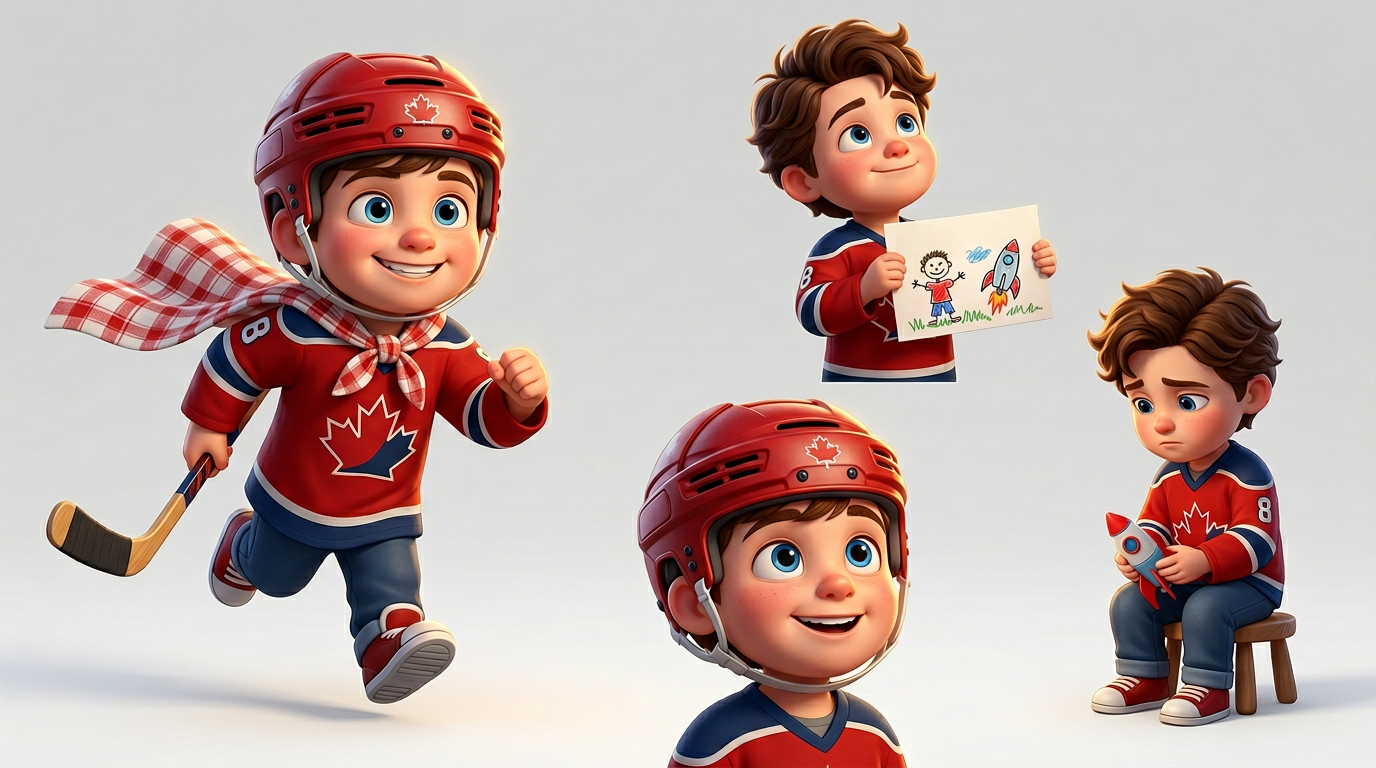
Max Lavoie

"Every city has a hero… but OUR city has the greatest hero EVER."

8 years old. Max doesn't just feel the story — he powers it. His belief in Rob is the mechanism by which an ordinary dad becomes Rocket Rob. When that belief goes silent mid-film, the hero diminishes. When it returns as a choice at the end — it's stronger than it ever was.

Hockey helmet (always) Dish-towel cape Canadian hockey jersey Sky blue eyes like Rob
Story MomentEmotional AgeWhat It Means
Opening — narrating everything7-ishPure, effortless imaginative belief. Costs nothing.
Act One montage7–8The bond at its most alive.
Narration fading8Starting to feel the weight of waiting.
The Silence8 going on 9Quietly outgrown — not by choice yet. By accumulation.
Hockey game bench9 (emotional)"It's okay… my dad saves bigger things." He's protecting his dad even after the belief went quiet.
Final narrationFully 9Old enough to know exactly what he's choosing. That's the weight.
"Rocket Rob repairs the Hydro Blaster!" — fixing the sink
"It's okay… my dad saves bigger things."
"You said that yesterday." — The Silence begins
"No. You're better. You're my dad."
"Every hero needs a sidekick." — handing Rob his drawing
Victor Watt
The False Answer — Rob's Dark Mirror

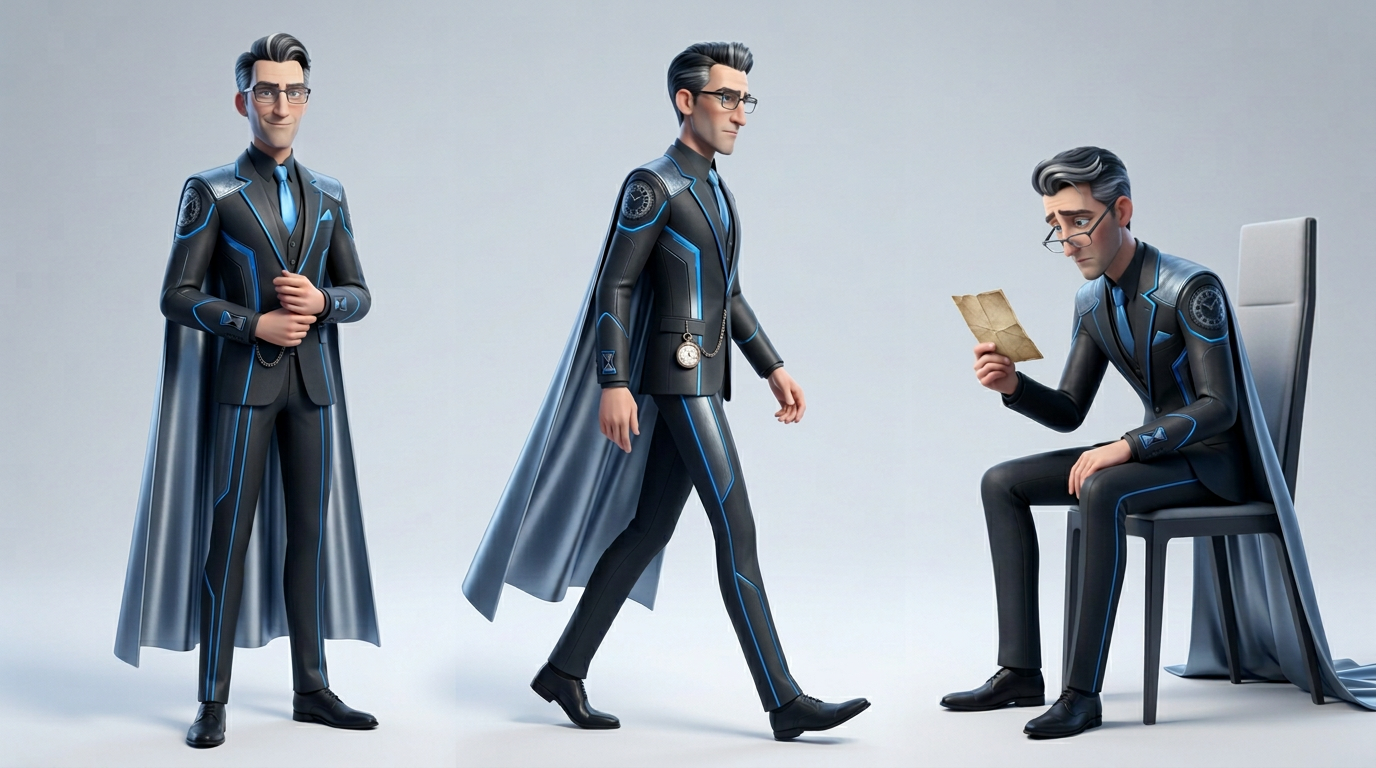
Victor Watt

"Heroes don't tuck kids into bed. They change the world."

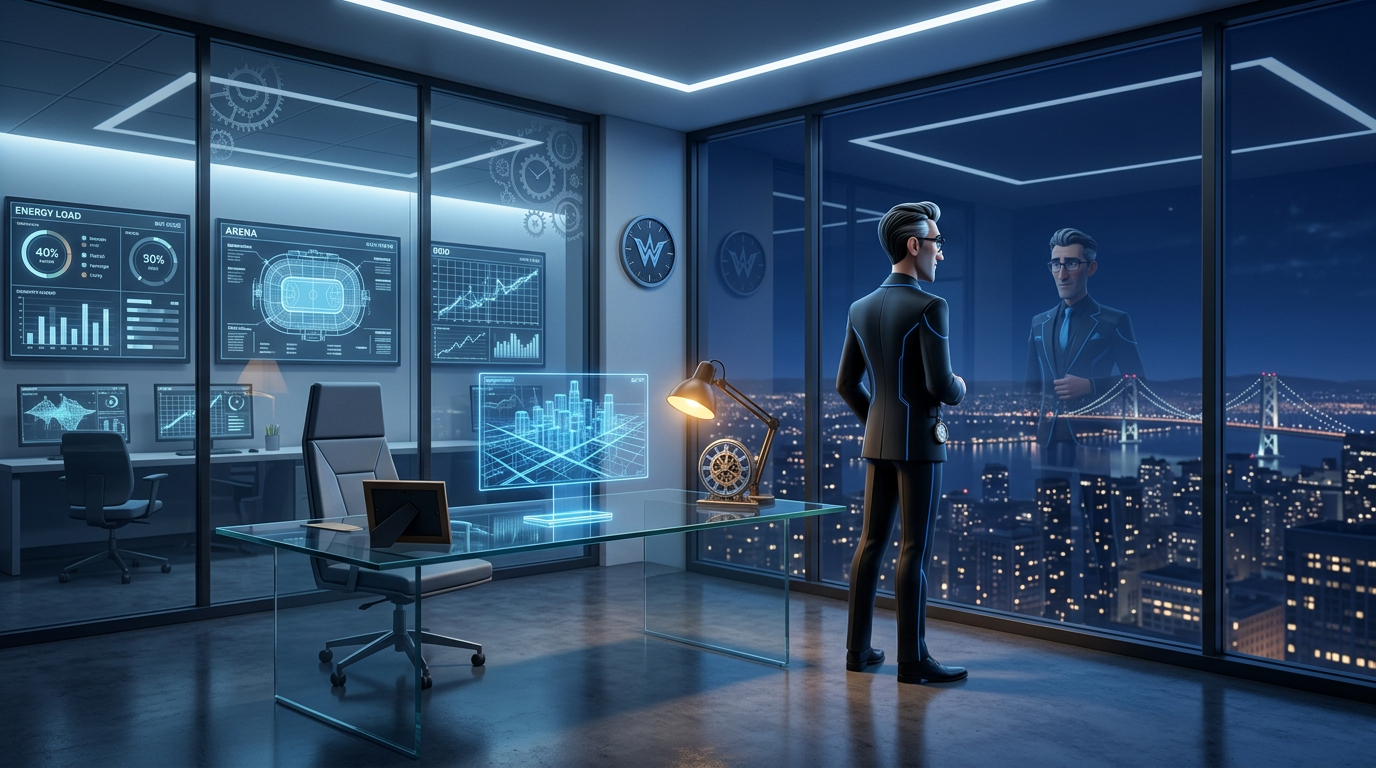
Late 30s–40s. Rob's former colleague at Titan Sports Tech. Both worked on Titan's arena energy systems — the grid-management technology that keeps stadiums running. Victor saw what Rob wouldn't: that Titan's arena-scale architecture could control an entire city grid. Titan said no. Victor left, founded Watt Dynamics, and took the core technology with him. He shed every trace of where he came from — his accent, his humor, his connections. He's not evil — he's in pain. And that's what makes him a Pixar villain.

Silver-streaked dark hair Electric blue suit Clock/time motifs Metallic cape The creased photo
Real Tragedy
He could have been Rob. The photo he carries proves he knows it.
Philosophy
"You can save the world or be there for your family. Not both."
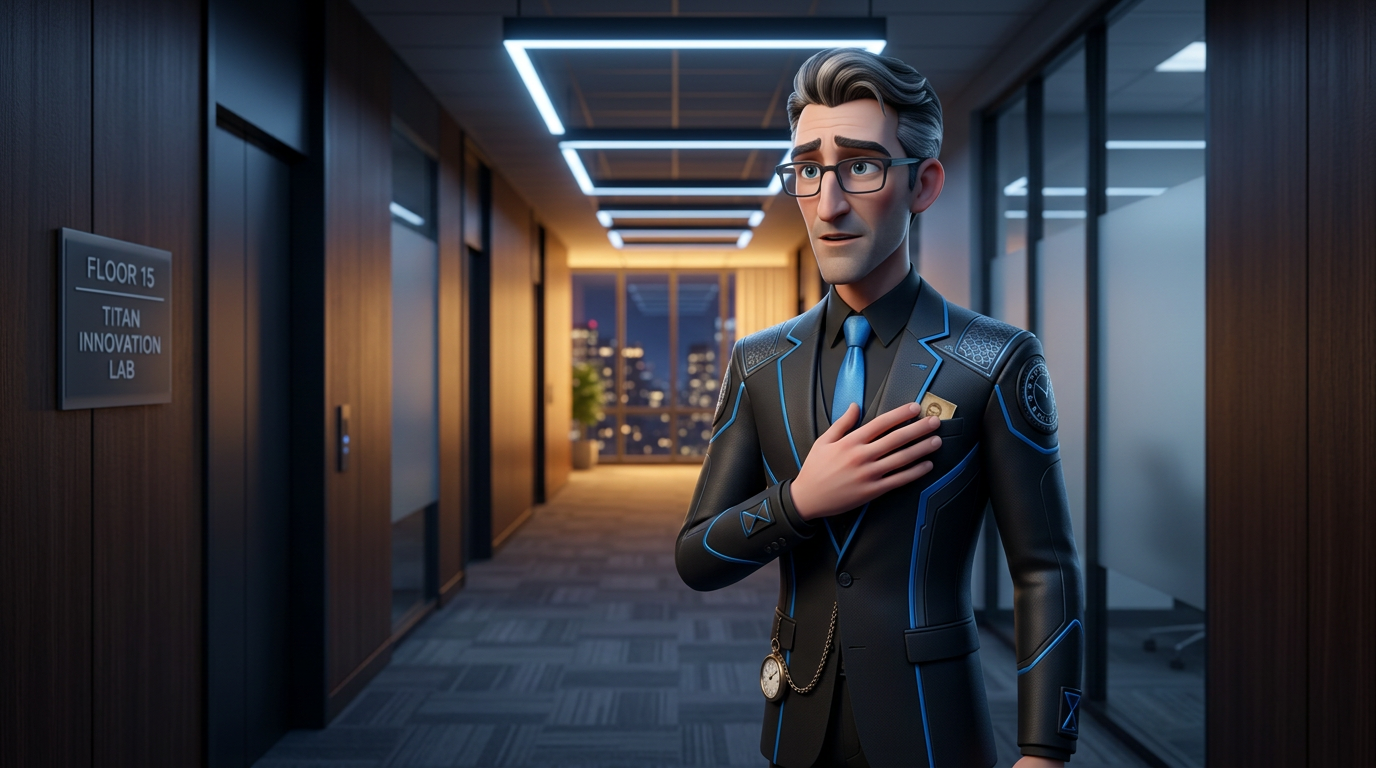
The Pocket Gesture
Every time Watt talks about family — "Family makes you weak" — his hand drifts to his jacket pocket. A subconscious gesture. He catches himself each time. In his final moment, he reaches for the pocket deliberately. Pulls out the photo.
Canadian Origin
Same origin as Rob. Opposite choices. He erased where he came from.
Exit
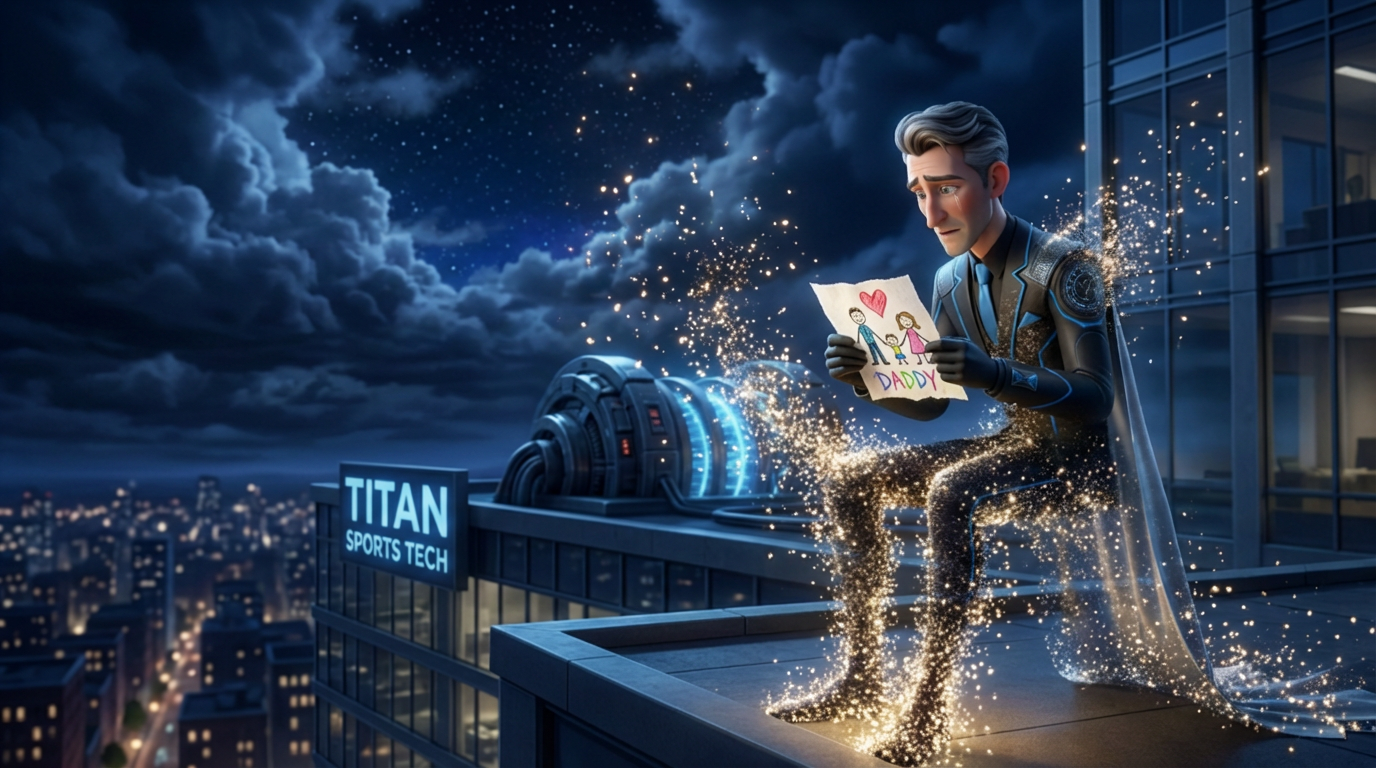
"I had one of those once." He looks at the photo. Looks at the drawing in Rob's hand. Two pieces of paper. Two different choices. Then dissolves — particles of golden-white light. Not defeated by force. Released when Rob chose differently.
Victor Watt — hand drifting to jacket pocket
The Pocket Gesture — His hand drifts to the jacket every time he talks about family.
Victor Watt dissolves — particles of light, photo in hand
The Dissolution — Victor looks at the photo one last time as he dissolves into particles of light.
"You could have been great, Rob. Instead you chose bedtime stories and hockey games."
"Family makes you weak."
"I had one of those once." — his final line, looking at Rob's drawing
The Marriage Thread
Rob & Claire — Four Scenes Across Three Acts

The marriage isn't a subplot — it's the spine. These four scenes track Rob and Claire from routine to rupture to honesty to partnership.

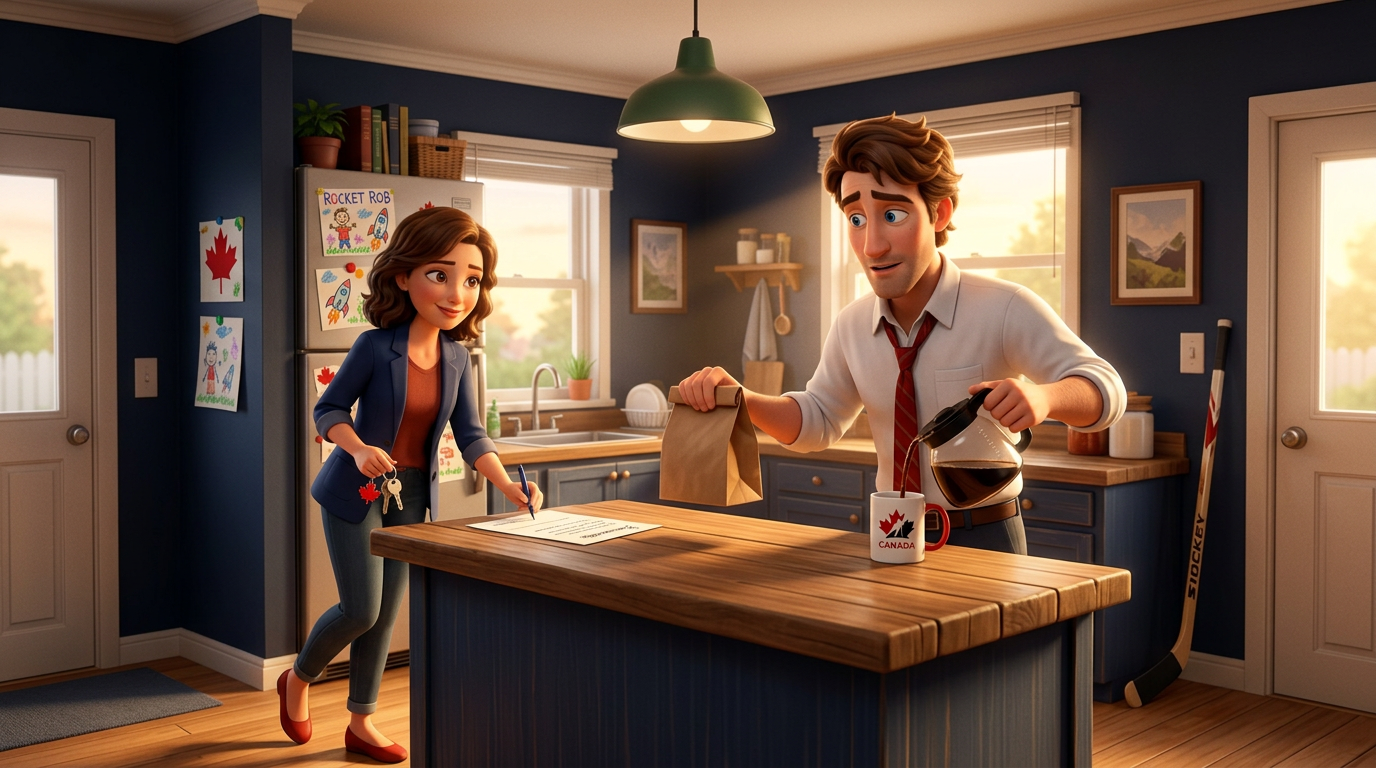
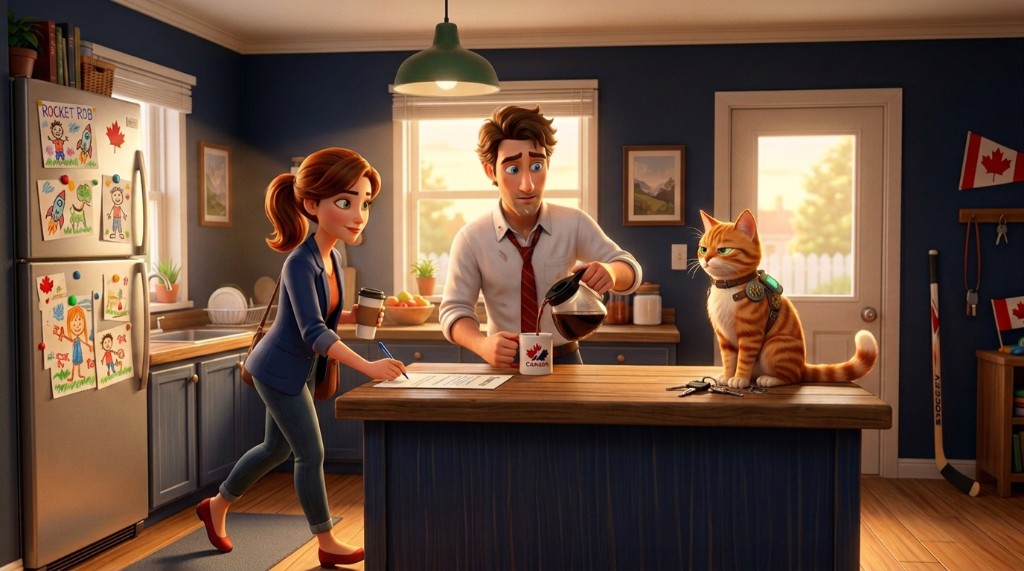
The Handoff — morning kitchen
Act 1 — The Handoff (~7 min)
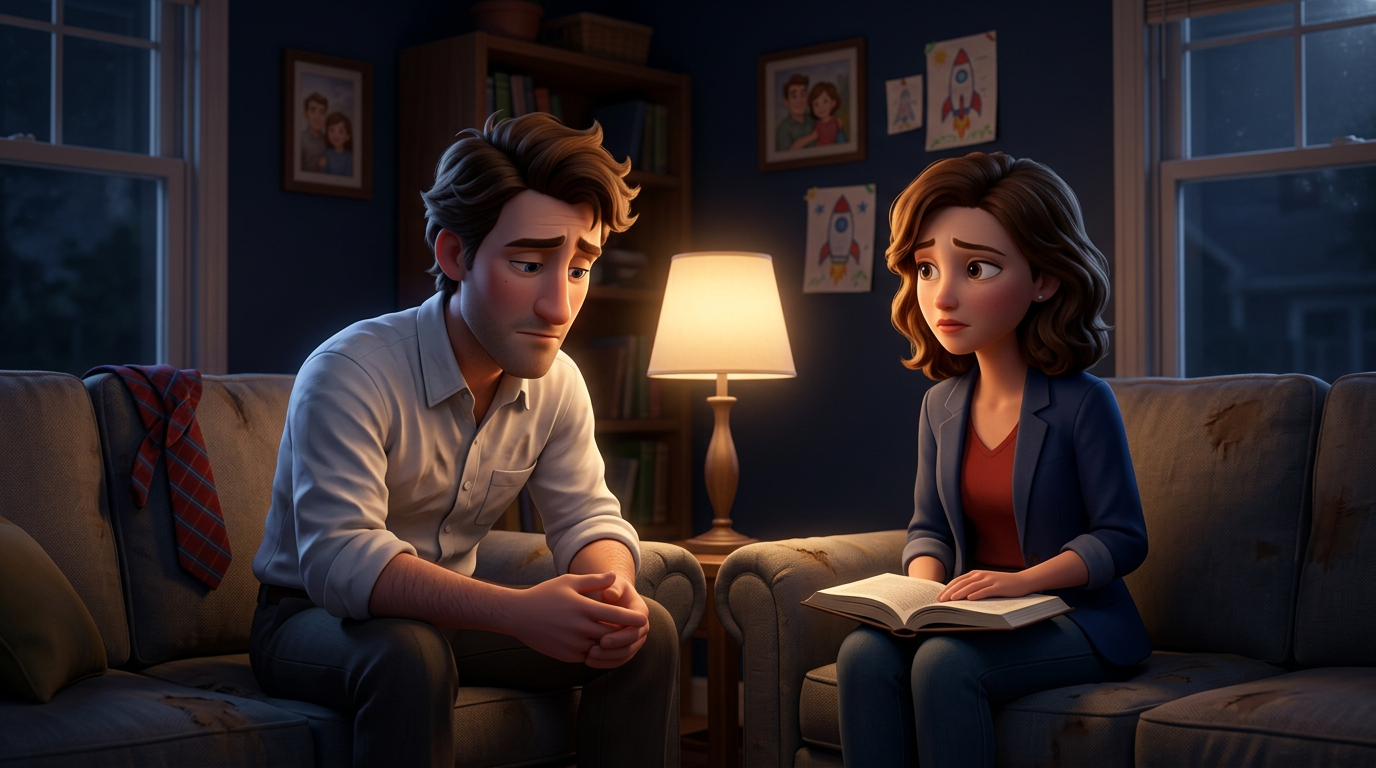
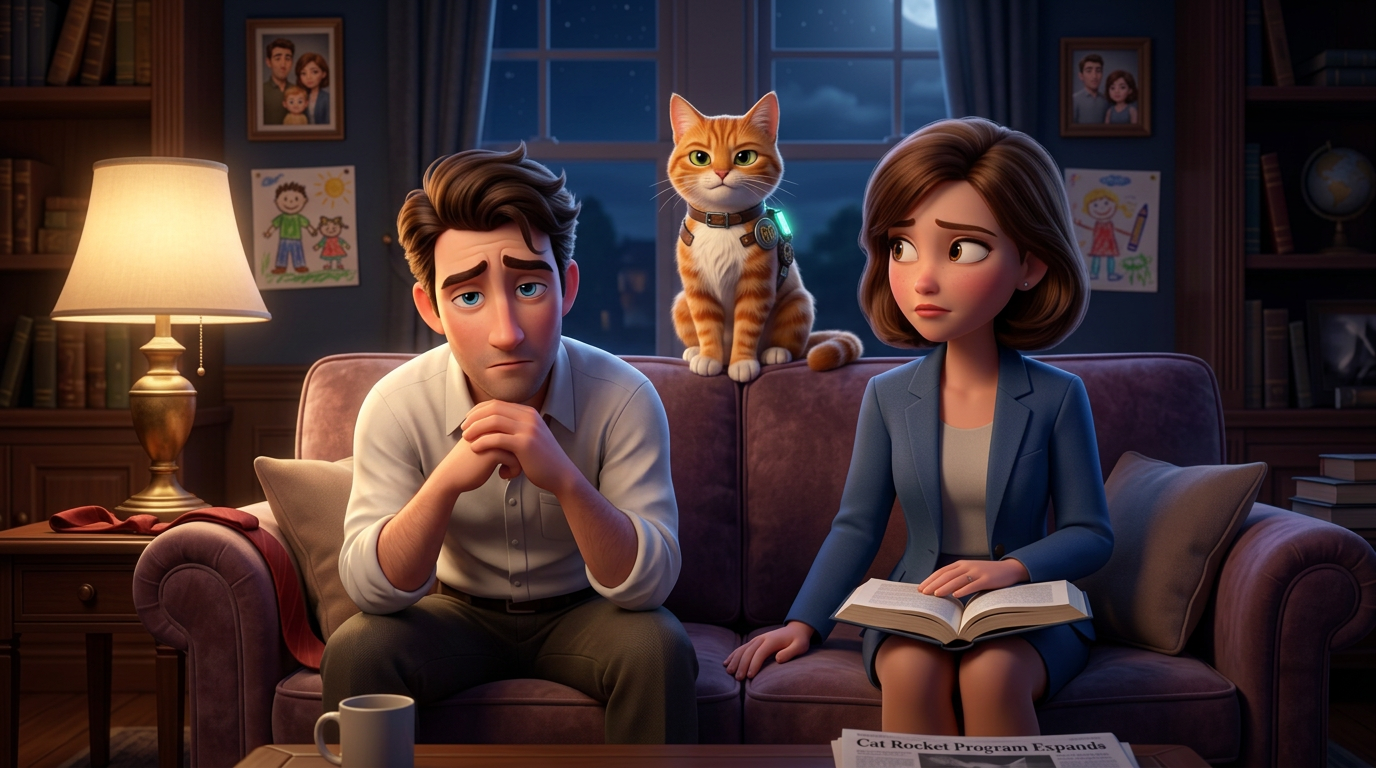
The Couch — late night
Act 2 — The Couch (~32 min)
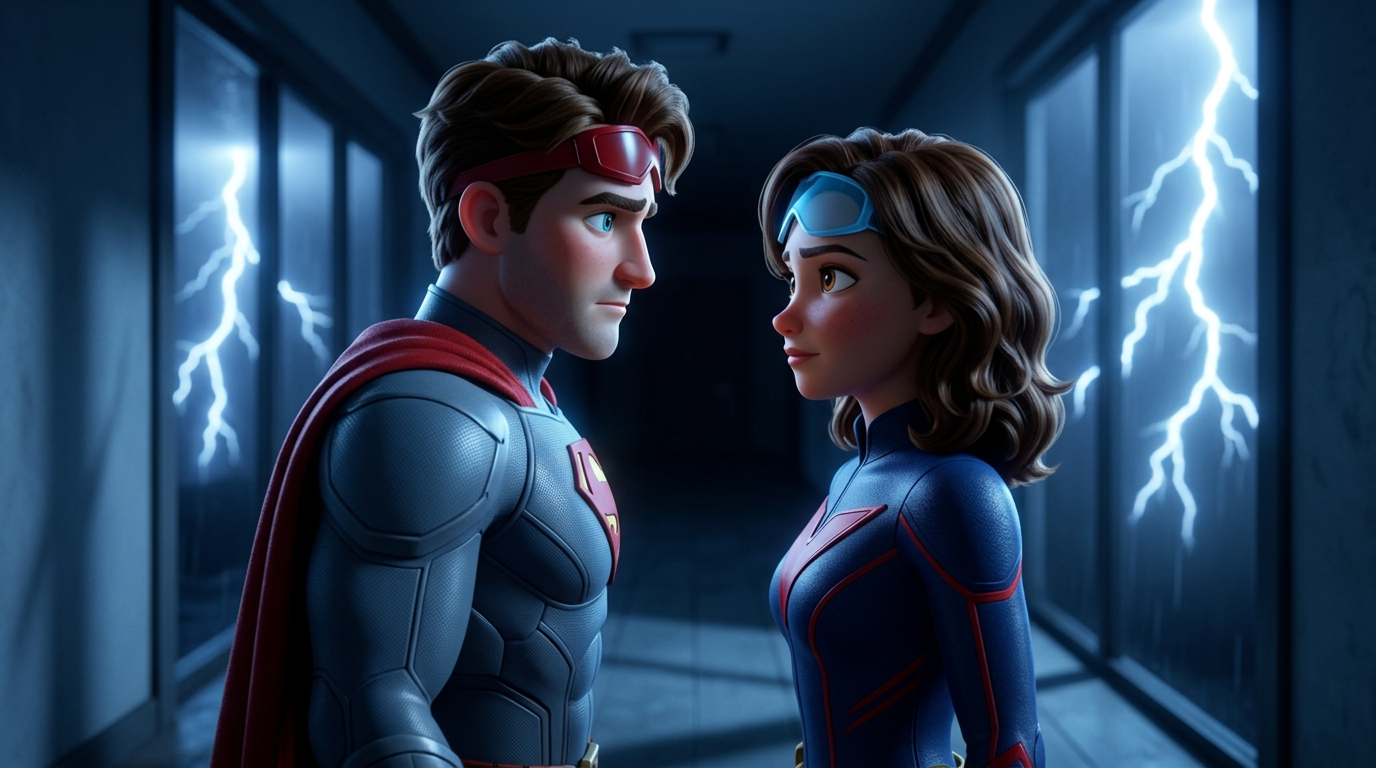
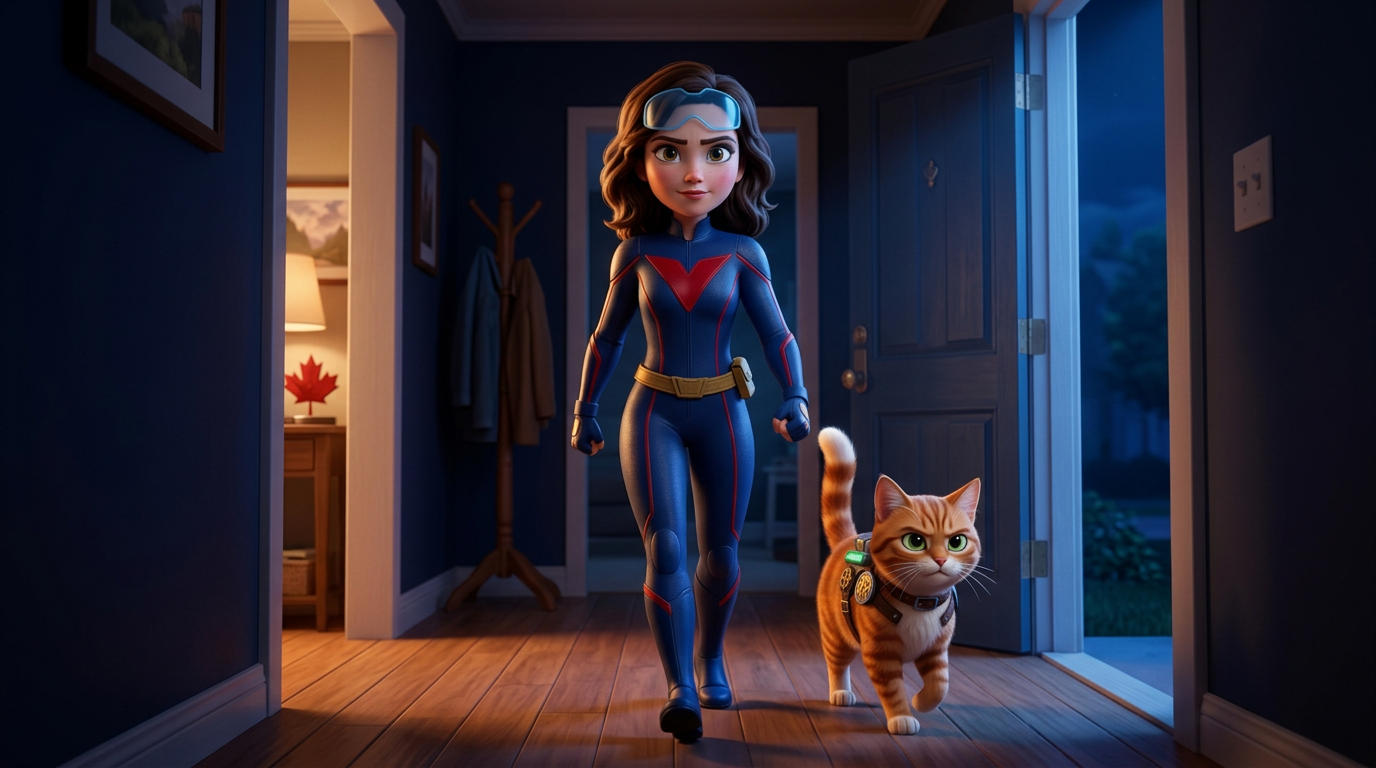
Before the Storm — hallway, two suits
Act 3 — Before the Storm (~69 min)
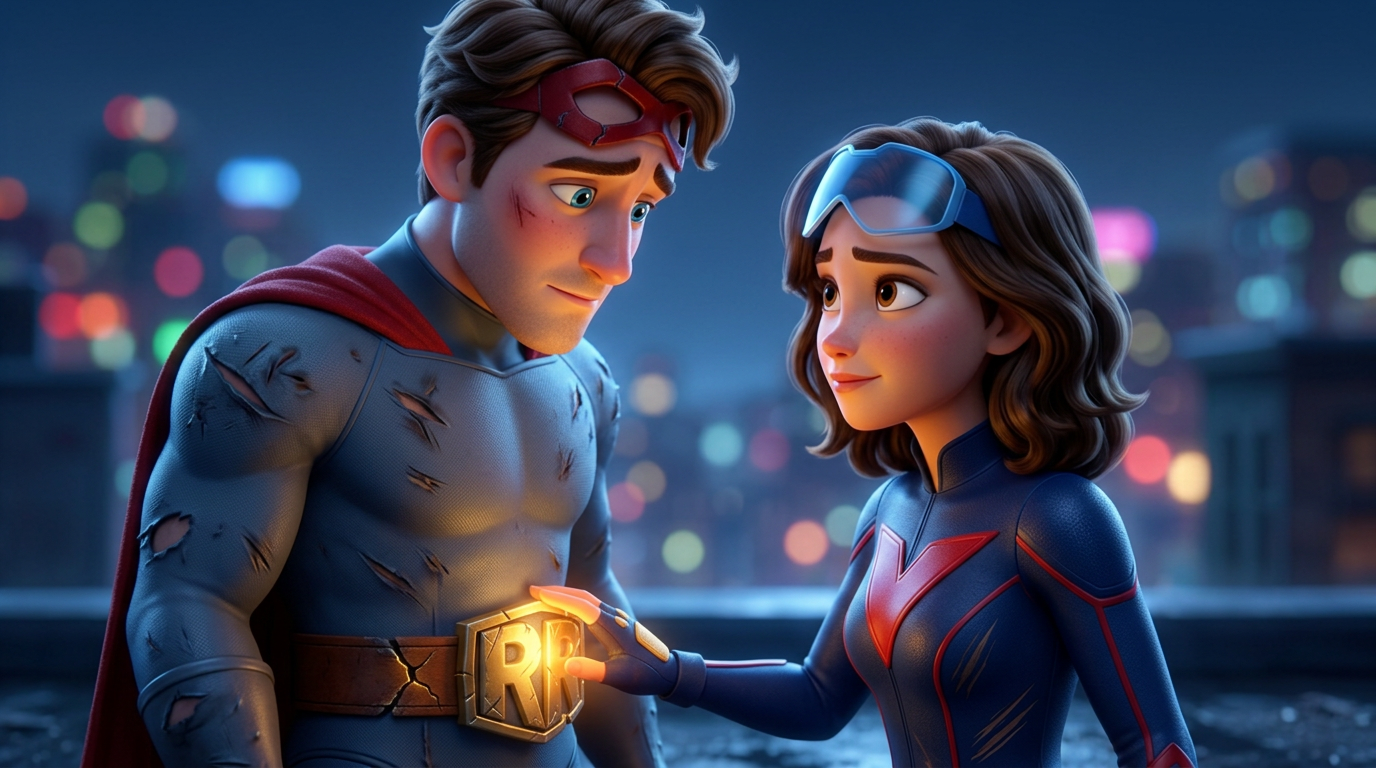
Claire touches Rob's belt buckle
Act 3 — The Buckle Touch (~69 min)
The Cat Sidekick
Comic Relief with Loyalty
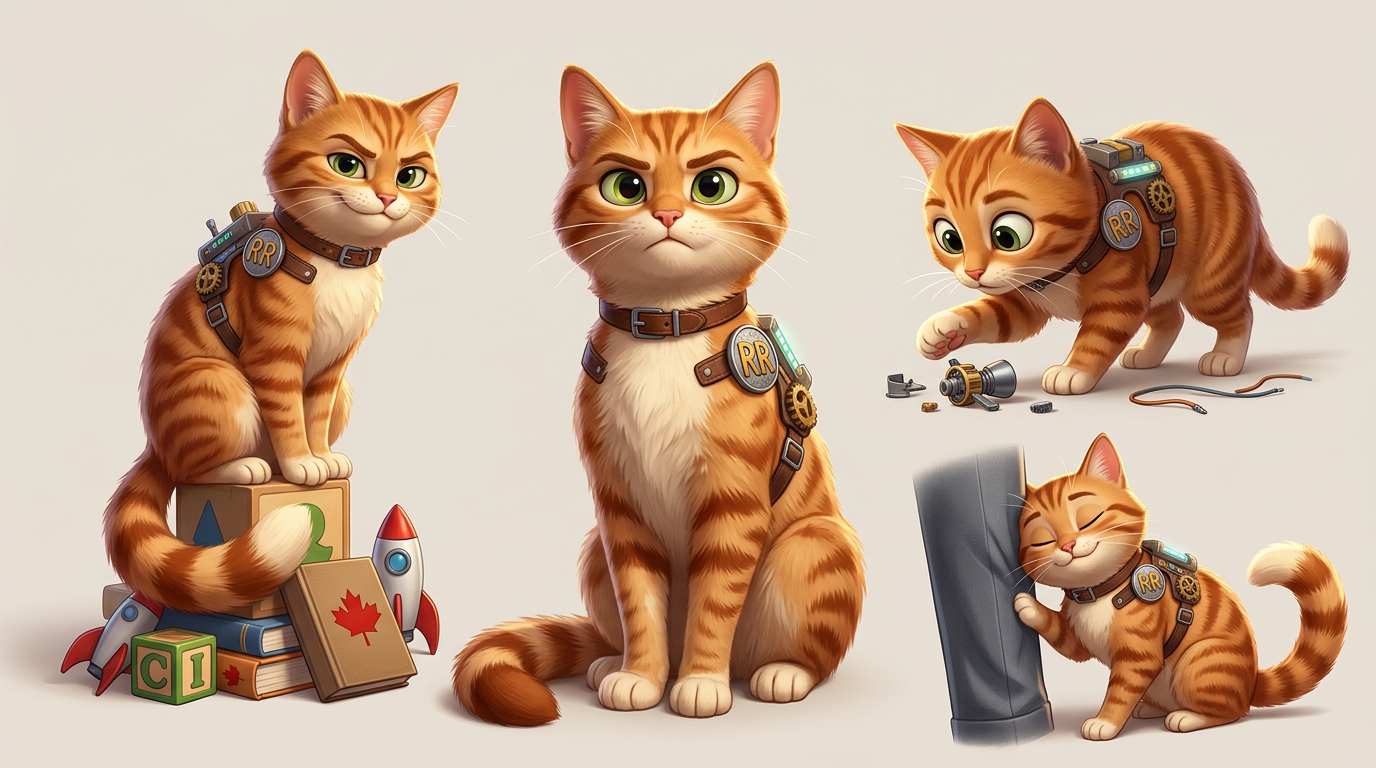
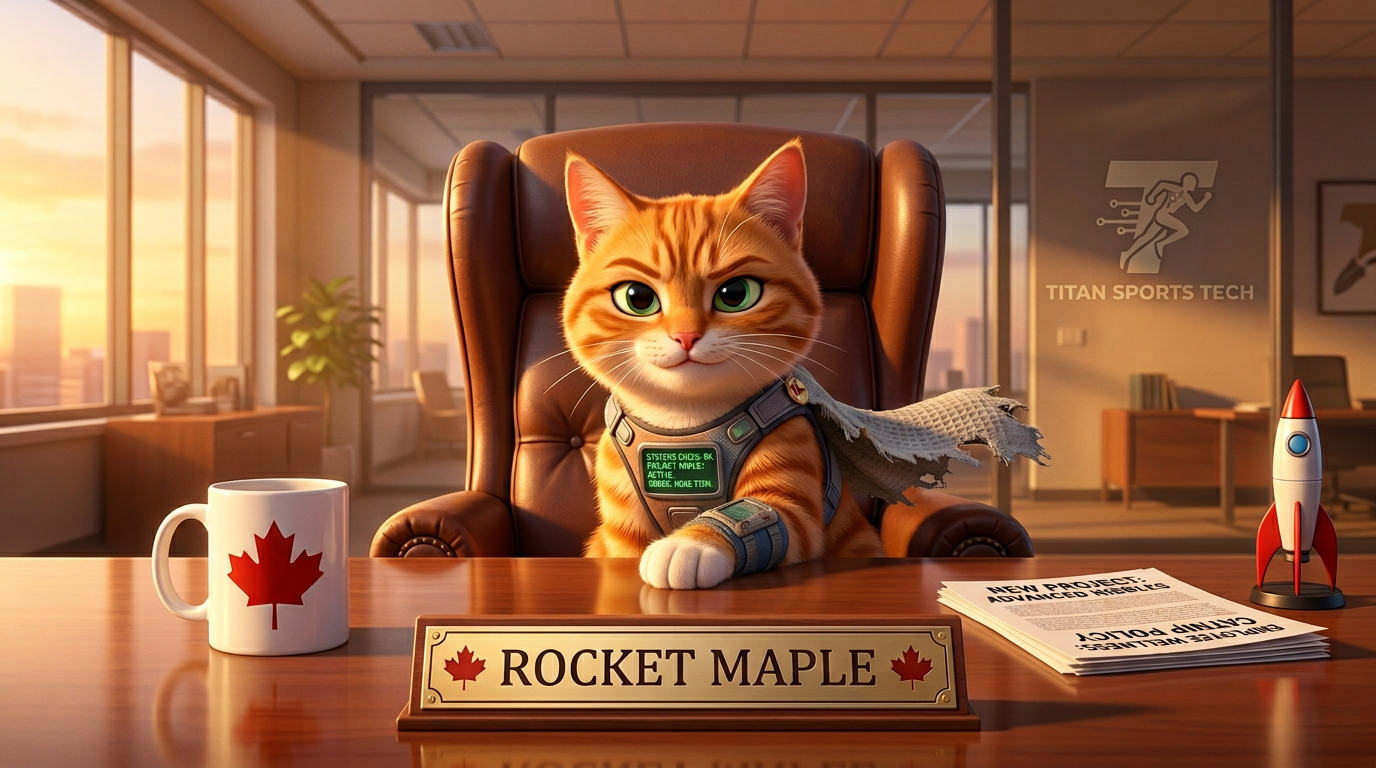
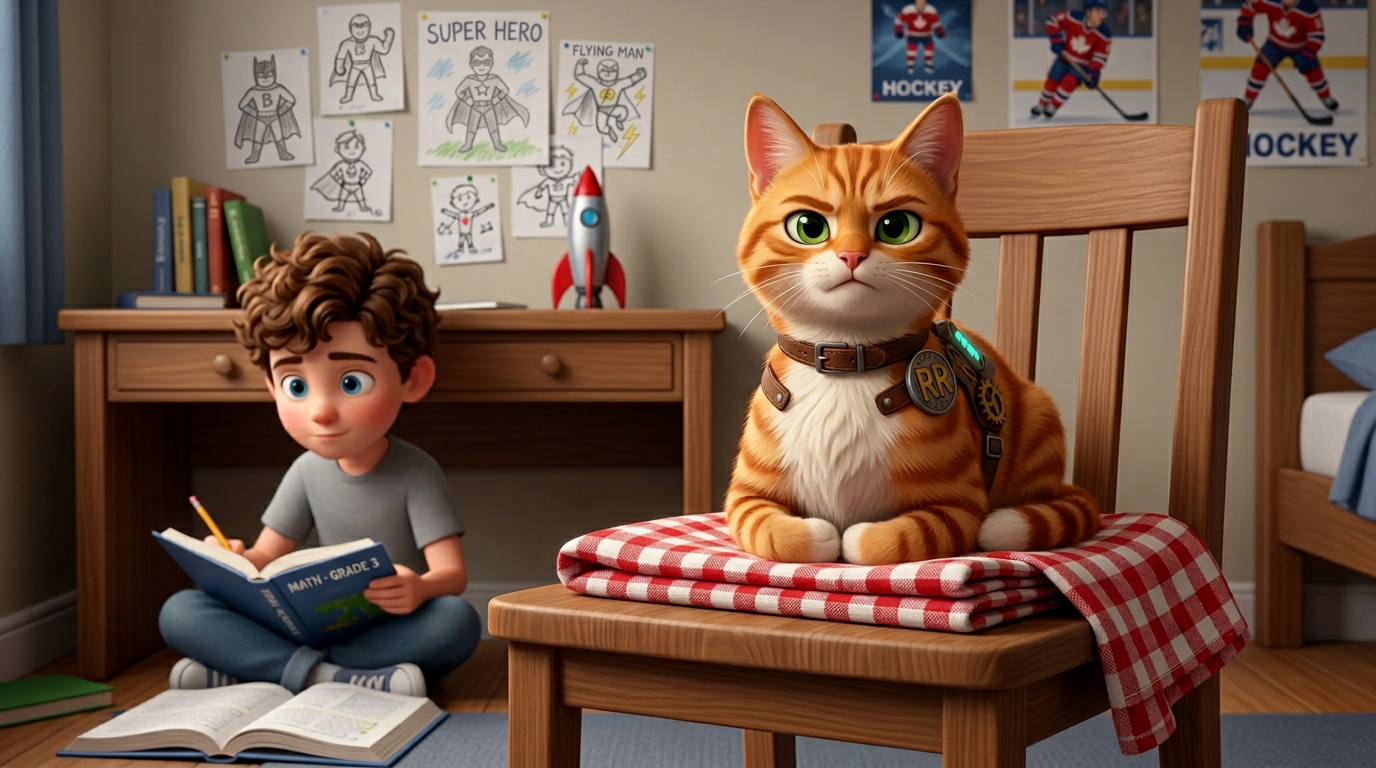
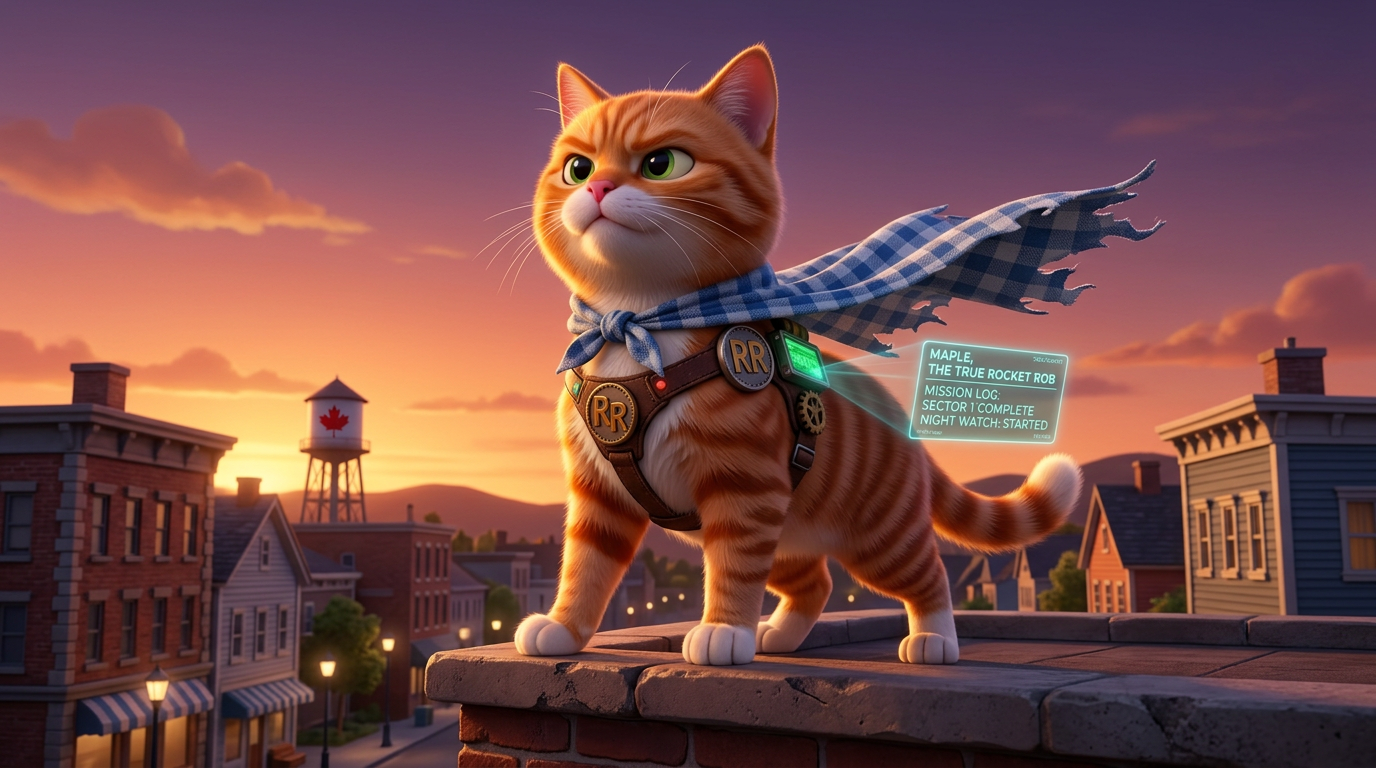
Maple — The Sidekick Cat
"..." (just stares at you until you figure it out)

Orange tabby. Wears a repurposed Titan Sports Tech harness with gadgets he probably knocked off Rob's desk. Decided Rob was his human long before Rob agreed. Takes everything Rob says as direct instruction. Shows up every time without being asked. Doesn't need to learn love — he already has it. Expresses it sideways.
Name: Maple Harness screen shows data Accidental hero
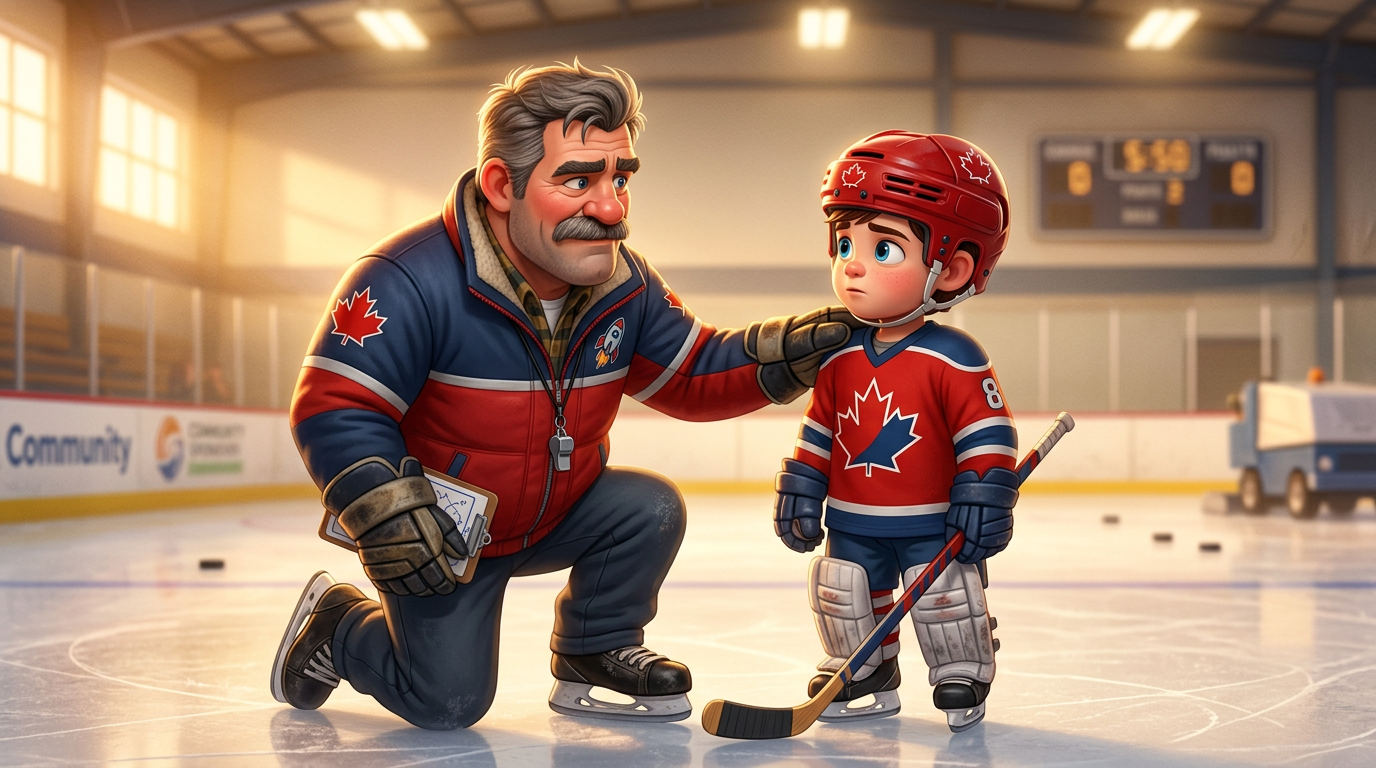
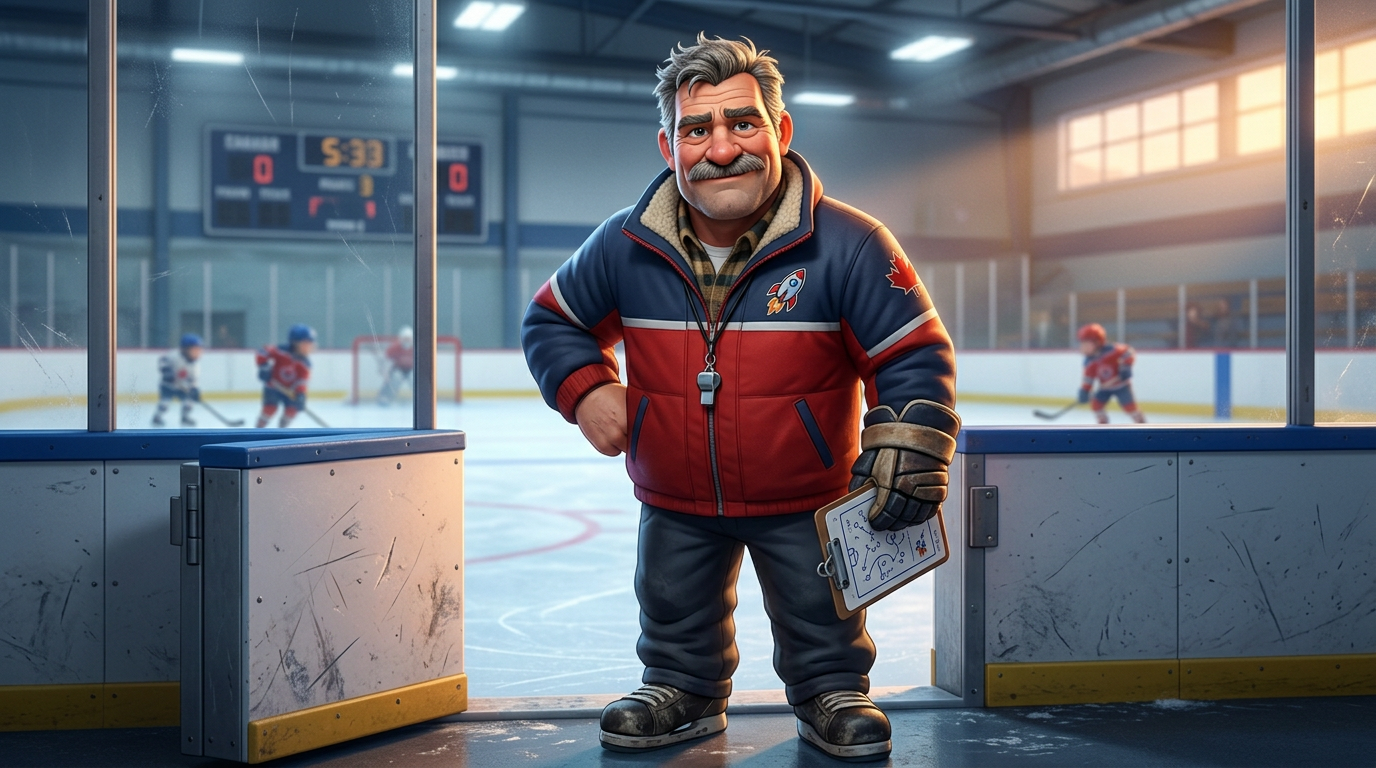
Coach Hank — character concept
Tough Love Mentor
Coach Hank
"Kid… hockey and parenting are the same thing."

Max's hockey coach. Gruff exterior, warm interior. Speaks in sports metaphors that accidentally apply to life. Respects effort over talent. Reinforces the theme in the most grounded, real-world way possible — no superpowers, no philosophy. Just a man who's seen a lot of kids and knows what matters.
"The best players aren't the ones who score. They're the ones who show up every practice."
Maple hero pose — dish-rag cape on rooftop
Imagination Track — Hero Pose
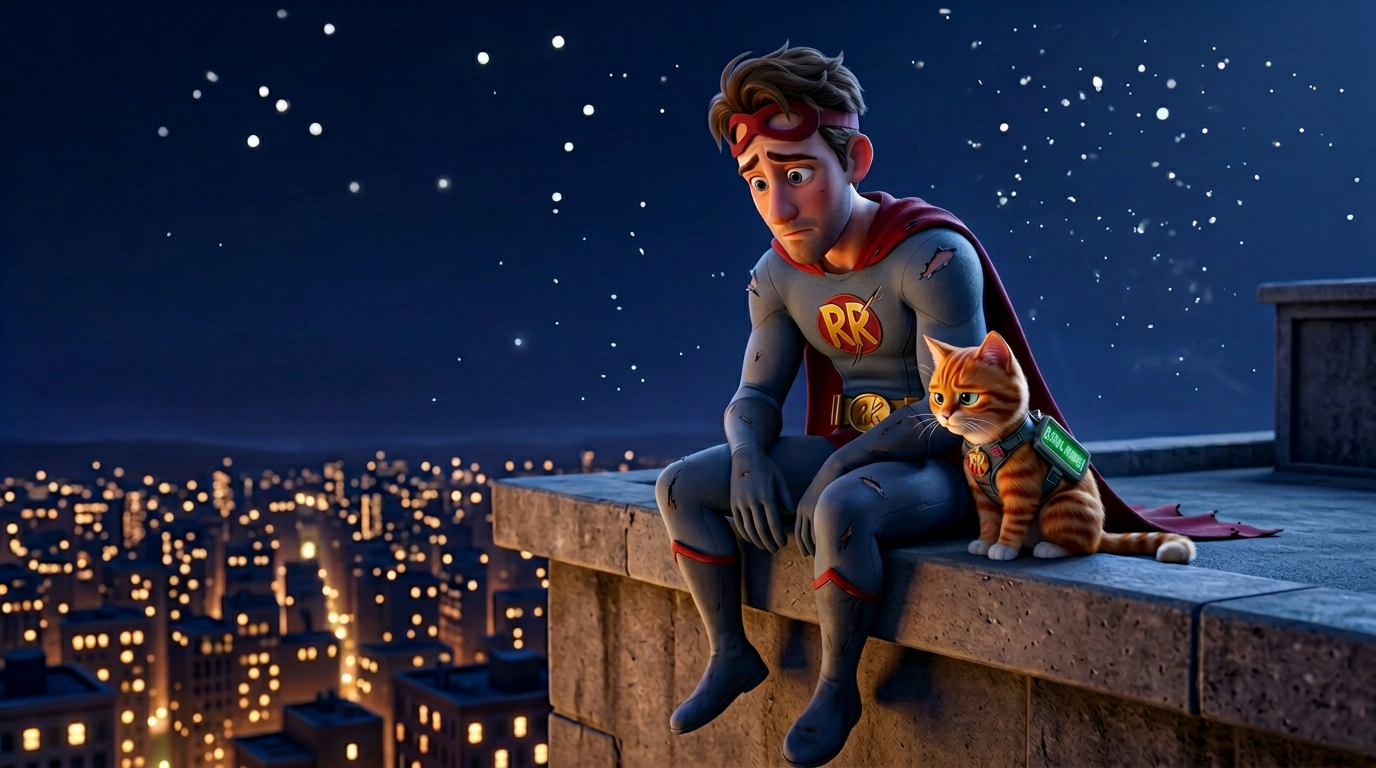
Rob and Maple on rooftop — Still Here
The Silence — Still Here
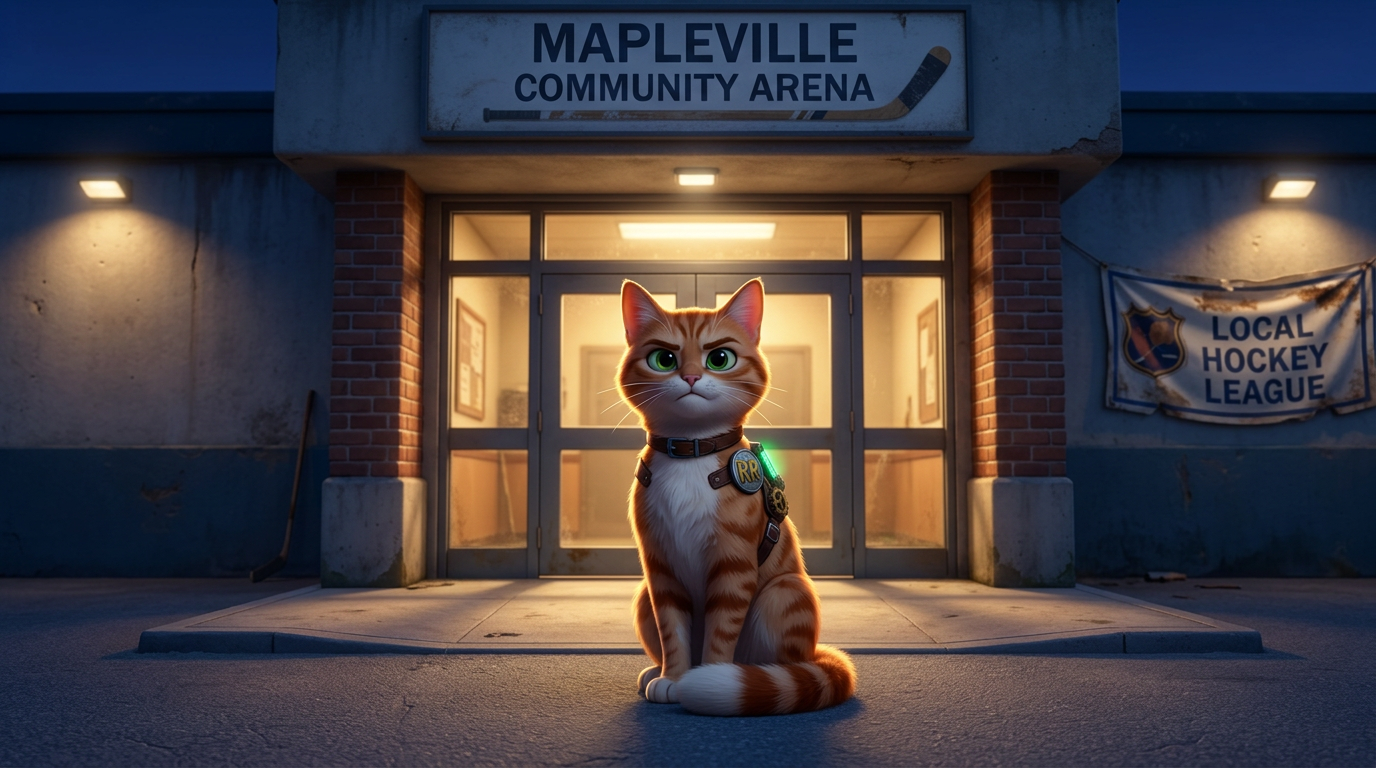
Maple at arena entrance
Arena Sentry — He Showed Up
Claire as Vela heading out with Maple
Team Assembled — Head Up, Ears Forward
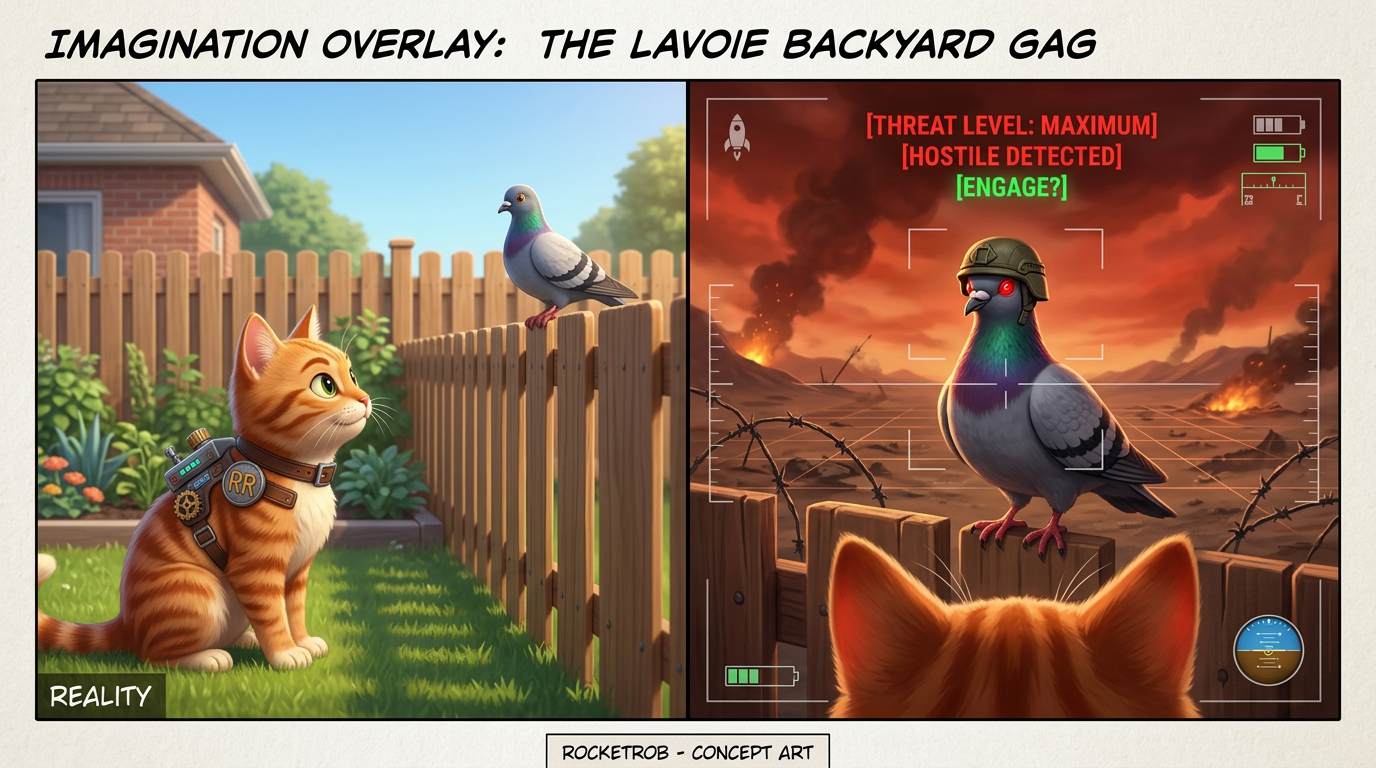
Maple imagination overlay — reality vs cat POV
Imagination Overlay — Reality vs. Maple POV
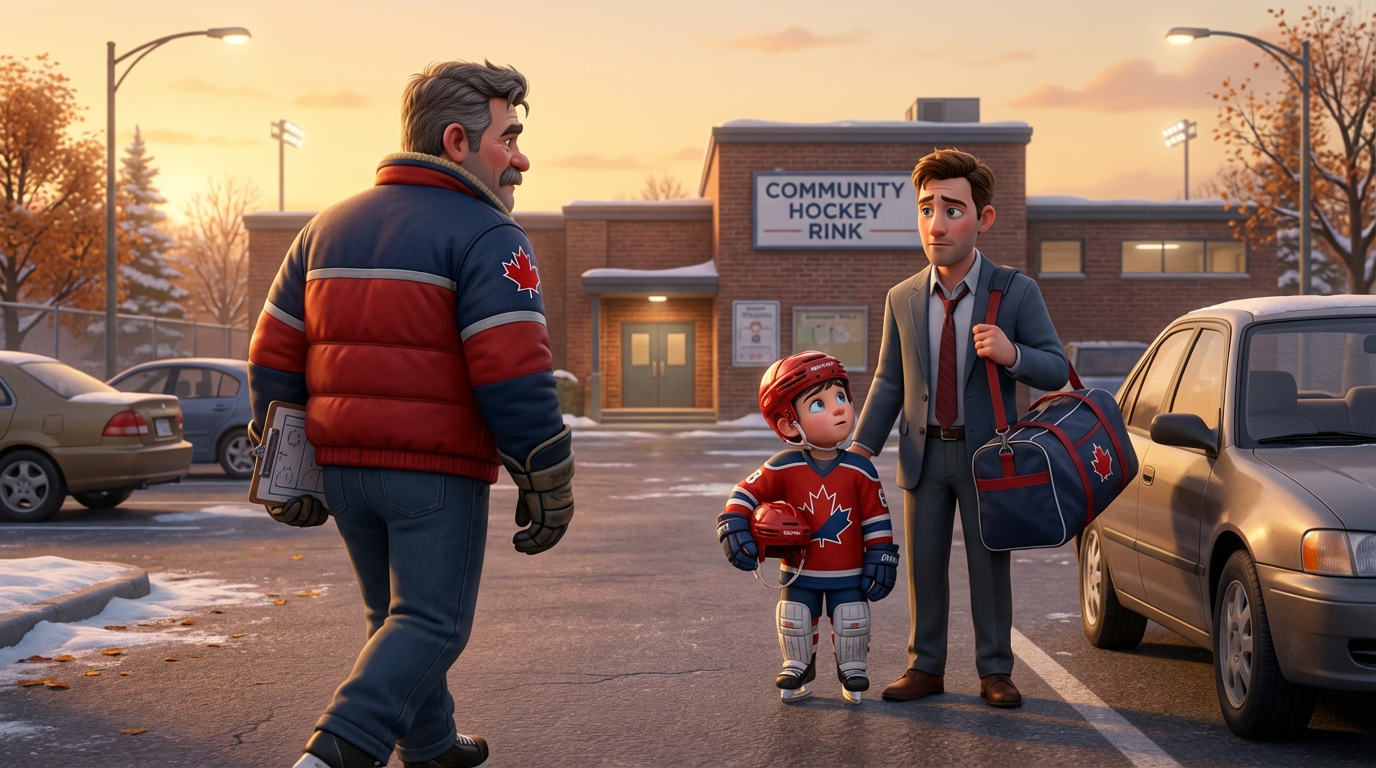
Coach Hank waiting with Max at practice pickup
Beat 1 — Practice Pickup (~8 min)
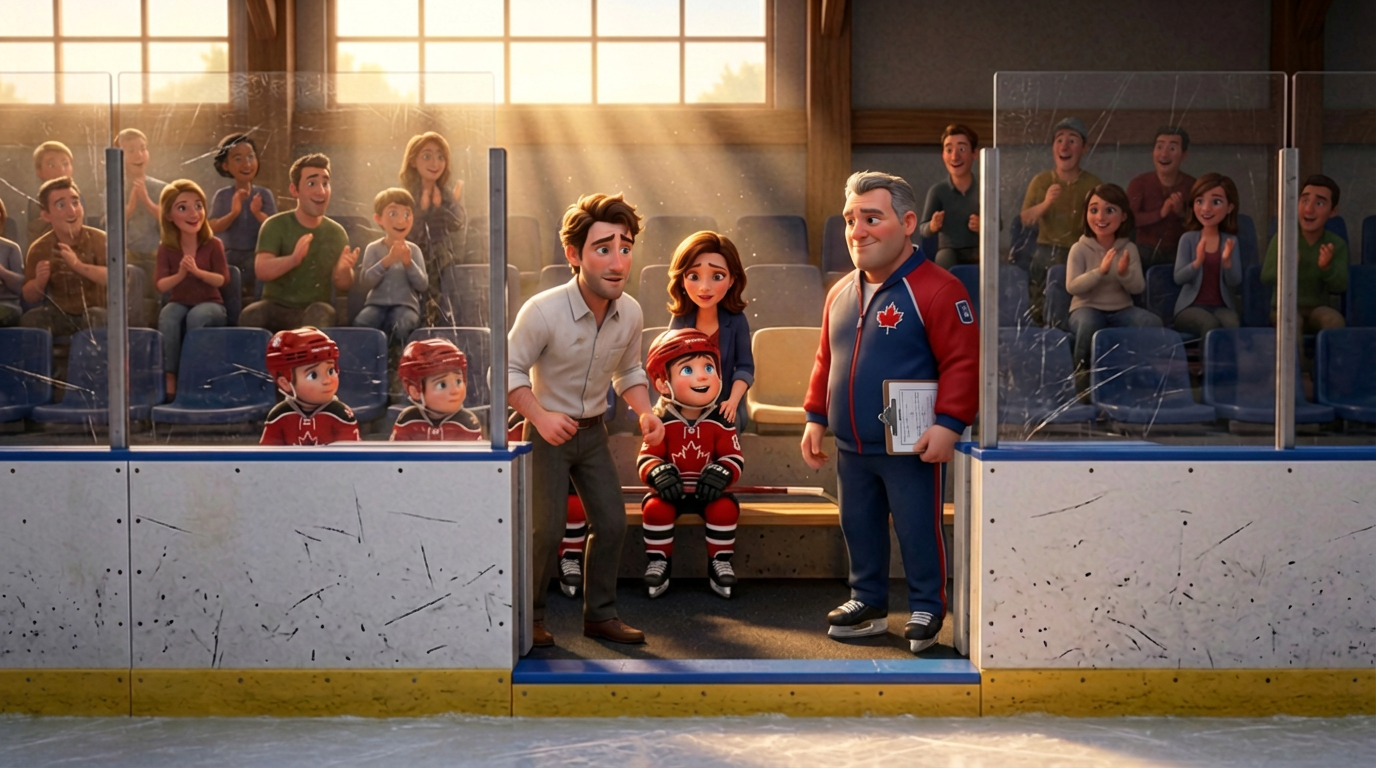
Coach Hank at the arena — the nod
Beat 3 — The Arena Nod (~82 min)
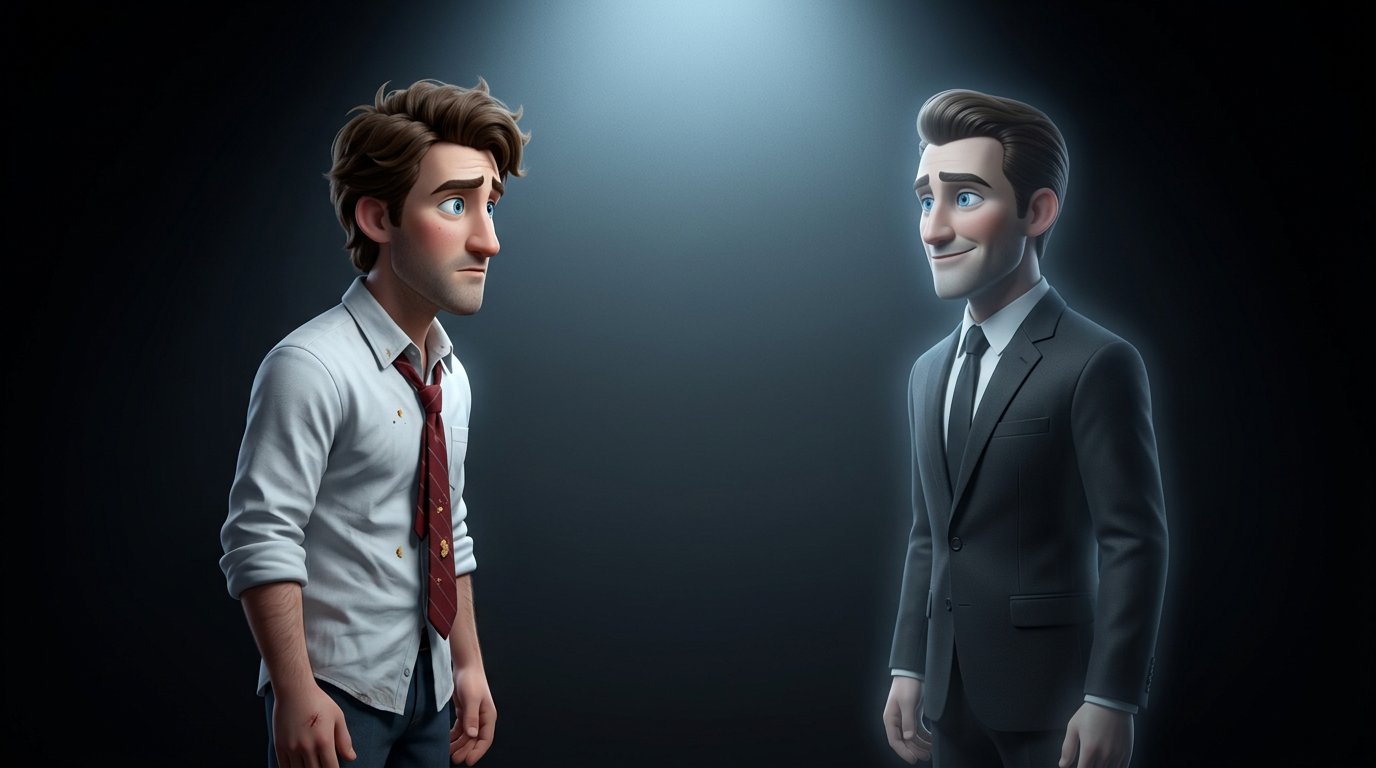
Shadow Dad — cubicle reflection seed Shadow Dad — mirror confrontation
Act Two Psychological Villain
The Shadow Dad

Rob's internal antagonist — a vision of himself if he chose work over family. Polished. Successful. Empty. Appears only in Rob's mind during his lowest point. Says one line: "They'll understand when they're older." Rob realizes: They won't. This isn't a physical fight — it's a Pixar internal moment, like the Bing Bong sequence in Inside Out.

Three-Act Structure

~90 minutes. Two parallel arcs colliding at a single turning point. The film's philosophical commitment: belief is the superpower, and it always belonged to the eight-year-old.

Visual Language Commitment

Rules of the World

Every Pixar film commits to the rules of its world. In Inside Out, emotions are literal people. In Toy Story, toys are alive. In Rocket Rob, the audience experiences the world through Max's belief.

Act 1 — Full Belief

Saturated, epic, imagination overlay active. Max narrates. Rob flies. The audience sees Max's reality.

The Silence — Stripped

Plain reality. No overlay. No narration. The audience sees the world as it is.

Act 3 — Elevated Reality

Grounded but purposeful. Real people doing extraordinary things. Engineering, not fantasy.

Final Image — Chosen Belief

Elevated reality + Max's returned voice. Not the full overlay — a chosen belief is more powerful than a given one.

Act One
"The Greatest Hero Ever"
~25 minutes
0:00
City Dawn + Opening Battle
30-second establishing montage: Pixar rooftops in golden light, quick flashes of Rob's everyday heroism, Claire catching a mug too fast, the pancake flip. Then Max's voice: "Every city has a hero..." Epic Rocket Rob vs. Hydro Rex battle — a towering plumbing-contraption villain built from pipes, faucets, and valves. Max's imagination at full power — SMASH CUT to Rob under the kitchen sink. "Rocket Rob repairs the Hydro Blaster." Claire: "Did the city survive?" Rob: "Barely." Alone: "Greatest hero ever." He doesn't quite believe it.
Hook: Was any of that real?
7:00
The Handoff
Max leaves for school. The house goes quiet. Rob pours coffee. Claire signs the permission slip he forgot. He sets out the lunch she almost left without. "I might be late tonight." "I'll handle bedtime." "You always do." He means gratitude. She hears weight. Both are right. Maple sits on the keys. Will not move. Maple's first appearance in the film.
Establishes: partnership, Vela seeds, and the invisible load
8:00
Establishing the World
Rob's morning routine. Titan Sports Tech cubicle (Team Canada mug, Max's drawings). Max at school and hockey practice — Coach Hank introduced: "Best players aren't the ones who score. They're the ones who show up every practice." Claire at home: too competent, too fast, catches things she shouldn't. Seeds are planted.
Grounding: make the audience love this family
12:00
"Little Hero Moments" Montage
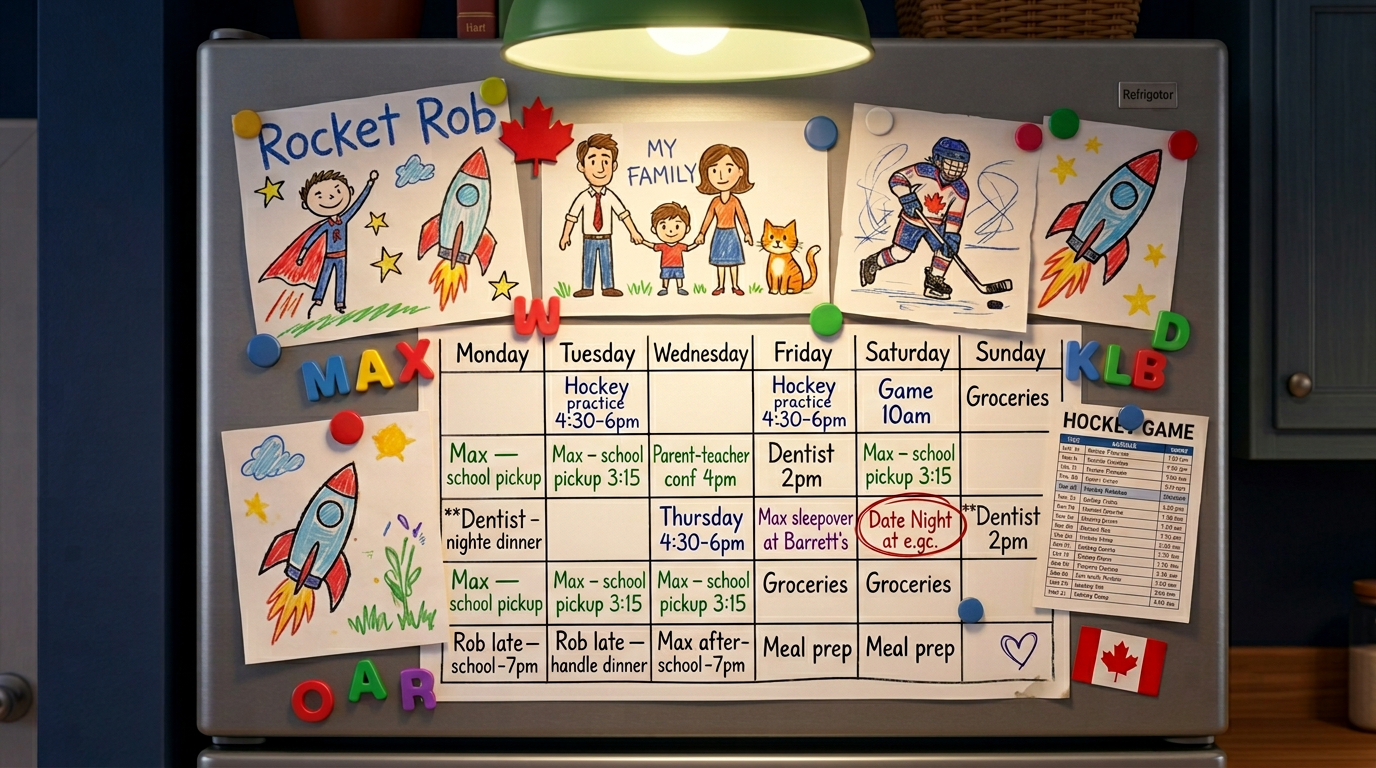
Silent. Piano and guitar. Tiny Max in a dish-towel cape. First time on skates. The two-tap ritual. Drawings on the fridge. The Pixar plant (~14 min): Claire finds Max's drawing in Rob's jacket, folds it, slips it behind the RR belt buckle on a hook. The audience thinks she's tidying up. Ends: Max hands Rob a new drawing — "Every hero needs a sidekick."
Bond the audience to this family — and hide the most important shot in plain sight
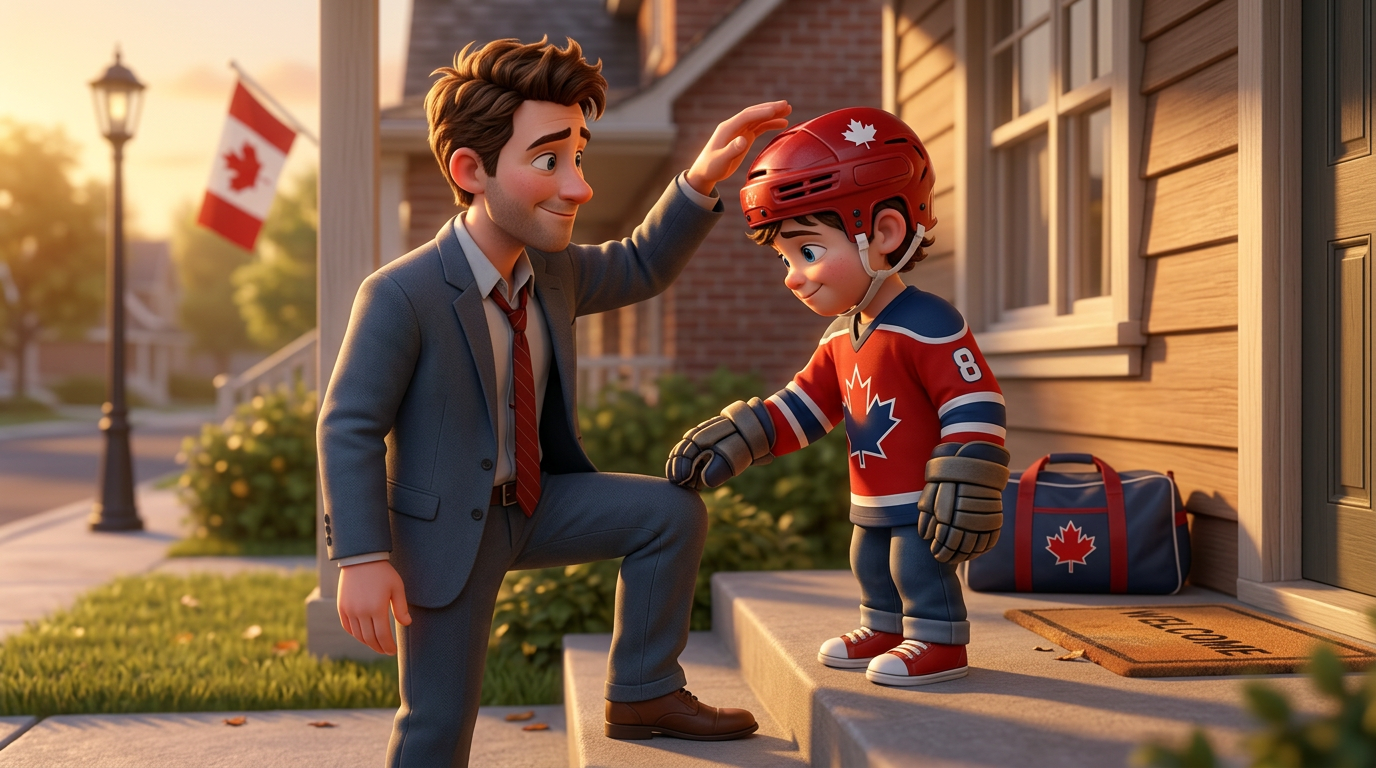
Max taps Rob's knee twice — their ritual
The Two-Tap Ritual — Max taps Rob's knee. Rob taps Max's helmet. Their thing. Established here, tested in The Silence, restored in the final scene.
18:00
Inciting Incident — Victor Watt
Watt unveils his machine — and Rob recognizes it. The interlocking rings, the energy-load balancing: it's Titan's arena grid architecture, scaled to the entire city. "I built half the load-balancing framework you just showed them." Watt's hand drifts to his jacket pocket when he says "Family makes you weak." Rob refuses. Watt activates the machine. The city grid flickers. This isn't innovation — it's control.
Act One turning point: Rob must choose to act
Act Two
"The Cost"
~45 minutes
25:00
The Double Life
Every save costs family time. Misses practice pickup. Gets home late. Max is asleep. Claire covers, drives Max, holds the house. The invisible load grows. Max's narration gets quieter — less excited, more routine.
Rising tension: "not both" starts feeling true
30:00
Shadow Dad — Planted Seed
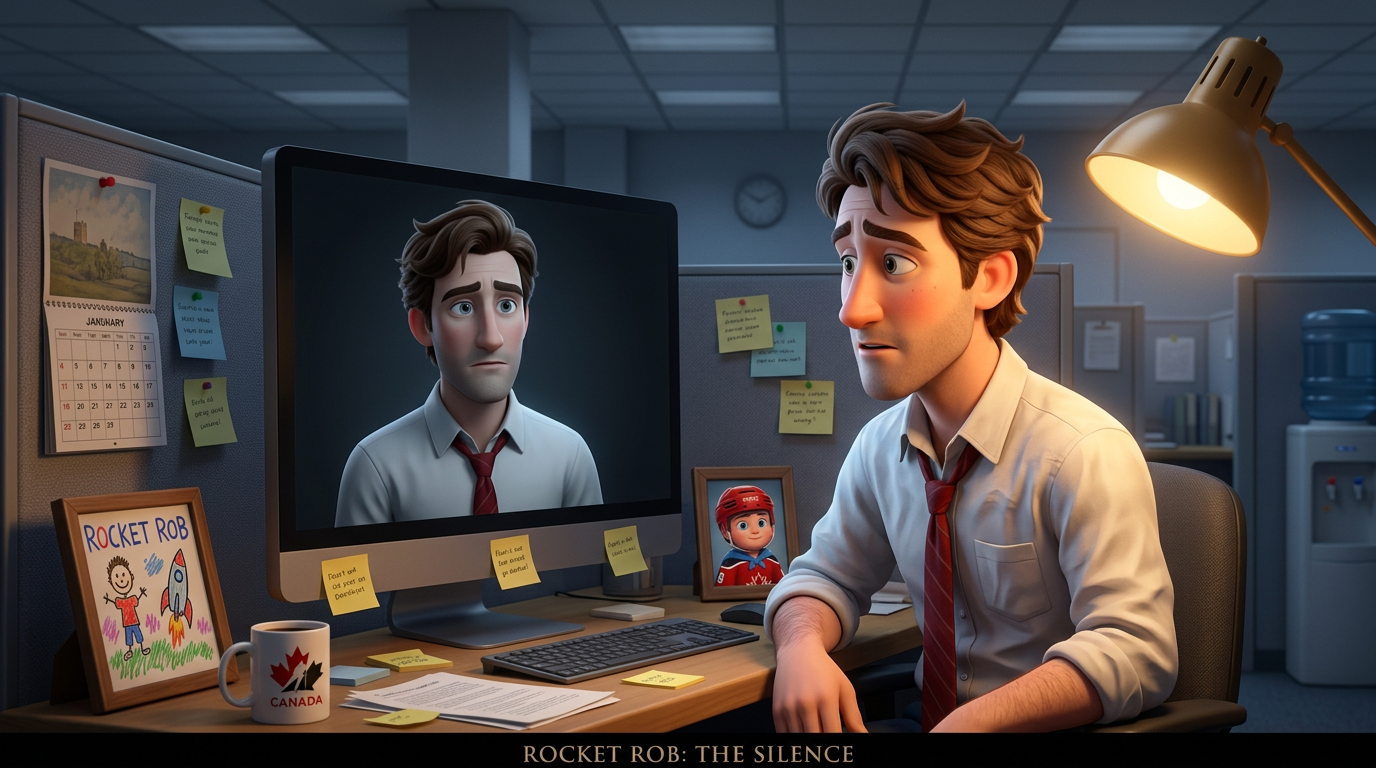
Rob at his cubicle late. Office empty. He catches his reflection in the darkened computer screen — for one frame, the reflection looks different. Sharper suit. Neater hair. Emptier eyes. Rob blinks. Gone. The audience files it away. Pays off 30 minutes later.
15 seconds that plant the Act Two psychological confrontation
32:00
The Couch
Late night. Max asleep. Claire on the couch with a book she isn't reading. "Max made the travel team." "He wanted to tell you himself." "I'll talk to him in the morning." "You said that Monday." Not angry — just accurate. The same factual tone Max will use in The Silence. Rob reaches for her hand. She lets him take it. Maple walks across the couch behind them. Sits between their heads. Tucks his paws under himself and closes his eyes. Everyone is home. He can stand down.
The marriage fraying — where Max learned to process disappointment
35:00
Coach Hank Beat 2
Rob catches Hank after a game. Asks how Max is doing. Hank: "Kid's good. Plays hard. But he's started looking at the bench instead of the net." Beat. "When a kid stops looking forward, something at home changed." Doesn't push. Leaves it there.
The theme stated as hockey wisdom — Rob feels the weight
40:00
The Silence Begins
Rob misses bedtime. Max doesn't narrate. Just: "You said that yesterday." Max rolls over. Over the next scenes: action figures in a drawer, dish-towel cape stays folded. The magic track goes silent. Rob becomes measurably less effective. After Rob snaps "I said I'm FINE," Maple doesn't flinch. Just presses closer against his leg. Watching Rob the way cats watch things they can't fix. Then Maple walks across the relay housing — casual, indifferent — and accidentally knocks loose the coupling Rob needed. Completely unaware he helped.
The gut punch: the audience feels the hero diminish
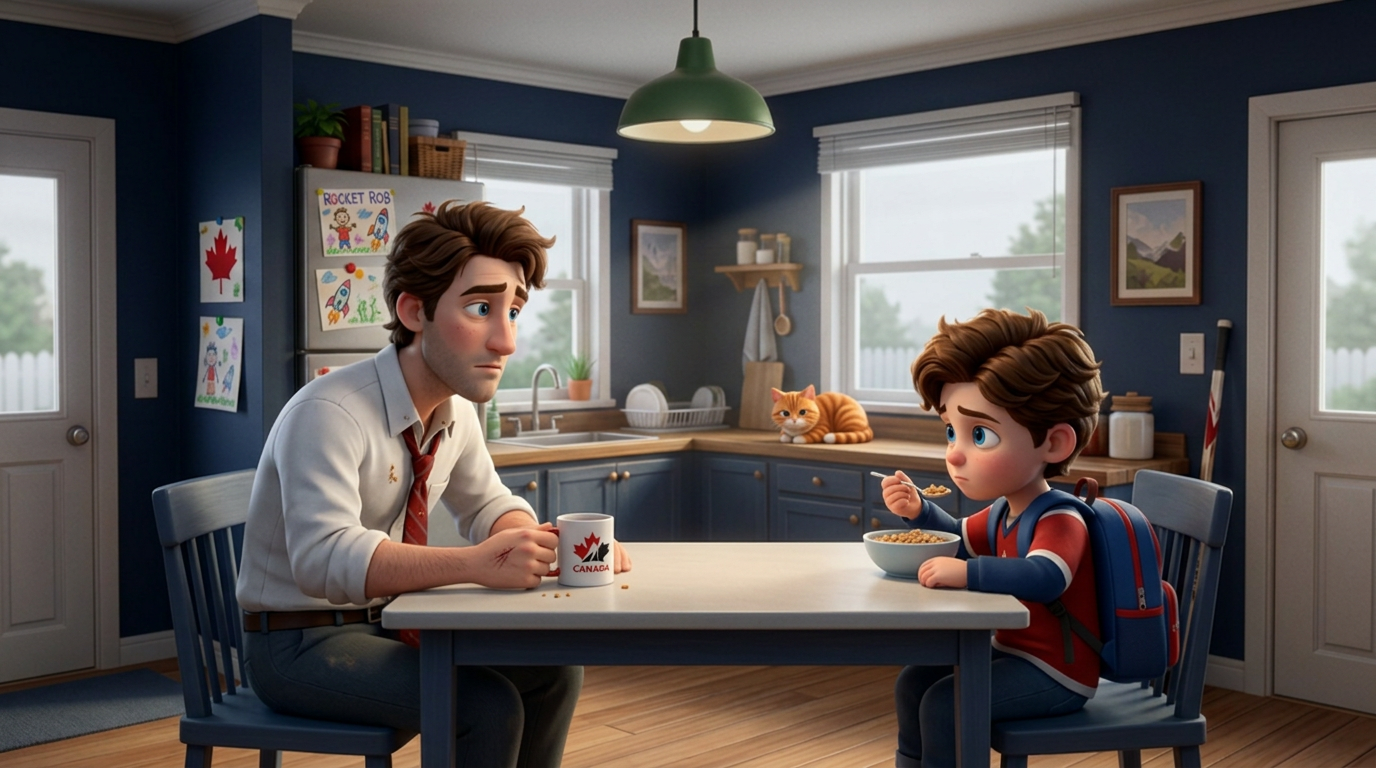
Rob and Max at the kitchen table in silence
The Breakfast Bridge — No narration. No imagination. Just a man and a kid.
Maple sitting on Max's folded cape
Maple Sits on the Cape — Same confidence as the keys. Different stakes.
50:00
The Hockey Game
Game day. Not the championship — just a regular Tuesday. Rob promises he'll be there. Watt escalates — citywide blackouts. Rob saves the city. Misses the game. Completely. The golden seat beside Claire stays empty for the entire game. Max sits on the bench, watches other dads cheer. Looks at the empty seat one more time. "It's okay... my dad saves bigger things." The seat never fills. The game ends. No hug. No two-tap. Just absence. It didn't need to be the big game to break your heart.
The scene that breaks parents
58:00
The Low Point — Shadow Dad Confrontation
The seed from ~30:00 pays off. Shadow Dad: same face, charcoal suit, empty eyes. "They'll understand when they're older." Rob realizes: They won't. "You're already me, Rob." Rob looks at the crumbs on his tie from Max's granola bar. "No. I'm not." The crumbs are the proof. Claire confronts Rob: "You're trying to save everyone except the people in this house... I know what you're trying to do. I've done it."
Darkest moment: the imperfection is the point
65:00
The Vela Reveal
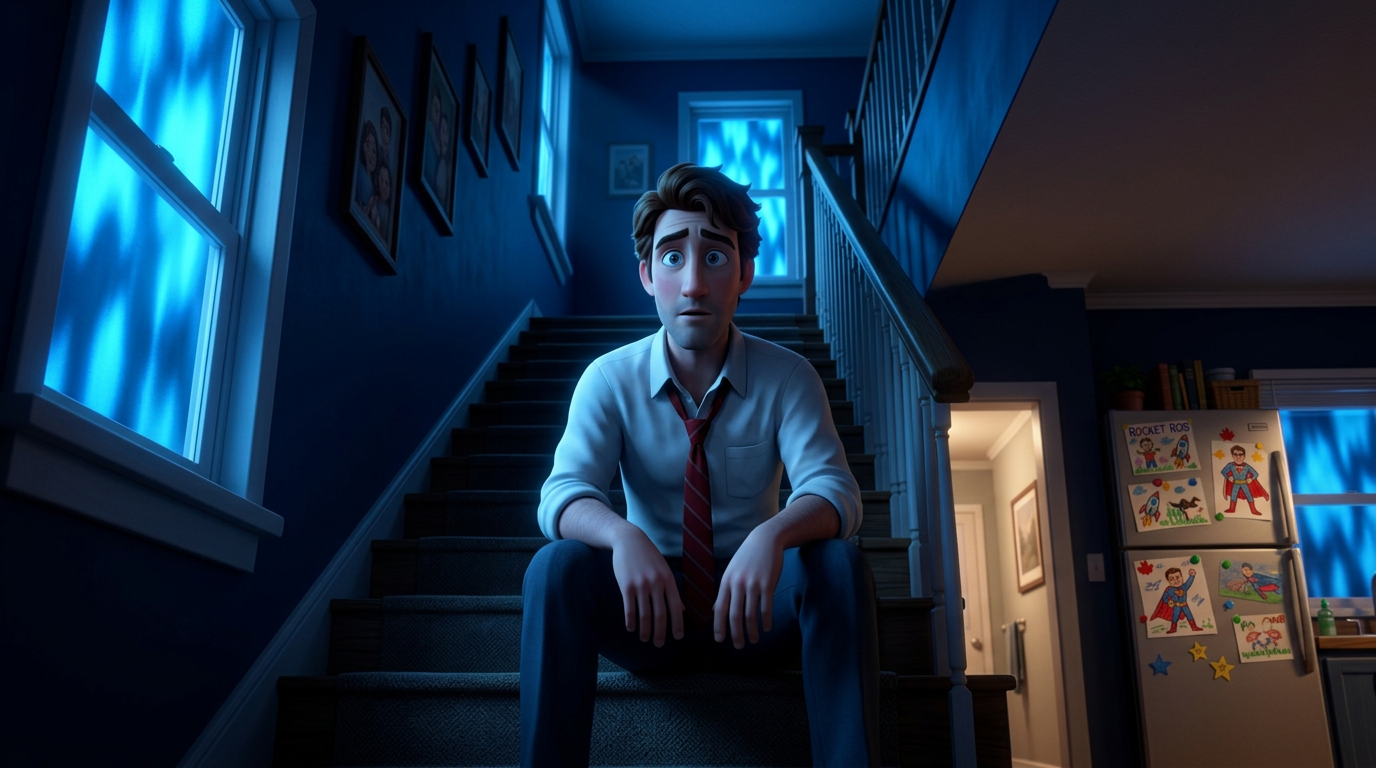
It's game day — Max's last game starts at seven. Rob came home early for the first time in weeks. Then the power dies. Watt attacks the Lavoie neighborhood. Claire moves like someone who's done this before. Gets Max to the Barretts' house — his teammate's family, already heading to the arena. Max: "The game starts at seven." Claire: "I know, baby. You won't miss it." She reroutes the house power with moves Rob doesn't recognize. "I was Vela before you were Rocket Rob." Why did she stop? "Because I chose something harder." Rob sits on the stairs alone, rewriting his memory of every moment she was too calm, too fast, too prepared.
Recontextualizes the entire film — the audience has been watching two movies
Rob sits alone on the stairs — processing the Vela reveal
The Stairs — Rob sits alone in the dark house, rewriting his own memory. She was right there. The whole time.
Act Three
"What Makes a Hero"
~20 minutes
69:00
Before the Storm
Max is safe — Claire got him to the Barretts' house, his teammate's family, already heading to the arena. Dark hallway. Both in suits. Masks pushed up. Real faces. "How long?" "Before Max." "Were you scared?" "Every time." Claire touches his belt buckle — the drawing is still there. "Game's at seven." "Then we finish this before seven." They go separate directions — she to the ground, he to the sky. Maple follows Claire out with purpose — head up, ears forward, moving like something matters. He is a professional.
Honesty, a ticking clock, and a promise to keep — the only scene where both masks are fully off
70:00
The Final Battle
Watt's machine at full power atop Titan tower — Titan's arena architecture scaled to something monstrous. The game clock is ticking — the last game of the season starts at seven. Rob takes the sky. Claire — Vela again — coordinates the ground, clearing Rob's path. They're faster together. That's the thesis made literal: partnership is the superpower. Rob recognizes the machine — he helped build the system it's based on. He shuts it down the way he'd shut down an overloaded arena grid: methodically, absorbing the overload himself. An engineer doing what he knows. Watt: “Why?” Rob, holding the drawing: “You already know why.”
The dual stakes — city AND hockey game — are the whole movie in miniature
76:00
The Dissolution
Watt reaches into his coat — the same pocket his hand has drifted to every time he talked about family. A creased photograph — the last real thing about him. He looks at the drawing in Rob's hand. Two pieces of paper. Two different choices. “I had one of those once.” Then Victor dissolves. Particles of golden-white light drifting upward like embers. His cape fragmenting into ribbons. Not defeated by force — released when Rob chose differently. The storm clears. Stars come through. The audience feels melancholy, not satisfaction. He could have been Rob.
The Pixar gut punch — pity, not triumph
77:00
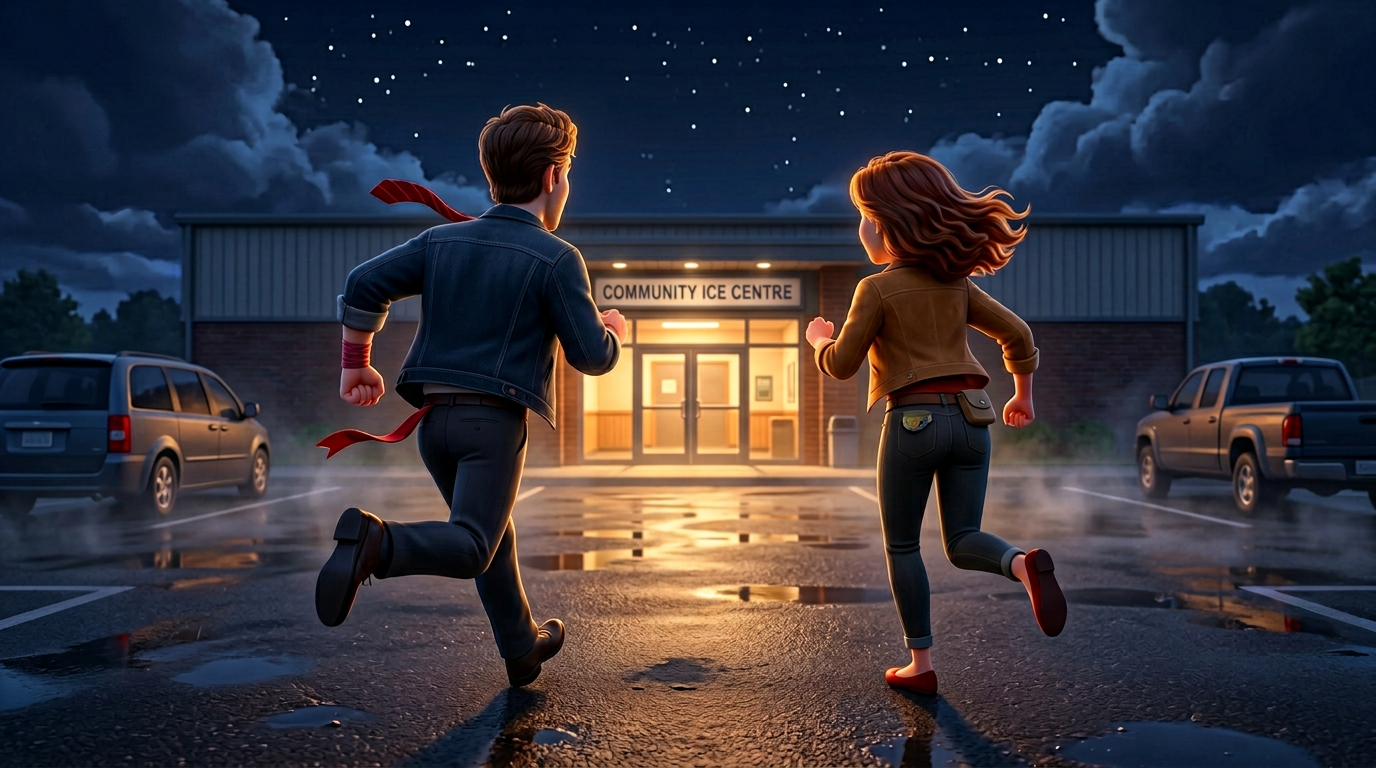
The Race
Rob and Claire on the rooftop. Exhausted. “What time is it?” Beat. They run. No dialogue. The montage melody building. Two people changing in the car. Pulling jackets over bruised arms. Running across a parking lot. Not heroes. Parents. 60 seconds of screen time that earns the entire movie.
The most Pixar image in the film — two ordinary people racing to make a hockey game
79:00
The Seat Fills
They arrive during the second period. Push through the doors. Find seats. Claire sits first. Then Rob slides in beside her. The golden seat — the one that was empty on that regular Tuesday — fills. Max on the bench glances at the stands. Sees his dad. Then his mom. His face changes — quiet certainty. He pulls his helmet down and plays the best shift of the season. Maple at the entrance door, harness dark. He showed up. He always shows up.
The empty seat from Act Two finally fills — visual payoff of the film’s central image
82:00
After the Game
Coach Hank catches Rob near the exit. “You’re gonna miss some games. Just don’t miss the ones that matter. And you’re here.” The line lands because Rob was here — during the game, not after. Max comes out. The two-tap. The hug. Max picks up Maple: “You came too?” “Everyone came.” The family walks out together. The arena lights dim behind them.
Coach Hank’s arc resolved in one line — recognition, not consolation
87:00
The Final Image
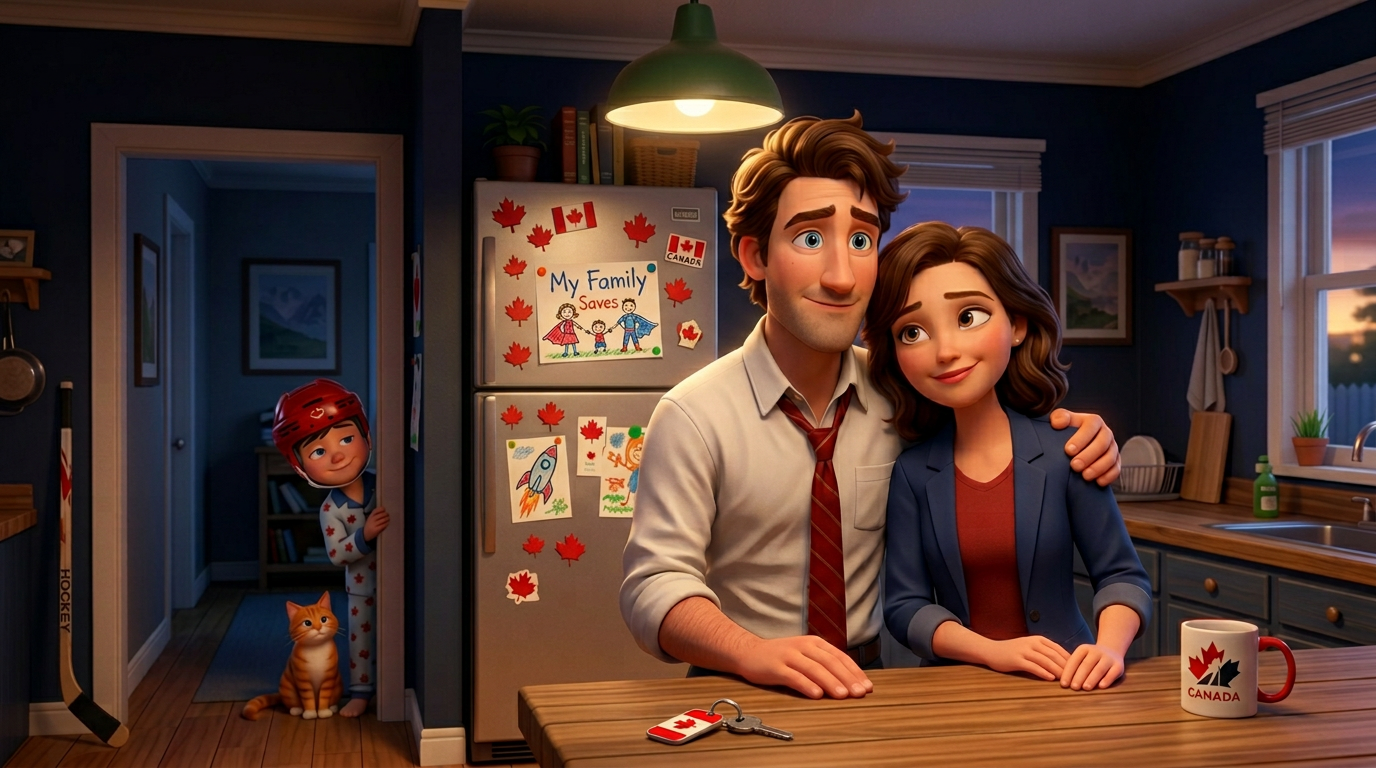
Bedroom: "Did you save the world?" "Something like that." "I knew it." Kitchen: Claire crosses to him. Leans against his shoulder. The fridge drawings say it all — including a new one with two superhero parents. Pull back through the kitchen window. House. Street. Hockey net. Neighborhood. City. Stars. Max's voice returns — soft, sleepy, certain: "Every family has heroes. Ours has the best ones." Not city — family. Not hero — heroes. He sees both parents now. This is an eight-year-old who chose to believe.
The Pixar moment — theme delivered in a kitchen, not a speech. A chosen belief is more powerful than a given one.
Rob and Claire in the kitchen — equal, present — Max in the doorway
The Final Image — Both parents. Equal. Present. Max peeks from the doorway with a sleepy, certain smile.
90:00
Post-Credits — "Rocket Maple"
Rob's office. Dark. Maple sits on the desk, harness blinking [WORLD: SAVED]. She bats a pen off the edge. Watches it fall. Looks at the camera. Cuts to black. The hero was always watching.
Maple owns the final frame — comedy beat that lands with unexpected emotional weight

World-Building

Fully fictional, unnamed — the Pixar way. The city is anywhere. Rob Lavoie is unmistakably Canadian. That distinction is the point.
Lavoie Family Home
Warm two-story house. Slightly cluttered yard. Hockey net in the driveway. Inside: Max's drawings covering the fridge, scattered gear, a cozy kitchen that's the emotional center of the entire film. Everything real and important happens here.
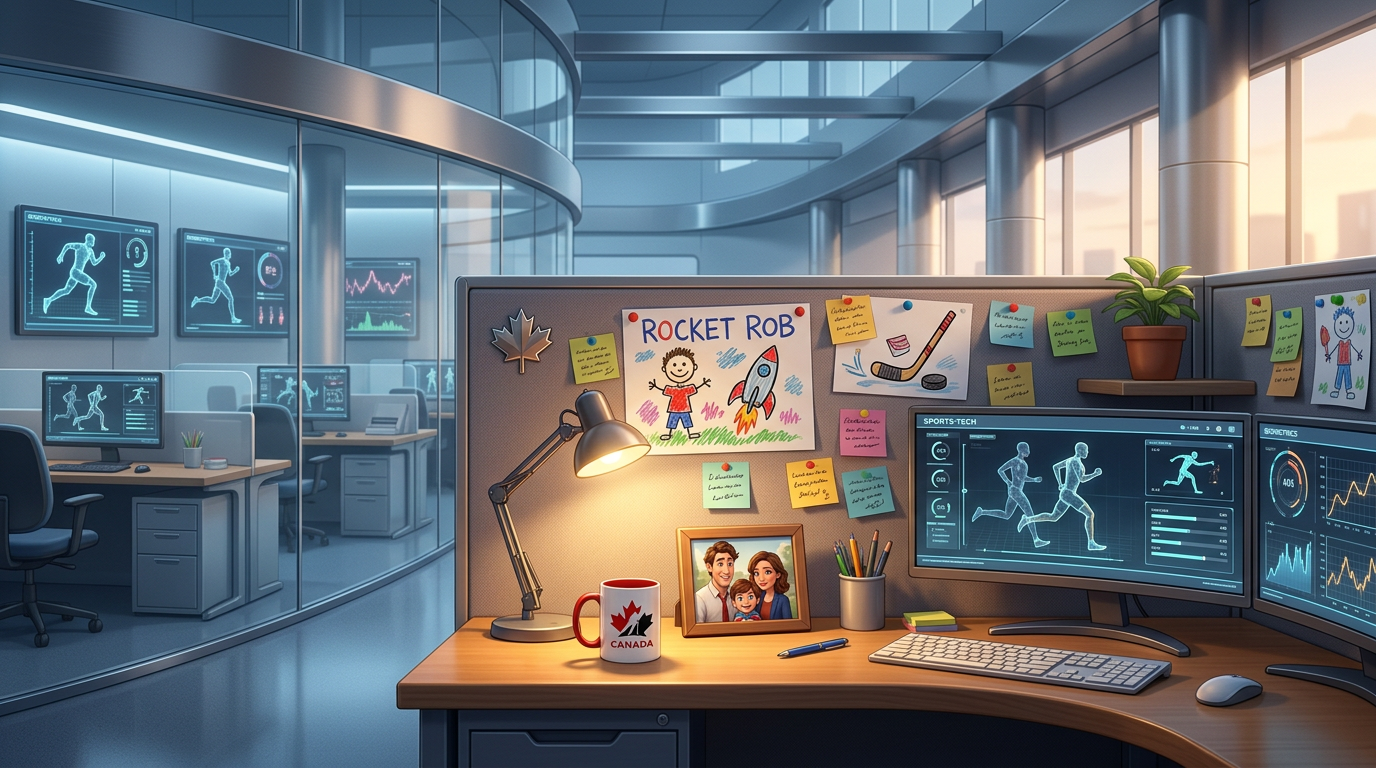
Titan Sports Tech Tower
Sleek glass tower. Cool blues and silver. Corporate clean. Titan develops the technology that powers modern athletic venues — arena energy management systems, stadium lighting grids, ice-plant infrastructure. Managing a 20,000-seat arena requires the same grid architecture that runs a small city. That's the bridge to the villain: Watt saw that Titan's arena-scale systems could control an entire city grid. Rob's cubicle is the warmest corner: Team Canada mug, family photos, Max's drawings, arena energy schematics on his monitor.
Max's Hockey Arena
Small. Warm. Community-scale. Bright ice, colorful banners, wooden bleachers. Smells like cold air and hot chocolate. Where Rob and Max connect. Rob misses a regular Tuesday game here — the Act Two gut punch. The golden seat stays empty. The last game of the season is where the film resolves — Rob and Claire arrive during the game, the seat fills, and Max sees both parents from the bench.
The Signature Bridge
A distinctive arched bridge connecting two parts of the city. Lit warmly at night. Appears in all skyline shots. Recognizable in silhouette. The visual anchor of the world's establishing shots.
The Park
Green space with a view of the skyline. Where Rob and Max have played since Max was small. A bench with their names scratched into it. Used for quiet emotional scenes and montage.
The Two Worlds
Reality: warm grounded palette, soft lighting, everyday textures. Max's imagination: more saturated, bigger compositions, physics are suggestions. The film deliberately leaves ambiguity about where one ends and the other begins. When The Silence falls, the imagination world disappears — and the film changes feeling entirely.

Rob's Canadian Identity in the World

The city is neutral and universal. Rob's Canadian-ness is personal, specific, and his. He brought it with him — the maple leaf pin on his lapel, the Team Canada mug, the hockey jersey he wears on weekends, the reflexive "sorry" to strangers, the particular dry humor of a man who grew up in a country that underplays everything. Victor Watt had the same origin and erased it. Rob held on. That contrast is the theme made visible.

Series Expansion

The film establishes the world. The companion series retells and expands it across 10 episodes. Episodes 1 and 10 bookend the season with the film's opening act and climax. Episodes 2–9 are original stories set between those events — deepening the world, introducing new villains, and exploring the family as Rob's double life escalates. Every episode runs two parallel tracks: a real family problem and a superhero crisis that mirrors it.
Max's Imagination Villain → Series Antagonist
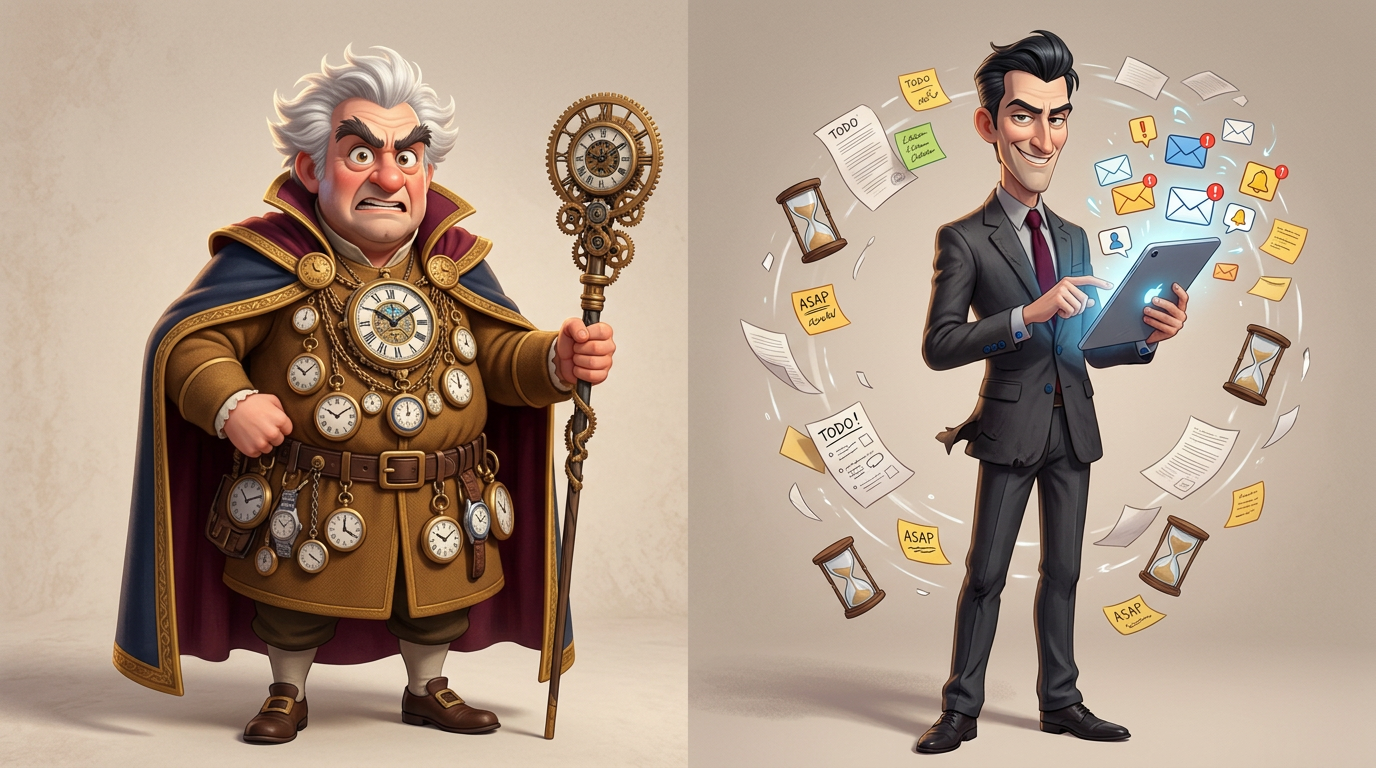
Dr. Overtime
"There's always more work to be done."

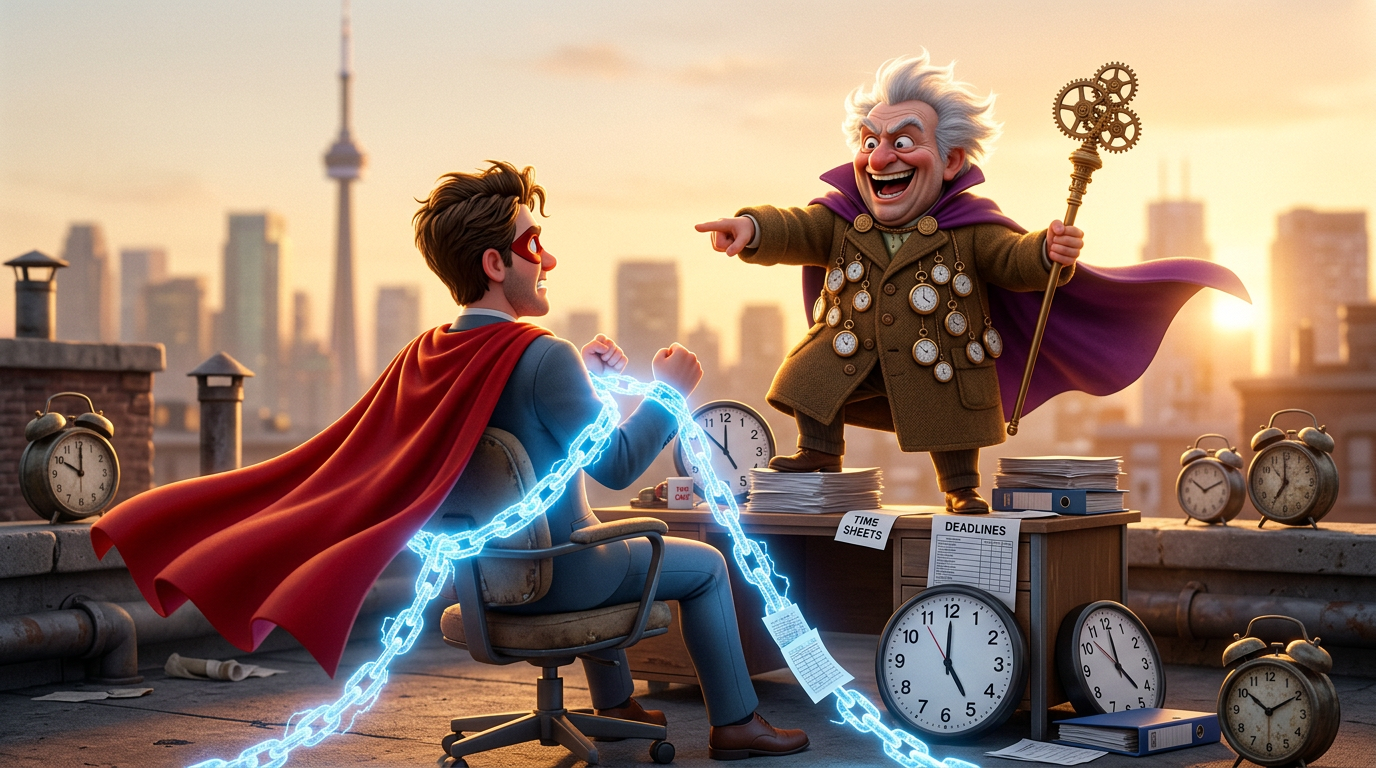
The time wizard who keeps dads at work. Too many clocks, too many watches, a fussy dramatic cape. He represents the endless grind — the feeling there's never enough time. An 8-year-old invented him from hearing adults say "I have to work overtime." In the film, he appears in Max's imagination overlay. In the series, he manipulates time itself.

Max's Imagination Villain → Series Antagonist
The Countdown
"Your time is UP."

The task monster that traps dads in work. A swirl of notifications, ASAP notes, hourglasses, and relentless buzzing. Annoying-dangerous, not cool-dangerous. He embodies modern work overload — the thing that steals time from family. Kids laugh at his chaos. Parents feel personally attacked. In the film, he's Max's fantasy. In the series, he's real.

Season 1 — 10 Episodes

Episode 1
"The Greatest Hero Ever"
Real Problem
Rob is late to pick up Max from hockey practice — again.
Hero Problem
Victor Watt announces his energy tech. Rob's pushback triggers Watt's descent.
Theme: Setting the stakes — can Rob be the dad Max believes in?
Episode 2
"The Missing Hockey Stick"
Real Problem
Max's lucky stick disappears before a big game. He can't play without it.
Hero Problem
Rocket Rob hunts it through increasingly absurd obstacles — the lost-and-found is a labyrinth, the neighbor's garage is a villain's lair.
Theme: The magic was always in you, not the stick.
Episode 3
"Laundry Day Apocalypse"
Real Problem
Claire is away. Rob is in charge of the house. Everything spirals.
Hero Problem
The washing machine becomes a portal. Socks become sentient. The dryer is a black hole.
Theme: Rob finally sees what Claire does every single day.
Episode 4
"The Science Fair Disaster"
Real Problem
Max's volcano won't work. The fair is tomorrow.
Hero Problem
The Homework Hydra attacks — every solution creates two new problems.
Theme: The process matters more than the result.
Episode 5
"The Homework Monster"
Real Problem
Max has a huge assignment. He can't focus. Rob can't help without doing it for him.
Hero Problem
The Homework Hydra returns. The cat sidekick keeps accidentally solving the wrong problem at exactly the right moment.
Theme: Let them struggle. That's how they grow.
Episode 6
"Dad vs. Bedtime"
Real Problem
Max refuses to sleep. Every excuse in the book.
Hero Problem
Each delay opens a mini-adventure. The one more question leads to a confrontation with Shadow Dad.
Theme: Even bedtime is a kind of heroism.
Episode 7
"Coach Crusher"
Real Problem
Max faces a hyper-competitive squad. Crusher's philosophy starts to infect Max.
Hero Problem
Rob must intervene without becoming the overbearing sports dad.
Theme: What are we teaching kids when we teach them to win?
Episode 8
"The Countdown"
Real Problem
An impossible work deadline at Titan. Rob is pulling late nights. Max notices.
Hero Problem
The Countdown villain manifests from Rob's work stress — emails and notifications forming a chaos monster that won't let him leave.
Theme: Work expands to fill the time you give it. The only way to beat it is to choose to leave.
Episode 9 — The Quiet One
"Little Hero Moments"
Real Problem
Max finds old home videos. He sees baby-Max with Rob. He asks about when he was little.
Hero Problem
Minimal. This is the quiet episode. The montage lives here.
Theme: Time is the real villain. The only way to fight it is to be present right now. This is the episode that makes parents cry.
Episode 10 — Season Finale
"What Makes a Hero"
Real Problem
Max's championship hockey game. Rob promises to be there. Watt launches his full attack.
Hero Problem
Watt's machine threatens the entire city. The game is in two hours. Then one. Then it starts.
Theme: Being a hero isn't about saving the world. It's about showing up for the people who believe in you.

The Children's Book Universe

The "Little Hero Moments" concept that powers the film is a picture book engine. Each book is one ordinary dad moment — transformed by a kid's imagination. Simple formula. Infinite stories. Proven emotional formula.
Little Hero Moments

A picture book series for ages 4–7. Each book takes one ordinary moment — fixing the sink, making breakfast, driving to school — and shows two versions: the mundane reality, and Max's imagination transforming it into an epic. Simple. Repeatable. The formula that makes parents cry and kids cheer is a picture book formula at its core.

This isn't a movie tie-in. It's IP development that works independently — and makes the film's eventual pitch to studios significantly stronger because the property is already in the world.

32
Pages per book
4–7
Target age
Possible stories
2
Spreads per moment
Both
Audiences crying
1st
Path to market

The Book Series — Volume by Volume

Book 1
Rocket Rob and the Hydro Blaster
Rob is under the kitchen sink. Water sprays everywhere. Max watches from the doorway in his hockey helmet. And whispers: "Rocket Rob… repairs the Hydro Blaster."
Left spread: man fixing a leaking pipe. Right spread: superhero battling a water monster in an underground city. Same scene. Two truths.
Book 2
Rocket Rob and the Rocket Launch
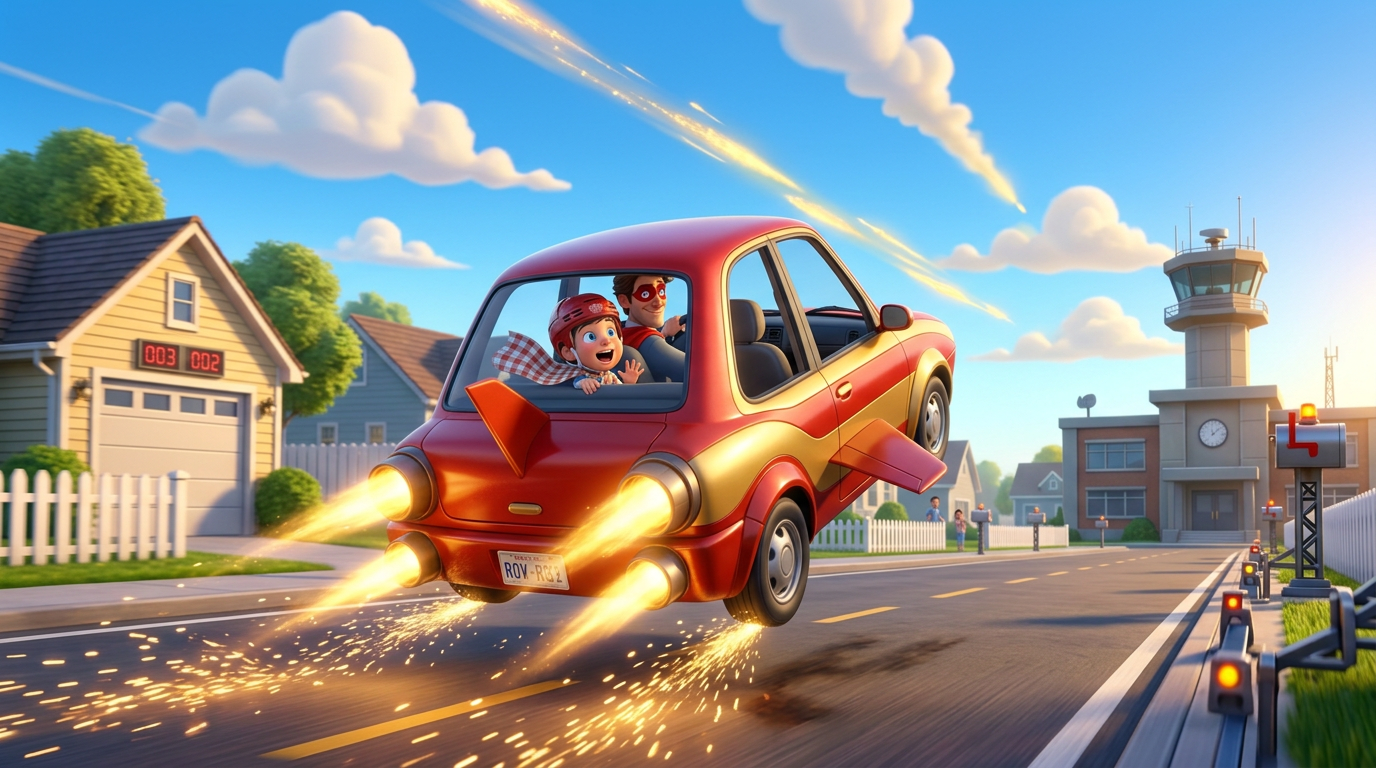
Every morning, Dad drives Max to school. But Max knows the truth: it's not a car. It's a rocket. And the school isn't a school. It's Mission HQ.
Left spread: minivan in morning traffic. Right spread: rocket ship breaking atmosphere. Same trip. Same dad. Same kid who believes.
Book 3
Rocket Rob and the Hunger Monster
Dad is making breakfast. The eggs are a disaster. The toast burned. But Max knows what's really happening: "The hero fuels up for his next mission."
Left spread: smoky kitchen, lopsided pancake. Right spread: supersonic refuel station in the stratosphere. Same terrible breakfast. Epic in the right hands.
Book 4
Rocket Rob and the Bedtime Battle
Every night, Dad reads Max a story. And every night, the story becomes real. The book is a portal. The bedroom is a command center. And Dad's voice is the bravest thing Max has ever heard.
Left spread: tired dad reading in lamplight. Right spread: two heroes on a quest through the story's world. Together.
Book 5
Rocket Rob and the Big Game
Max has a hockey game today. Dad promised to be there. And when Max skates onto the ice, he knows one thing: the stands are full — but only one face matters.
A quieter book. The heroism is the showing up. Both spreads hold the same warmth — just one has a cape.
Standalone / Seasonal
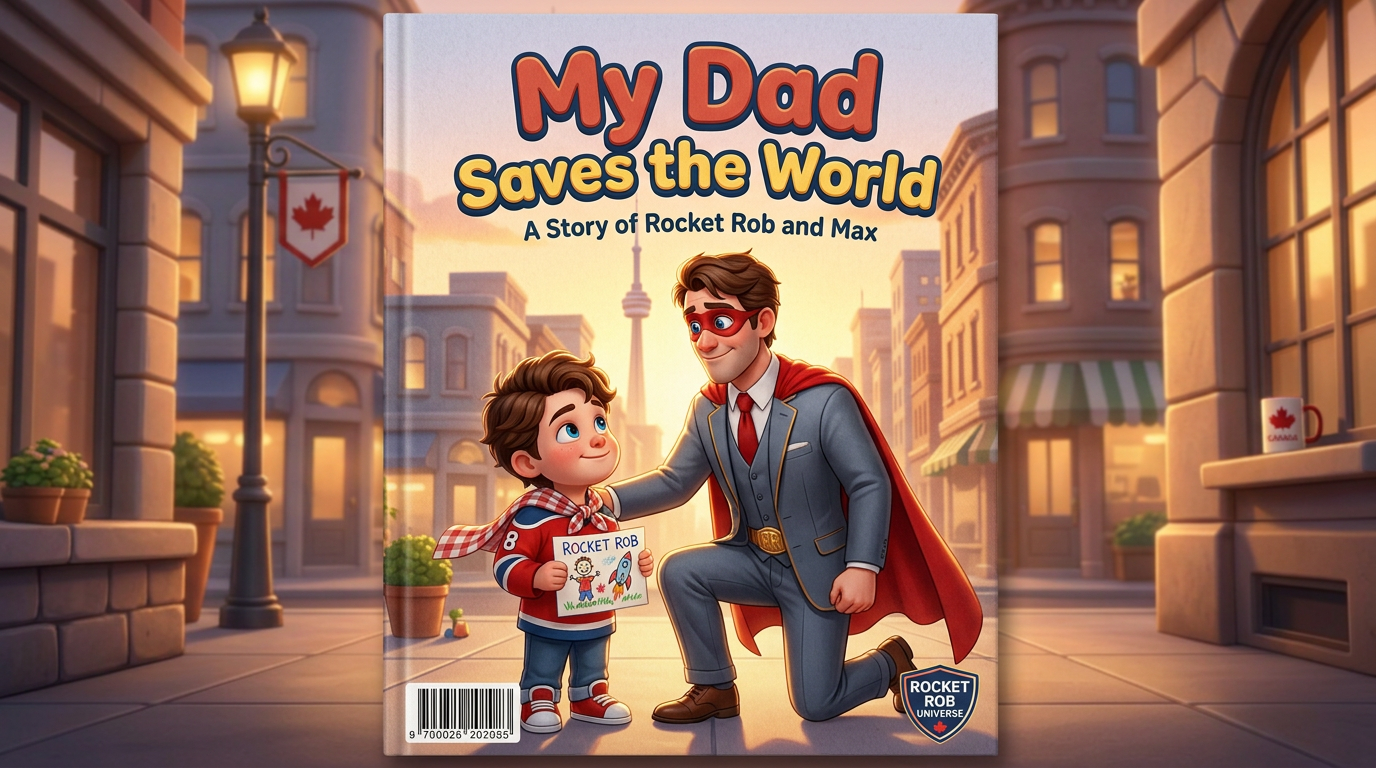
My Dad Saves The World
Max's drawing from the belt buckle — told as a picture book. What Max draws. What Dad does. Why both are the same thing. The film's core thesis in 32 pages for a four-year-old.
The thematic centerpiece of the IP. The book you give a dad on Father's Day. The one that sits on the nightstand next to the bed.

Why the Picture Book Path Works

📚
Proven Formula
The dual-spread format (mundane + imagined) is a picture book classic. The Dot, Dragons Love Tacos, The Pout-Pout Fish — simple repeatable structure with big emotional payoff. This fits that shelf.
🎬
IP Proof-of-Concept
A published book series is a studio pitch with an audience already attached. It proves the concept works before a single frame of animation is financed.
📅
Father's Day Machine
My Dad Saves The World is a Father's Day gift that sells itself. The retail hook is built in. That's a publisher's dream for a debut property.
🍁
Canadian Publishing Path
Canadian publishers (Kids Can Press, Annick Press, Orca Book) actively seek Canadian-authored family content with strong visual identity. The art is already done.
👨‍👧
Both Audiences, One Book
Kids read the adventure. Parents feel the quiet truth underneath. Every great picture book does this. Love You Forever. The Giving Tree. Guess How Much I Love You. This belongs in that conversation.
🖼️
The Art Is Ready
The visual style is defined. The characters are designed. The tone is locked. Most picture book pitches start from nothing. This one starts with a fully realized Pixar-style world already built.

The Bottom Line on the Book

The film asks: "What if a child's belief is a superpower?" The picture book answers it in 32 pages, for a four-year-old, at bedtime, with their dad reading it to them. That's not a tie-in product. That's the thesis of the entire property — delivered in its purest form. You don't need the movie to exist for the book to work. But the book makes everyone want the movie.

Every family has heroes. Ours has the best ones.

← Pitch Deck  |  Scripts →

© 2026 Jack Autrel. All rights reserved. Rocket Rob™ — Story, characters & creative concepts by Jack Autrel.