Rocket Rob
A Rocket Rob Story
Twenty key sequences — the spine of the whole film.
The Sequences
Twenty scripted sequences in chronological film order, bookended by the title card and the post-credits tag. Each covers a pivotal emotional beat.
Title Sequence
Cinematic title card. The city, the family, the blur between imagination and reality.
The Greatest Hero Ever
Epic battle cuts to the kitchen sink. The hook that tells the audience what kind of movie this is.
The Handoff
Morning kitchen. Permission slip. Lunch bag. "You always do." The marriage in one scene.
The World
Titan cubicle. Max narrating everything. Coach Hank Beat 1. Claire seeds. Maple's first mission.
Little Hero Moments
The Up-style silent montage. Claire plants the buckle drawing. The scene that bonds the audience forever.
The Inciting Incident
Watt's keynote. "Family makes you weak." The grid flickers. Rob chooses to act.
The Double Life
Hero saves cost family time. Max's narration fades. Coach Hank Beat 2. The pattern that breaks everything.
The Couch
Late night. A book she isn't reading. "You said that Monday." The marriage fraying.
The Shadow Dad
Two beats: the cubicle reflection seed, and the confrontation. "You're already me, Rob."
One Good Saturday
The Frozen Cup. The overlay at full power. Rob silences the alert and stays. The high before the drop.
The Skeptic
Recess. Max defends the belief with playground logic — "That's his cover." — and loses to the evidence.
The Silence
The power goes offline. Mirrored scenes without narration. The most devastating sequence in the film.
The Demonstration
Watt reads game night off a power graph and arms a quiet grid square. "Then he says yes."
The Hockey Game
Rob misses the game — just a regular Tuesday. The empty seat. "My dad saves bigger things."
The Confrontation
"You're trying to save everyone except the people in this house." Claire breaks the silence.
The Vela Reveal
"I was Vela before you were Rocket Rob." Everything recontextualizes.
Before the Storm
Dark hallway. Two suits. Masks up. "About time." The buckle check.
What Makes a Hero
The final battle. The quiet choice. Watt's exit. "We can still make it."
You Showed Up
Coach Hank's final beat. Maple at the entrance. The two-tap. "Everyone came."
The Final Image
"Did you save the world?" "Something like that." The fridge drawings. The voice returns — changed.
Rocket Maple
Cape on. Harness glowing. [WORLD: SAVED]. The real hero was the cat all along.
Title Sequence
The skyline at first light. Soft golden glow bouncing off rounded rooftops. The Titan Sports Tech tower catches the sun. Clouds part gently.
A small red streak crosses the sky — just a flash, gone before you're sure you saw it. A thin trail of smoke briefly forms a shape that might be the letters RR before dispersing.
Music opens: confident brass, warm.
Quick cuts, rhythmic with the music:
Each moment is mundane. Each is framed like it's heroic. The music treats them as epic.
Claire in the background, shaking her head, smiling. She could have caught Rob. She chose not to.
The imagination/reality moment — the film's visual thesis in 10 seconds:
Rob flips a pancake in the kitchen. In mid-air, the pancake becomes a falling citizen. Rob catches them both. Lands heroically. The scene snaps back to the kitchen — just a pancake on a plate. Max applauds.
The music builds.
Camera tilts upward — past the rooftops, past the clouds, into bright blue sky.
The RR belt buckle glints in the sun (a close-up insert).
The ROCKET ROB title appears in bold, stylized lettering with slight 3D perspective. A tiny rocket streaks off the R, leaving a warm gold trail.
Music resolves: one bright, confident chord.
Cut to black. Story begins.
Director's Notes
Length: 45 seconds maximum. Great title cards are tight. Every frame earns its place.
No villains: The title sequence is about the world and family, not the conflict. The title card should feel like sunrise, not foreshadowing.
Claire as herself: Claire appears as a mom, not as Vela. But the animation plants tiny seeds — the too-fast catch, the choice not to catch Rob. On first viewing, nobody notices. On rewatch after the Vela reveal, it's everywhere.
The Blur: The pancake/citizen flip is the signature visual motif of the film. It should appear here first, establishing the language the entire movie will use: reality and imagination are the same shot, separated by belief.
"The Greatest Hero Ever"
FADE IN:
We hear breathing. Then a child's voice — hushed, reverent, dramatic.
A single point of light appears in the darkness. It grows — warm gold, pulsing.
MUSIC SWELLS. The camera sweeps across a gleaming skyline — rounded saturated architecture, a signature bridge lit golden against deep navy sky. Bright colors. Everything pops. This is a kid's version of the city — more vivid, more fun, more alive than reality.
A MASSIVE WAVE of water CRASHES over a downtown block. Streets flooding. Cars bobbing like bath toys.
HYDRO REX rises from the flood — a towering contraption of copper pipes, chrome faucets, PVC joints, brass valves, and rubber hoses, all assembled into a roughly humanoid shape fifty feet tall. A crown of twisted faucet handles on his head. Glowing blue-green pressure-gauge eyes. Water BLASTS from his pipe-arm cannons, sprays from every joint. He is exactly the villain an 8-year-old would build from the parts under a kitchen sink.
He SLAMS his fists down. Geysers ERUPT from the streets. Fire hydrants POP like champagne corks. Water everywhere.
A RED STREAK cuts across the frame.
ROCKET ROB bursts into view — cape flowing, mask bright, eyes blazing sky blue. He banks hard around a skyscraper, dodging a massive water blast that SPLASHES against the building in a spectacular spray.
Rob weaves between buildings, closing on Hydro Rex.
Rob catches a falling chunk of debris and HURLS it aside.
Rob lands on a rooftop across from Hydro Rex. The villain looms above him, water swirling. Rob's cape whips in the spray. He grins — not scared, excited.
Rob CHARGES. Hydro Rex FIRES a massive tidal wave. Rob dodges — barely — slides across the wet rooftop, and LEAPS.
EPIC SLOW MOTION: Rob sailing through the air, cape spread, fist forward, water droplets suspended around him like diamonds —
He connects. Hydro Rex EXPLODES into a thousand harmless water droplets that rain down on the city like a summer shower. Kids on the street below look up and laugh. The city sparkles.
Rob stands on the rooftop. Wind in his cape. City glowing behind him. Heroic. Grinning.
BEAT.
SMASH CUT TO:
SILENCE.
Then: the sound of water SPRAYING.
ROB LAVOIE — no mask, no cape, wearing a wrinkled dress shirt with the sleeves rolled up — is on his back under the kitchen sink. Water sprays him in the face.
He fumbles with a wrench. More water.
PAN TO: MAX (8), standing in the kitchen doorway wearing a hockey helmet and pajamas. He holds two action figures. His eyes are HUGE.
He leans toward the sink and whispers:
Rob slides out from under the sink. Soaking wet. Hair plastered to his forehead. He looks at Max.
Max grins.
Rob can't help it. He grins back.
CLAIRE walks in. Blue blazer. Coffee mug. She surveys the flooded kitchen floor with absolute calm.
Rob looks at the puddle. Looks at Claire.
Claire steps over the puddle. Kisses Rob on the forehead. Hands Max a granola bar.
Max BEAMS. He turns to his action figures.
Rob watches Max walk away. The grin fades slightly. He looks down at the wrench. At the broken sink. At the clock on the wall — he's already late for work.
He takes a breath. Squares his shoulders. Picks up the wrench.
He doesn't quite believe it.
HOLD on Rob's face. The tiniest crack in the confidence.
FADE OUT.
Director's Notes
The Hook: Kids just watched an incredible superhero battle. They're pumped. Then the hard cut to the kitchen reframes everything — was that real? Was that Max's imagination? The audience doesn't know, and that ambiguity is the engine of the story.
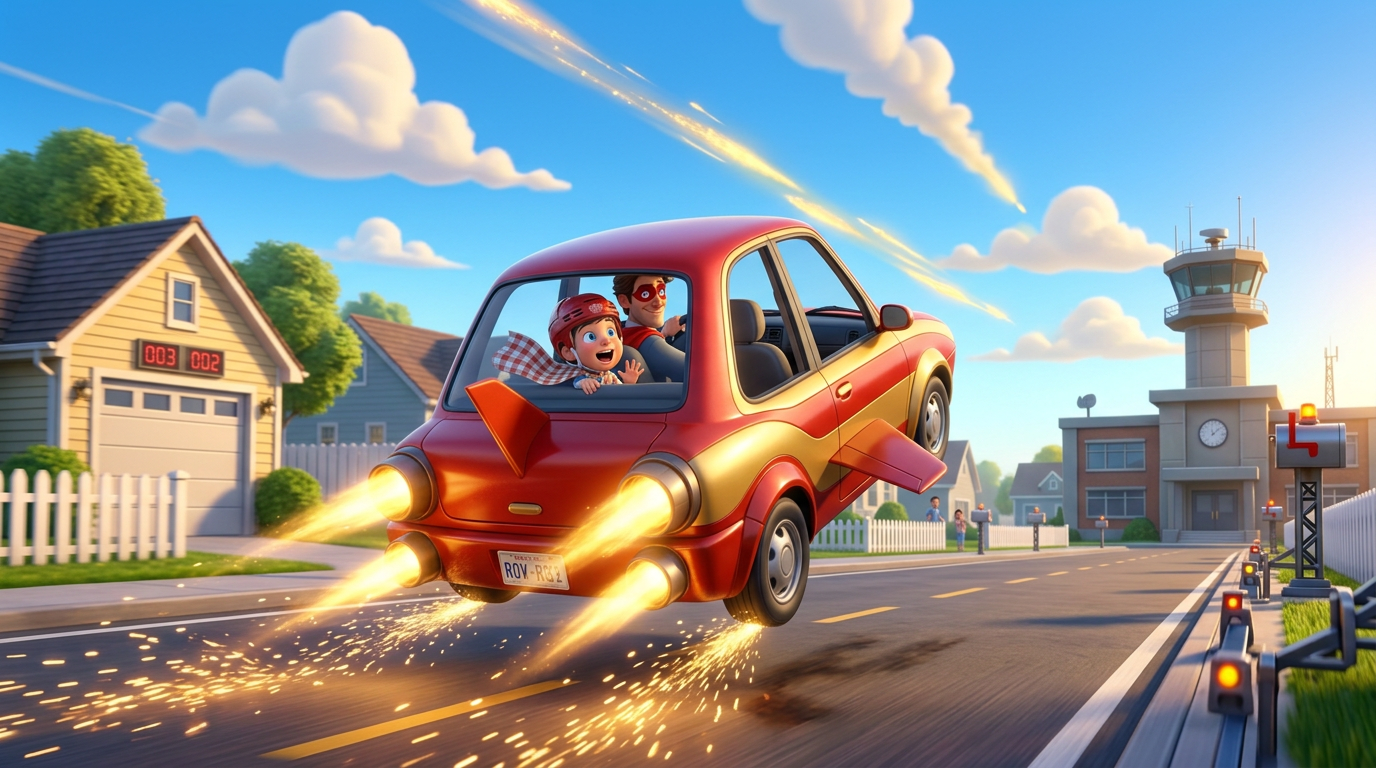
The Emotional Setup: Rob's quiet "Greatest hero ever" to himself — with that small crack in his confidence — tells parents everything they need to know about this story. He's trying. He's not sure it's enough. That's the whole movie in one moment.
Tone Transition: The shift from epic orchestral to warm, quiet kitchen sounds should feel like waking up from a dream. That's the tonal space Rocket Rob lives in.
The Handoff
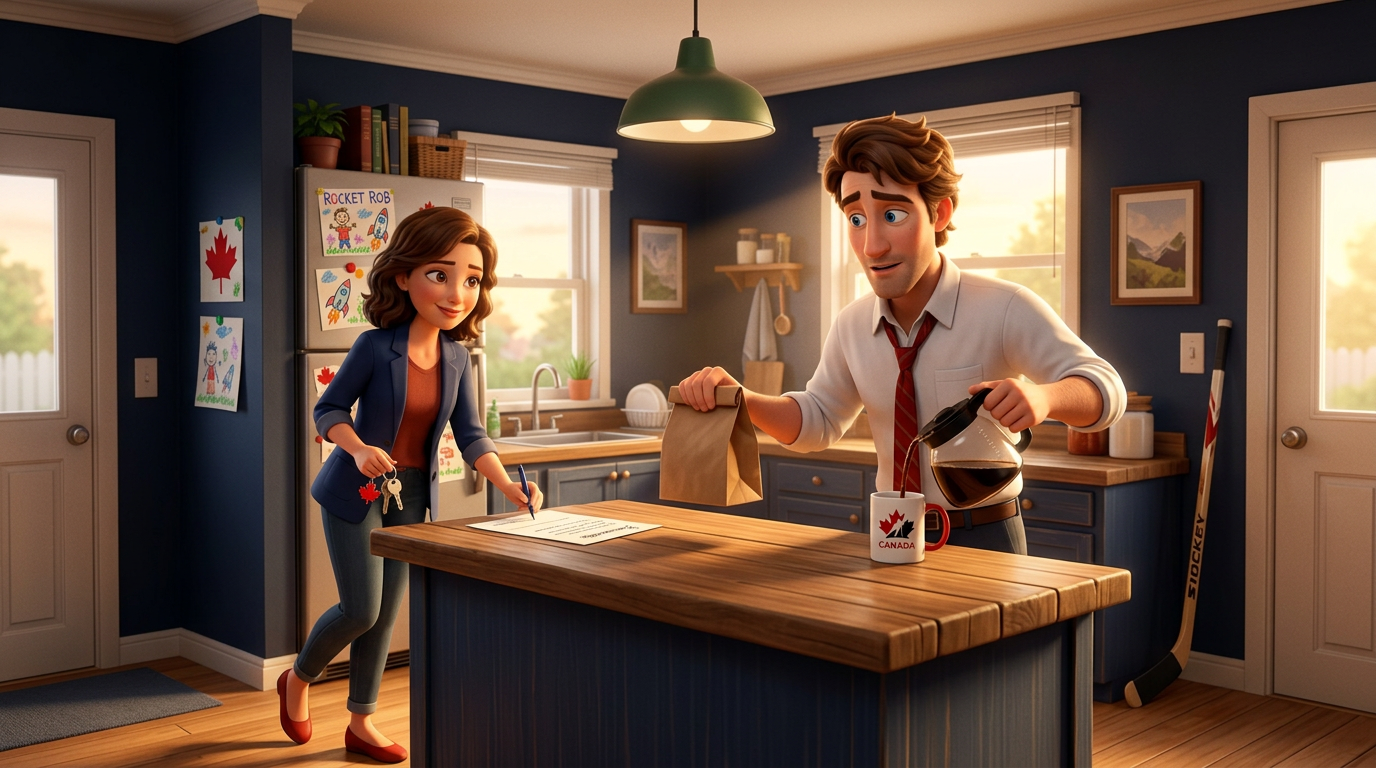
The front door closes. Max is gone — hockey bag, backpack, the whole kid tornado just walked out.
Through the kitchen window: Max is already in the driveway with a KID FROM DOWN THE STREET — same age, same hockey jersey. They're stick-handling a ball back and forth on the asphalt. Two kids in a driveway, doing what they always do before the school bus comes. The camera doesn't stop on them. They're texture.
The kitchen is suddenly quiet.
Rob stands at the counter pouring coffee. His shirt is half-tucked. There's toothpaste on his collar he hasn't noticed.
Claire is already dressed. Blue blazer. Red shoes. Keys in hand. She moves through the kitchen with the efficiency of someone who's done this ten thousand times.
She sees a permission slip on the counter. Unsigned. She signs it without breaking stride. Slides it into Max's folder by the door.
Rob opens the fridge. Pulls out Claire's lunch. Sets it on the counter near her bag. She almost walked out without it. Neither of them comments on the exchange. They've done this a thousand times.
A beat. Small but specific. He means it as gratitude. She hears it as weight. Both are right.
Claire crosses to Rob. Kisses his cheek. Straightens his collar — finds the toothpaste. Wipes it with her thumb. Doesn't mention it.
She grabs her bag. Her lunch. Gone.
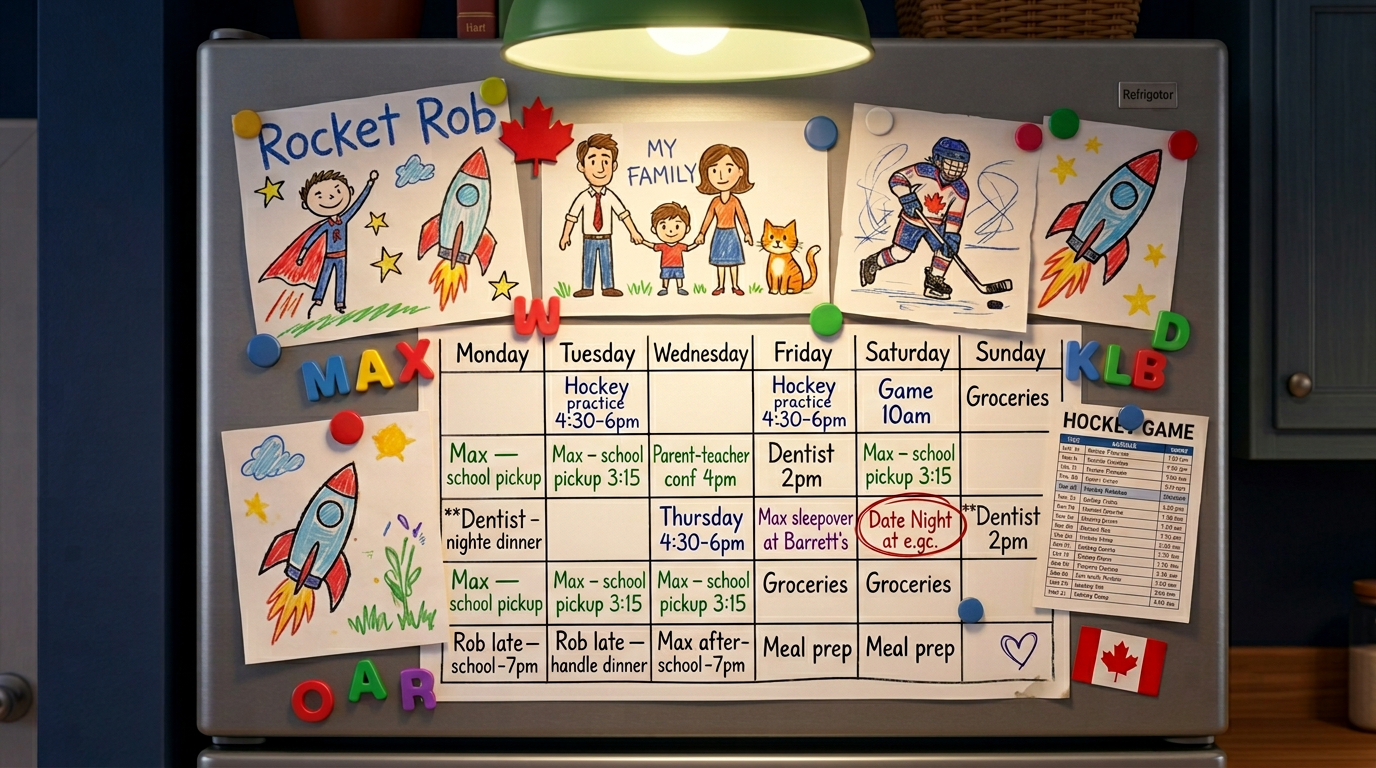
Rob stands in the kitchen alone. The fridge hums. Max's drawings cover the door.
At the front door, Claire pauses — her eyes drift to the hallway closet. Just for a beat. The locked one. The one nobody opens. Her hand reaches for the knob, then pulls back. She adjusts her bag strap instead. Gone.
He grabs his keys. Maple is sitting on them. Rob reaches. Maple shifts his weight onto the keys harder. Stares.
He lifts the cat. Takes the keys. Puts the cat down. Maple jumps back on the counter and sits exactly where the keys were.
Director's Notes
"You always do": This line does double work. In Act One, it sounds like a grateful husband. After the Vela reveal, it sounds like a man who never saw how much his wife was carrying.
Claire's Speed: She moves through this scene noticeably faster than Rob — organized where he's scattered. This is a Vela seed: her competence isn't just personality, it's training.
Maple on the Keys: This is Maple's first appearance in the film. No introduction — he's just there, sitting on the keys, as if he's always been there.
The World
Rob drops Max at school. Max whispers into his collar: "Agent Sidekick is in position. Begin Phase Two." He runs toward the school. The bag is bigger than he is.
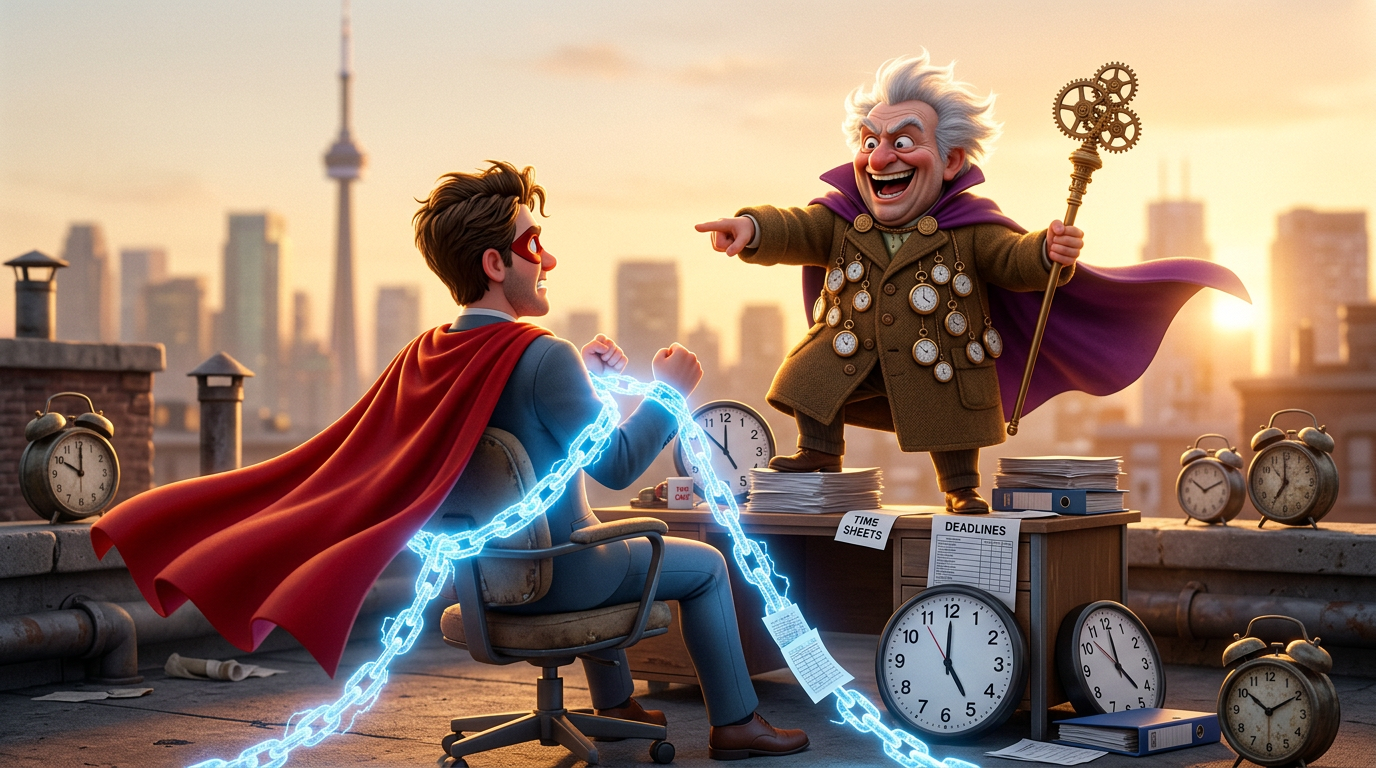
QUICK CUT — Max's imagination: a villain made of clocks and overtime buzzers — DR. OVERTIME — has Rob trapped at his desk, chains of spreadsheets wrapping around him. Max's whispered voice: "Dr. Overtime has captured Dad again! But Rocket Rob always escapes!" The fantasy is bright, fun, completely absurd.
BACK TO REALITY: Rob watches Max go. A beat too long. The car behind him honks.
A kid bumps into him. "Watch it." Max doesn't flinch. Another kid — passing by, older — glances at the dish-towel cape sticking out of Max's bag.
Max doesn't break stride. Doesn't argue. Doesn't even slow down. He just keeps walking with the absolute certainty of someone who knows something the other person doesn't.
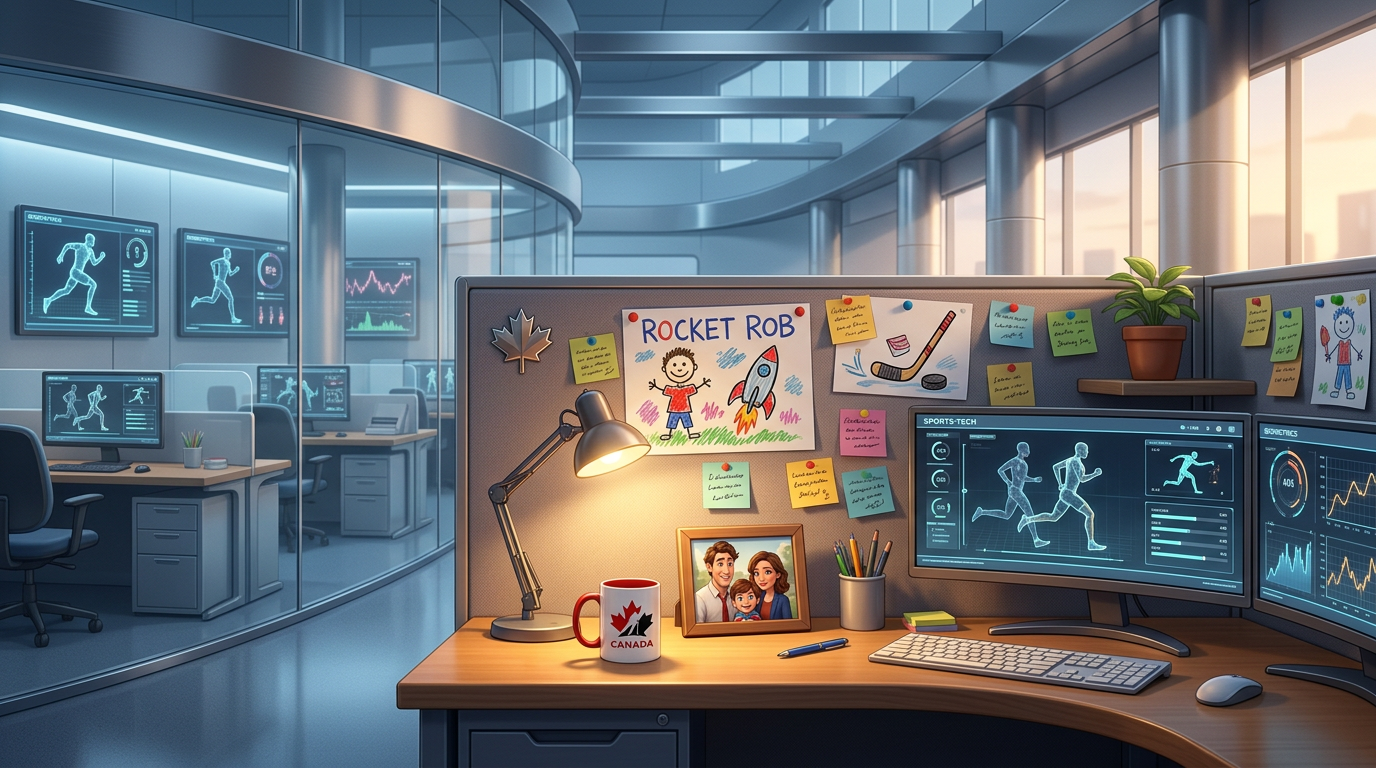
Rob's cubicle is the warmest corner of a cold building. Team Canada mug. Max's drawings pinned everywhere. Family photos tucked into the monitor bezel. An email from Victor Watt's department: "GRID INNOVATION SUMMIT — MANDATORY."
The house is quiet. Claire clears dishes. Hangs Rob's forgotten lunch by the door. TV: "...Titan Sports Tech CEO Victor Watt is expected to unveil his latest innovation..." Claire looks at the TV. Not surprise. Recognition. She turns it off.
Maple jumps onto the counter. Claire: "Off." Maple does not get off. He sits on Max's permission slip. Claire reaches for it. Maple extends one paw onto her hand. Holds it there. Looks her in the eye.
Claire pulls the slip free. Catches the fruit bowl before it falls — not a reflex. Too fast. Too smooth. A Vela seed planted and buried.
Rob pulls up late. Max is the last kid. Coach Hank is leaning against the wall nearby.
Hank watches Max walk to the car. Small kid. Big bag.
He taps the boards twice. Walks inside. Rob stands there. He heard hockey advice. The audience heard the theme.
Max is already in the car. He doesn't ask why Rob was late. As Rob gets in — before he can say anything — Max reaches over and taps Rob's knee with his hand. Twice. Quick. Automatic. Rob taps Max's helmet. Twice. Their thing. Still theirs. Even when everything else is strained, this is the handshake that still works.
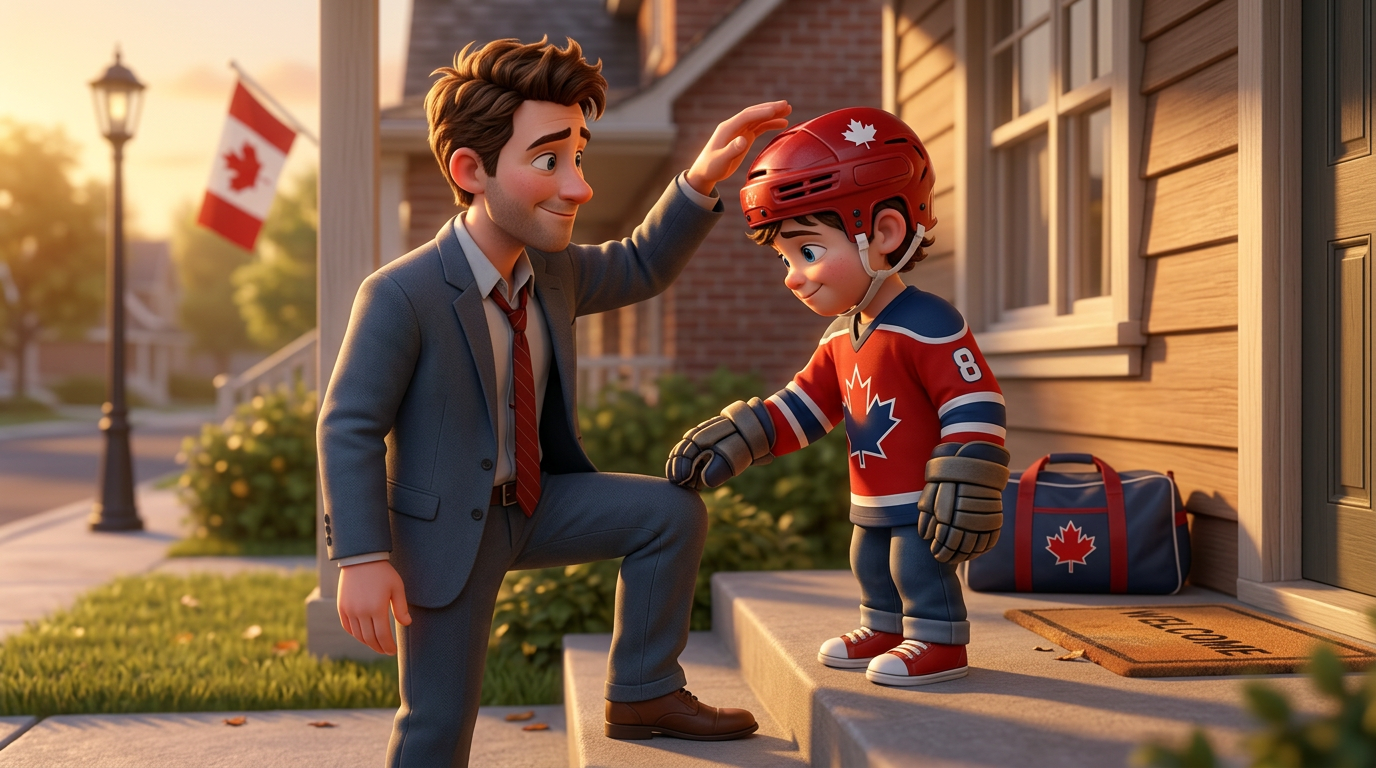
Maple cut: Back at the house, Maple watches the car return from the window. He drops into a low crouch — ears forward, eyes locked, tracking the vehicle like a predator calculating approach speed. His cape (dish rag) snags on the curtain rod. He doesn't notice. He is a professional.
Director's Notes
Coach Hank Beat 1: "Best players are the ones who show up every practice" is the theme of the entire film spoken as hockey advice. Hank's four beats form their own mini-arc: observation, warning, absence, redemption.
Claire Seeds: Three Vela plants — the too-fast fruit bowl catch, her recognition of Watt on TV, and the way she runs the house like a mission. On first viewing, she's a capable mom. On rewatch, she's a woman who was Vela in her own mind long before any of this.
Max's Narration: At full power here — enthusiastic, constant. This is the baseline. When it fades in Act Two, the audience needs to feel the difference.
"Little Hero Moments"
The montage plays approximately 20 minutes into the film, after the opening scenes have established the family and the central conflict. It should feel like turning the pages of a family photo album.
MUSIC BEGINS — gentle piano, single notes.
CLOSE ON: Rob's hands tying a dish towel into a cape around LITTLE MAX (age 3-4). Tiny, wobbly, enormous eyes.
Max takes off running across the couch cushions. He mouths "ROCKET ROB!" — we read his lips.
Rob "flies" behind him, arms out, making whooshing sounds we can't hear over the music.
Claire watches from the doorway, laughing. She holds up her phone to record.
GUITAR JOINS THE PIANO.
TINY MAX on skates for the first time. He can barely stand. His hockey gear is absurdly oversized.
Rob skates backwards in front of him, holding both of Max's hands.
Max falls.
Rob DRAMATICALLY dives onto the ice beside him, sliding on his stomach.
We see Max's face: laughing so hard his eyes are closed.
Rob helps him up. Steadies him. Then — lightly, naturally — taps Max's helmet. Twice.
Max grins. Taps Rob's knee with his tiny hockey stick. Twice.
Their thing. Already.
Rob's face: pure joy.
Rob at his desk. The office is empty. Harsh fluorescent light.
Clock on the wall: 9:45 PM.
Rob rubs his eyes. Looks at a framed photo on his desk — Max in hockey gear, grinning, missing a front tooth.
Rob closes his laptop.
Rob opens the door quietly. Hallway light spills in.
Max is asleep. He's wearing a homemade Rocket Rob mask — red construction paper, crooked eye holes, tape visible.
Rob sits on the edge of the bed. Doesn't wake him.
Just sits there. Smiling.
MUSIC SWELLS SLIGHTLY — a warm chord.
A series of SMALL MOMENTS, each lasting 2-3 seconds:
The MUSIC DEEPENS. More instruments join.
Max (current age, 8) walks up to Rob, who's pouring coffee.
Max hands him a piece of paper.
INSERT — THE DRAWING: Rocket Rob flying through the sky, holding a hockey stick. Cape streaming behind him. Below, the city is safe. Stars surround him. Written in wobbly kid handwriting at the bottom: "Every hero needs a sidekick."
Rob looks at the drawing. Looks at Max.
He laughs. Ruffles Max's hair.
Max runs off to grab his hockey bag.
Rob puts the drawing on the fridge. Next to all the others.
HOLD ON: Claire in the background, watching. Her smile is warm but her eyes are different — she knows someday Max will grow up. Someday the drawings will stop. Someday the cape won't be magic anymore.
But not today.
MUSIC RESOLVES — final gentle chord.
Director's Notes
The Precedent: This montage serves the same function as the opening of Up — it bonds the audience to these characters so deeply that every scene after it carries emotional weight.
The Fridge Detail: The drawings accumulating on the fridge is a visual motif. Each drawing is a timestamp of Max's belief. When this detail returns later (Rob opening the fridge during a low moment, surrounded by his son's faith), it should devastate.
Claire's Final Look: The montage belongs to Rob and Max, but Claire's quiet awareness at the end adds a third emotional layer. She sees what Rob can't: time is passing.
No Dialogue Rule: This montage must remain completely silent (music only). The moment any character speaks, the spell breaks.
The Return of Victor Watt
An enormous banner: TITAN SPORTS TECH — THE FUTURE OF ENERGY. Victor Watt takes the stage. The machine hologram blooms behind him — a tower of interlocking rings, cables feeding into a city grid. Beautiful. Elegant.
Rob's eyes narrow. He recognizes the architecture — the interlocking rings, the energy-load balancing structure. It's Titan's arena grid system. The same framework Rob helped design for managing stadium power loads. But scaled up. Massively. Wrong in a way Rob can now name precisely.
He says it lightly. The crowd laughs. Rob doesn't.
Rob confronts Watt privately.
Watt's face changes — for a half-second, something real flashes underneath the control. Not vulnerability. Recognition. He's heard this question before. Maybe asked it himself, once. Then it's gone. The warmth drops.
As he says it, his hand drifts to his jacket pocket — a small, unconscious gesture. He catches himself. Pulls the hand away. The audience files it without understanding it.
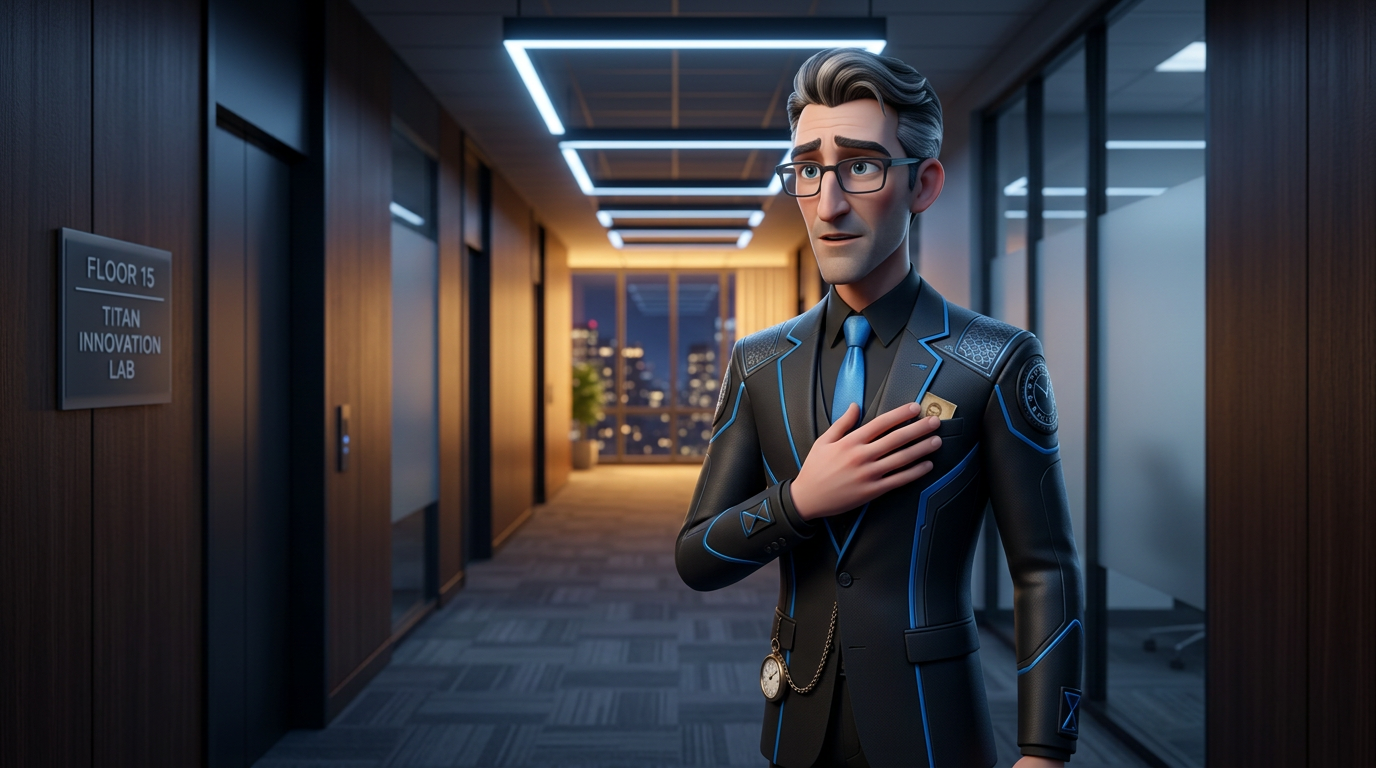
The streetlights FLICKER. All of them. At once. Then surge — blindingly bright. The machine is ACTIVE. A hospital siren starts in the distance.
He starts walking. Not toward the car.
Director's Notes
Rob's Choice: He doesn't choose heroism because he wants glory. He chooses because the grid flickered and a hospital siren started. Because he's a dad who can't not help.
"Family makes you weak": The thesis Rob will spend the rest of the film arguing against — not with words, but with choices.
Claire on the Phone: She's been Vela. She recognizes power grid instability. On rewatch, her silences here are loaded.
The Double Life
Power surge. Transformer sparking. Rob catches it, redirects the surge. His hand catches on the housing — a scratch across his knuckles. He checks his watch. 8:47 PM. "I can still make it."
He can't. Claire picks Max up from practice. "Where's Dad?" "Work ran late. I've got you."
No excitement. No sound effects. Just the facts.
Rob dismantles a Watt relay station. Gets home at 11:23 PM. Missed call from Claire — no voicemail. She doesn't leave them anymore. Max is asleep. Claire's light is off.
Grid failure at the hospital. Rob patches it by hand. From the roof, he can see the hockey rink across town. Max's pre-game skate started 15 minutes ago. Three more relay stations pulsing across the grid. He turns away from the rink.
At the rink, Max looks at the stands. Claire waves. The seat next to her is empty. Max looks at it for one second. Turns back to the ice. He doesn't look again.
The whisper is flat now. Mechanical. Like a recording playing back.
Quick cuts, hero theme stripped to a single piano: Rob catches a surge, comes home, Max is asleep. Rob patches a grid sector, comes home, Claire's light is off. Rob stops a brownout at a school, comes home, Maple is the only one awake.
Rob's phone buzzes: a photo from Claire. Max holding a test — 92%. Rob types "Proud of you bud." Stares at it. Doesn't send it. Puts the phone away.
Claire covers. She drives Max. Handles the house. Signs the forms. Carries the gear bag. She's efficient where she used to be warm. Sharp where she used to be soft.
Maple cut: A pigeon lands on the fence outside. Maple drops into a crouch. Ears flat. Eyes locked. His whole body tenses — a hunter assessing a threat on the perimeter. He swats at the glass. The pigeon doesn't move. Maple stares at it. The pigeon stares back. Neither blinks. Maple's tail lashes once. He shifts his weight forward. The pigeon ruffles a feather. The Stalingrad of backyard conflicts.
A TV plays in the living room — a news broadcast. Watt's face fills the screen, confident and controlled. A REPORTER: "Watt Dynamics CEO Victor Watt announced today that the city-wide grid integration project is ahead of schedule—" Claire walks past. Reaches for the remote. Turns it off. Her face is unreadable. She stands there for one beat, looking at the blank screen. Then she picks up Max's gear bag and keeps moving.
The Shadow Dad seed (~30:00) and The Couch (~32:00) play within this section — see their dedicated scripts.
Rob catches Coach Hank after a regular-season game.
Beat.
He leaves it there. Doesn't push. Rob stands in the empty parking lot. His phone buzzes — another grid fluctuation. He starts the car and drives toward the failure. Not toward home.
The hero theme plays — a single horn now. Thin. Almost questioning.
Director's Notes
Three Saves, One Pattern: Escalation not in danger but in cost. Save 1: misses practice pickup. Save 2: gets home after everyone's asleep. Save 3: misses pre-game skate. The ratchet tightens without anyone saying "things are getting worse."
The Unsent Text: Rob typing "Proud of you bud" and not sending it. He's so far inside the hero identity that he's lost the language of fatherhood.
Coach Hank Beat 2: "Looking at the bench instead of the net" — Max is looking for his dad instead of playing hockey. Hank speaks in hockey metaphors because that's the only language he trusts.
Max's Narration Fading: Starts muted, goes mechanical, then trails off mid-sentence. The warning siren before The Silence.
The Couch
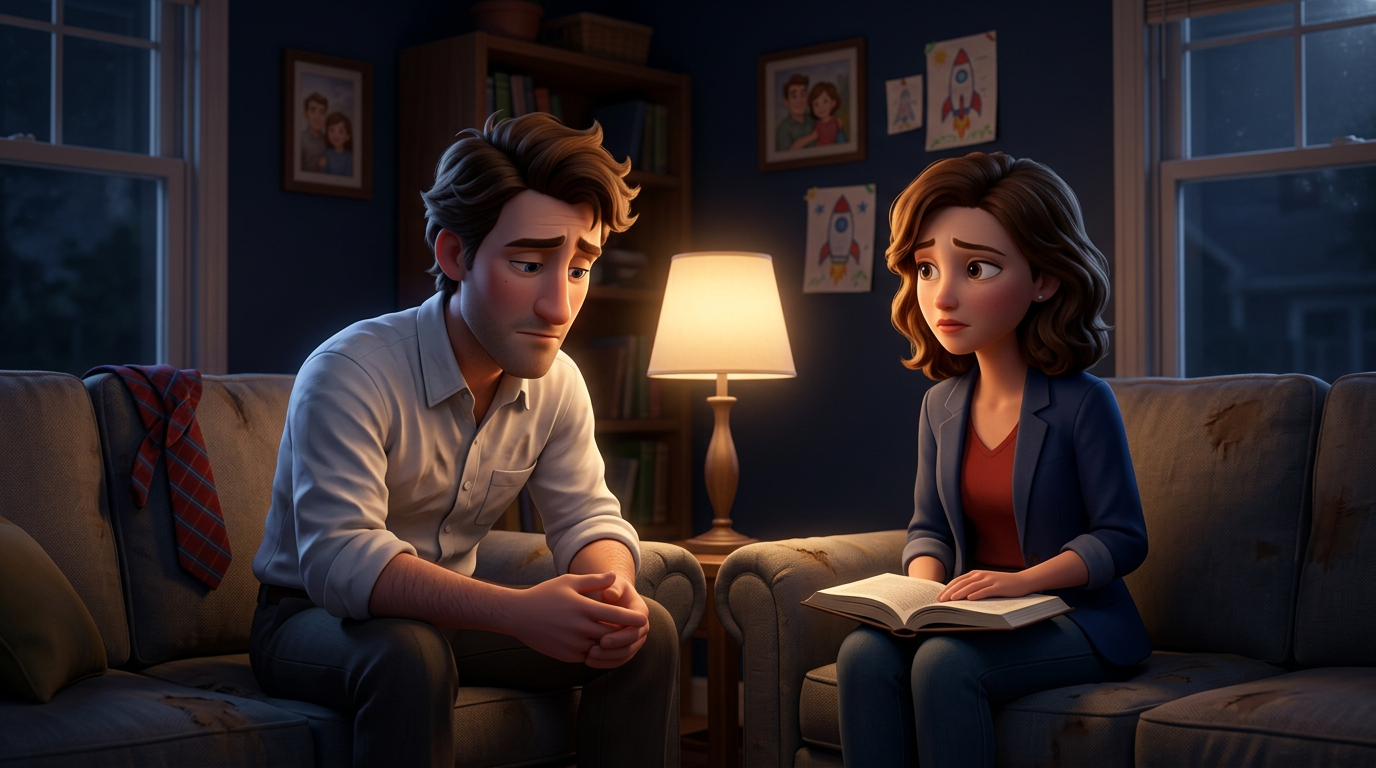
Late night. Max is asleep. Rob comes home. Claire is on the couch with a book she isn't reading. She doesn't ask where he was.
Not angry. Just accurate — the same factual tone Max will use in The Silence. The audience sees where Max learned it. Rob reaches for her hand. She lets him take it. The distance between them is small but specific.
Maple walks across the back of the couch behind them. Sits between their heads. Looks at both of them. Looks at the dark hallway toward Max's room. Then he tucks his paws under himself and closes his eyes. Everyone is home. He can stand down. Nobody notices.
Director's Notes
"You said that Monday": Claire's factual tone is the precursor to Max's silence. The audience sees where the kid learned to process disappointment without drama.
The Small Distance: They're sitting together. But the couch might as well be a mile wide. The hand-hold is Claire letting Rob try.
The Shadow Dad
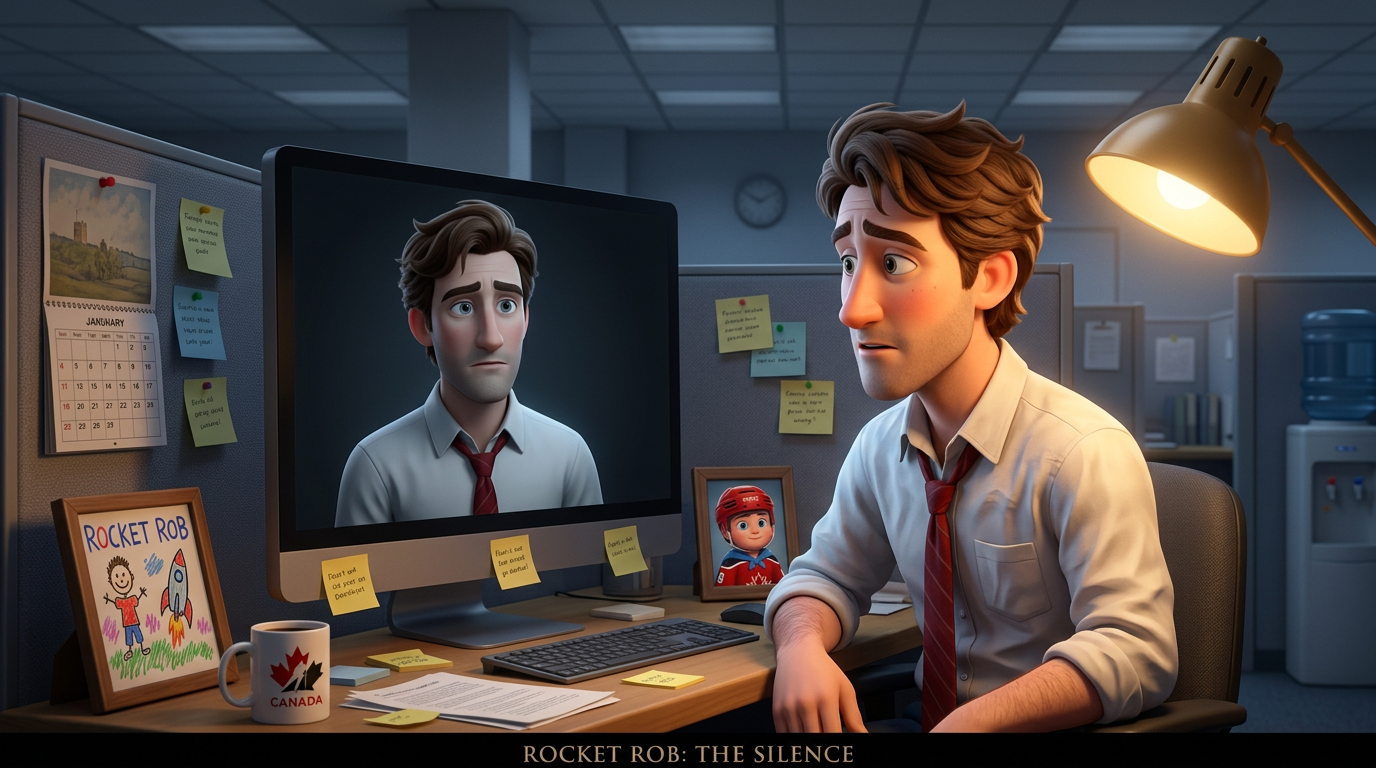
The office is empty. Rob sits at his desk. Desk lamp on. He reaches for the mouse. The monitor is off — dark screen, power-save. In the black glass, his reflection stares back.
The reflection is wrong. Not dramatically wrong. Just off. The hair is neater. The tie is straight. The eyes are the same blue but there's nothing behind them.
Rob blinks. The reflection is just him again. Tired. Rumpled. Real. He shakes it off. Goes back to work. But his hand is slower on the keys.
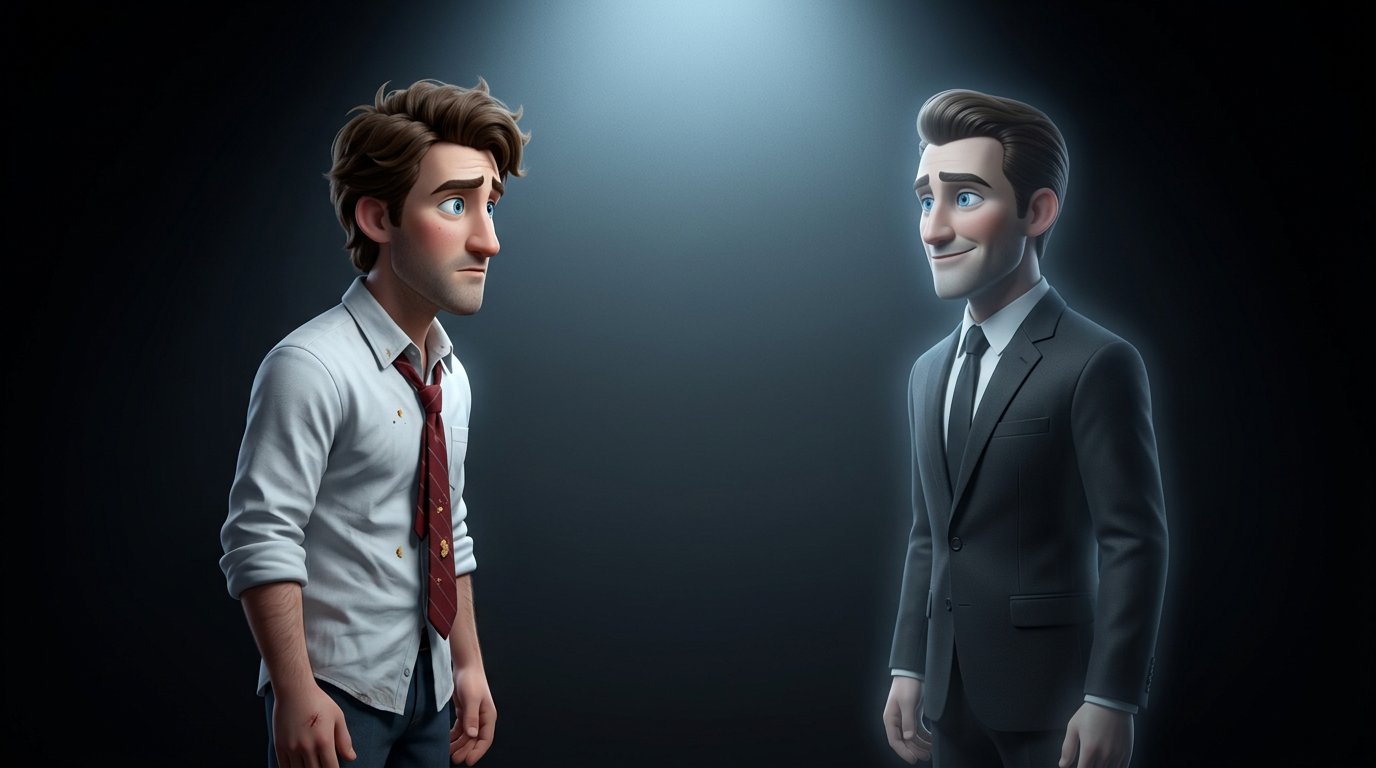
No room. No walls. Just darkness and a single overhead light splitting the space between two figures.
ROB on the left: wrinkled shirt, loose tie, crumbs, scratch on his hand. SHADOW DAD on the right: same face, charcoal suit, geometric tie, sculpted hair, ramrod posture. Warm smile. Completely empty.
The words hang. Rob has heard them before — in his own head, every time he chose work over home.
Rob looks at him. The perfect suit. The perfect emptiness. Then Rob looks down at himself. The scratch on his hand. The crumbs on his tie from Max's granola bar.
The crumbs. The imperfection. The proof.
The light flickers. Shadow Dad is gone. Rob stands alone. The crumbs are still on his tie.
Director's Notes
The Crumbs: The most important prop in the scene. Evidence of a morning Max reached out. Shadow Dad has no crumbs. He has no one to make him messy. That's the whole argument.
Tone: Think Bing Bong's sacrifice in Inside Out. Quiet, internal, devastating. No explosions. Just two men and a question about what kind of person you want to be.
"One Good Saturday"
Sun. The good kind of cold. The hockey net in the driveway — the one from every establishing shot — finally in use.
ROB is in goal. Sweatpants. Toque. An oven mitt on his blocker hand because the real blocker is lost somewhere in the garage. MAX is at the foot of the driveway with a street hockey ball, his teammate DYLAN BARRETT (8, from two doors down) beside him. Rob is home. Actually home. No phone in his hand. Saturday is theirs — he promised.
THE OVERLAY IGNITES — the fullest imagination rendering since the Hydro Rex battle. The driveway stretches into a STADIUM. The recycling bins become goal-light towers. The parked car becomes a JUMBOTRON showing Max's face, crowd roaring. The neighbor's sprinkler erupts as rink-side pyrotechnics. The maple tree drops leaves like falling confetti.
And in goal: ROCKET ROB — cape, mask, the oven mitt rendered as a gleaming gauntlet — guarding THE NET OF DESTINY.
Rob — in the overlay and the reality at once — does an exaggerated goalie stretch. Plays it completely straight. This is a dad who knows his job: the camera never winks, and neither does he.
A montage of attempts, narrated like a broadcast:
CLAIRE watches from the porch with coffee. Real-register, warm. She glances at Maple holding his perimeter.
Maple does not acknowledge her. He is working.
Final attempt. Max at the top of the driveway. The narration drops to a whisper — the way it does for the big moments.
Rob crouches. And this beat is real: he's not going to let Max score. He's actually trying. Dad rules — the day Max beats him, Max beats him for real.
Max dekes left. Rob bites — a real goalie mistake against a real move — Max tucks it right. The ball hits the back of the net.
THE OVERLAY DETONATES: the Jumbotron explodes in light, the pigeons scatter like a flyover, the sprinkler pyro fires, the maple tree dumps its entire confetti reserve. In reality: a ball in a sagging net, a kid with both arms up, and a dad sitting in his driveway, beaten, laughing harder than he has all film.
Rob's laugh catches for half a second — the smallest possible sting, gone immediately. Someone else has been there for the lessons. He buries it. Grabs Max. Helmet-noogie. Dylan piles on. Maple observes the celebration from the fence post, supervising.
The celebration settles. Claire brings out lemonade. Max and Dylan re-stage the goal for her, talking over each other.
Rob, smiling, steps back toward the garage — and checks his phone. One glance. ON THE SCREEN: a grid alert. Southeast sector. Minor. He looks at it. Looks at the driveway — his kid mid-re-enactment, arms wide.
He silences the phone. Puts it away. Stays.
But the audience saw him check. And later — in the car after Hank's parking-lot conversation, when the same buzz comes and he drives toward the grid instead of home — they'll remember that this time he stayed, which means it was always a choice.
HOLD on the driveway. Full sun. The net. The family. The best Saturday in the history of Saturdays. It's the last one before The Silence.
Director's Notes
Why This Scene Exists: The kid audience needs one full-joy sequence here, and the film needs it structurally: The Silence lands hardest if the audience has just been reminded what full-power belief feels like. The hero theme plays its biggest statement here and then disappears until Act Three. The audience should miss the music before they understand why.
"Coach Hank." — One Line, Two Altitudes: Max crediting Hank for the move is a kid being honest. For Rob, it's the gentlest possible version of the knife: presence is where the lessons happen, and someone else has been present. He buries it in half a second. Do not linger. Do not score it.
Rob Stays — The Choice Made Visible: The phone-check is the scene's load-bearing beat. Rob CAN silence the alert. He does it here. Which converts every later choice — the car after Hank's talk, the storm over the arena — from "he couldn't help it" into "he chose." The film never says this. The pattern says it.
The Real Goal: Rob genuinely trying and genuinely losing matters. In the overlay Max scores on a superhero; in reality he scores on his actual dad playing for real. Reality momentarily matching the imagination happens exactly once in the film — here. It's what Act Three's ending will rebuild on honest terms.
"The Skeptic"
Cold sun. Kids everywhere. MAX and DYLAN BARRETT are against the fence with two other boys from the team — and OLLIE (9), a kid built entirely out of facts. Ollie is not a bully. Ollie is worse: Ollie is reasonable.
Max is mid-story, arms wide, fully committed.
The team boys are in. Dylan is nodding — he's heard these before, he's a believer by association.
A couple of the boys laugh — with Max, not at him. The cover story is a great answer. Playground logic: airtight.
Ollie considers this. He's not done. He's just reloading.
And here it comes. Not mean. Just true.
Silence. The kind only a playground can produce — three boys looking anywhere but at Max. Dylan shifts.
It makes it worse. Everyone knows it makes it worse, including Dylan.
ON MAX. He doesn't have a cover story for this one. The audience watches him reach for one — we can see him searching the shelf where the answers live — and find it almost empty.
Beat. Ollie shrugs. The shrug of a kid who isn't trying to win anymore.
The bell RINGS. Recess is over. The boys peel off the fence — the conversation already forgotten by everyone who didn't need it. Except Max. He walks toward the doors last. Slower than the others.
The hallway. In Act One, this was the MISSION CORRIDOR — Max narrated it into a gauntlet of laser grids and sliding blast doors every single morning.
Max walks down it. The overlay flickers ON — a half-rendered laser grid, dimmer than we've ever seen it, the edges unfinished — and Max stops walking.
He looks at it. The way you look at a toy you suddenly see the seams of. The overlay holds for a second. Waiting for him.
He walks through it without narrating. It dissolves around his shoulders like mist.
HOLD on the empty hallway behind him. Just a hallway.
Director's Notes
Ollie Is Not a Bully: No one is humiliated, and the saddest lines are flat factual kid-truths. Ollie's kill shot works because it is delivered without cruelty and is simply, observably true. "My dad's not a superhero, and he comes to all of them" is the entire film's thesis inverted into nine-year-old empiricism: presence is the only evidence that counts. Ollie should never smirk. He should look slightly sorry, the way kids do when they win an argument they didn't realize mattered.
The Evidence Problem: This scene converts The Silence from a mood into a verdict. Max doesn't stop believing because he grew up overnight — he stops because the evidence stopped supporting the belief, and another kid made him see it. When the bedtime story is missed that same night, it isn't the first blow. It's the confirming data point.
The Flicker — The First Frame of The Silence: The half-rendered hallway overlay is the most important visual in the scene. It is not OFF — it ignites the way it always does, dimmer, and waits for Max to power it. He declines. The imagination doesn't get taken from him; he sets it down. The dissolve should be gentle — mist, not shatter. This is the only time in the film the audience sees the overlay die in real time. No score. Hallway tone only.
Two Altitudes: Kids experience this scene as a playground argument they have personally had. Parents experience it as surveillance footage of the exact moment their absence becomes visible to their child's peers. No adult in the film ever learns this scene happened. This is the wound Rob never finds out about.
"The Silence"
Late. The hallway light is on. Max's hockey gear is scattered across the floor. His Rocket Rob drawings cover the wall above his bed. The dish-towel cape hangs on his bedpost.
Max is in bed. Eyes open. Staring at the ceiling.
He's been waiting.
The front door opens. Footsteps. A pause. Then Rob appears in the doorway. Tie loosened. Exhausted. A scratch on his hand he's trying to hide.
Beat. Rob steps in. Sits on the edge of the bed.
Not angry. Not accusing. Just... factual. A kid stating what's true.
Rob doesn't have an answer. He reaches to ruffle Max's hair.
Max rolls over. Pulls the blanket up. Goes still.
Nothing.
Rob sits there. The room is quiet. On the wall above Max's bed, Rocket Rob flies through a dozen crayon cities. The hero Max invented. The hero who always came home.
Rob stands. Walks to the door. Looks back.
No narration. No sleepy whisper of "Rocket Rob completes his secret mission." Just a dad in a doorway and a kid who's done waiting.
Rob pulls the door mostly closed.
HOLD on the sliver of hallway light across Max's bed.
Rob is at the counter making breakfast. Pancakes. He flips one — it goes sideways, lands half off the plate.
Max walks in. Hockey bag over his shoulder. He glances at the mess.
No narration.
In Act One, this moment would have been: Max whispering, "The hero fuels up for his next mission!" and the pancake flip becoming an epic citizen rescue in the imagination overlay.
Now it's just a man making a bad pancake. And a kid getting cereal instead.
Max sits down. Eats. Doesn't look up.
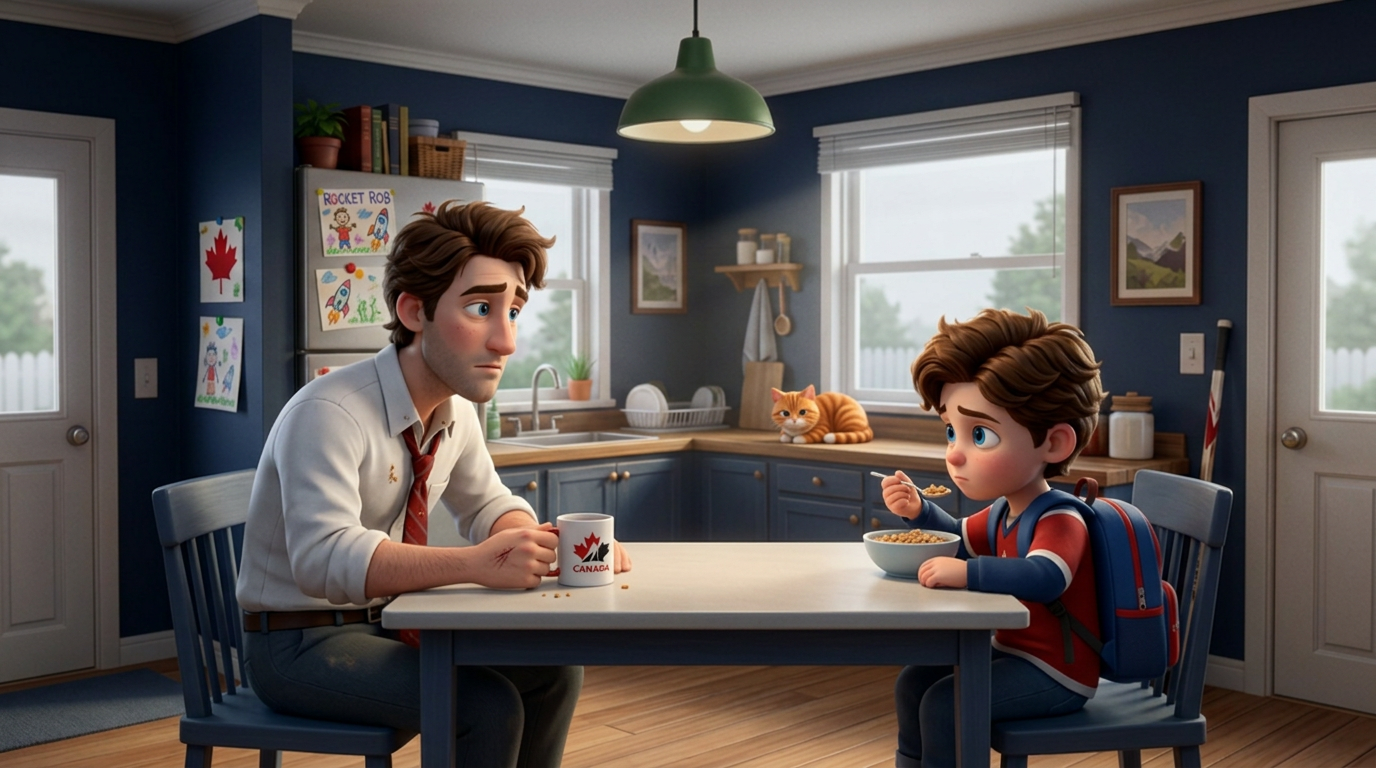
Rob drives Max to school. In Act One, this was a "rocket launch" — Max narrating the car blasting through the atmosphere.
Now it's a car pulling out of a driveway. Traffic. A red light. Radio playing quietly.
Silence. They arrive at school. Max grabs his bag.
He's gone before Rob can respond.
Rob watches him walk in. Small. Backpack too big. No backward glance.
BRIEF CUT: Maple is on the sidewalk. He followed Max partway — not heroically, just padding along behind the way cats sometimes do. Max didn't notice. At the end of the block, Maple stops. Sits. Watches Max disappear around the corner toward school. His ears track the sound of Max's footsteps fading. Then he turns. Walks back toward the house. Unhurried. Still on duty.
Max comes home. Drops his bag.
He opens his desk drawer. Picks up his Rocket Rob action figures — the ones he and Rob used to stage elaborate battles with on the living room floor.
He looks at them for a moment.
Then puts them in the bottom drawer. Under some books.
CLOSE ON: the dish-towel cape, still draped on his chair. Max looks at it.
He folds it. Neatly. Sets it on the chair seat.
Sits at his desk. Opens a school textbook.
Maple jumps onto the chair. Sniffs the folded cape. Then sits on it — the same impassive, immovable confidence he had sitting on Rob's car keys in Act One. Same gag. Different object. The cape. The imagination. The thing that just died.
Max doesn't react. He's doing homework. Maple settles his weight. He's not moving.
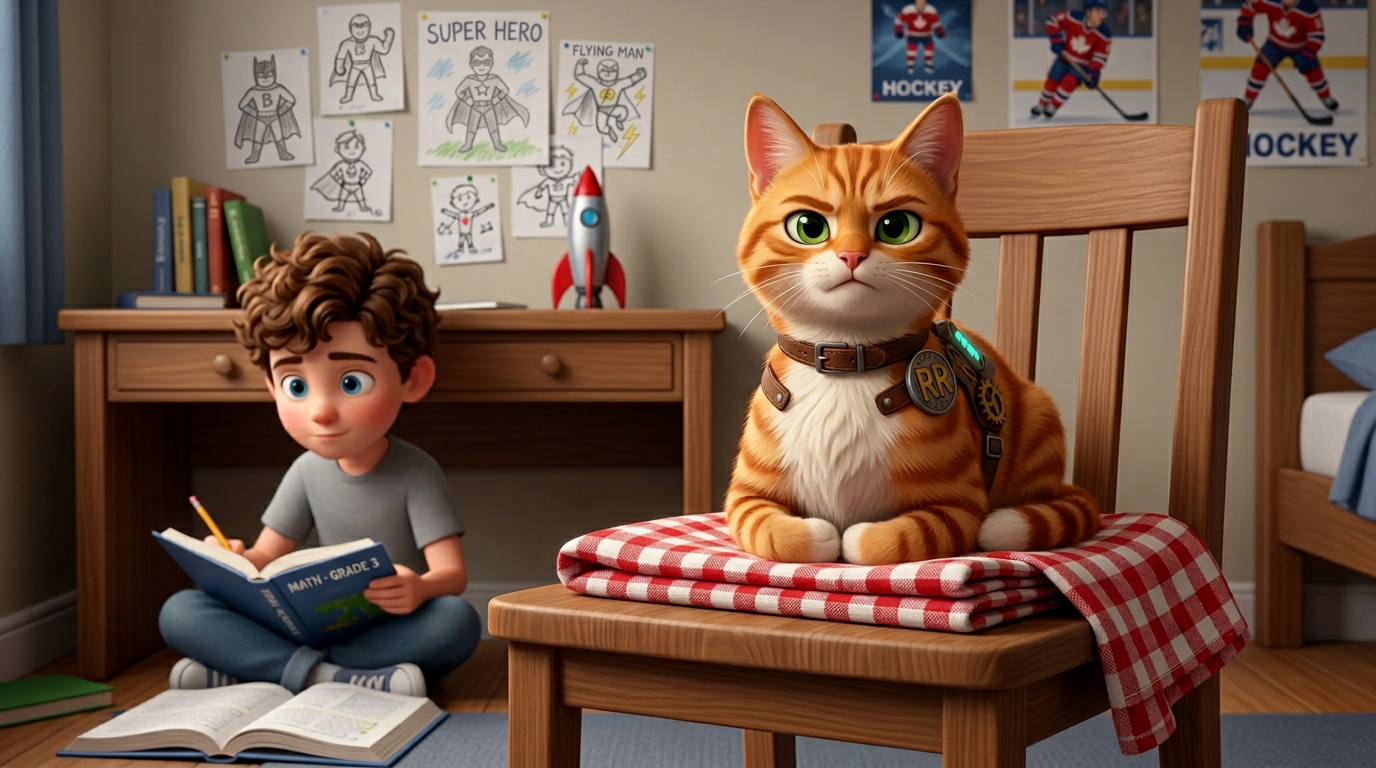
The following scenes mirror earlier moments from Act One — the same shots, the same framing, the same situations. But without the narration. Without the imagination overlay. Something essential has been withdrawn.
The sink is dripping. Again.
Rob opens the cabinet under the sink. Gets on his back. Reaches for the wrench.
In Act One, this was the Hydro Blaster. Max crouched in the doorway whispering combat narration. The water spray was enemy fire. The wrench was a weapon.
Now it's a leaking pipe. Rob turns the wrench. Water sprays in his face. He sighs. Wipes his eyes.
No Max in the doorway. No narration. No imagination overlay.
But Maple is there. Sitting in the doorway. Same spot. Same camera angle as Act One — an orange tabby where an eight-year-old in a hockey helmet used to be. He watches Rob with the same steady gaze, head tilted slightly.
Rob slides out from under the sink. Soaking wet. Looks at the doorway. Sees the cat. Not his kid.
Just a man fixing a sink.
Rob at his desk. Team Canada mug. Max's drawings pinned to the wall.
An alert comes in — another grid anomaly. Watt's machine probing the city's infrastructure.
In Act One, Rob would have straightened up, jaw set, eyes bright. Now Rob stares at the screen. Rubs his eyes.
He hesitates. For the first time in the film, the hero hesitates.
A soft chirp from Rob's bag. The cat sidekick pokes his head out, ears rotating like satellite dishes. He stares at Rob. Then at the screen. Then at Rob again. Insistent.
He closes his laptop. Sits in the silence of his cubicle.
HOLD on Max's drawings pinned to the wall behind him. Rocket Rob in every one. A record of belief that's gone quiet.
CLOSE ON: one drawing near the center. The specific one — "Every hero needs a sidekick." The drawing Max handed Rob at the end of the montage. Rocket Rob flying with a hockey stick. Stars around him. The city safe below. It's pinned right at Rob's eye level. He's been looking at it every day. He's not looking at it now.
Rob walks to his car. The city around him is ordinary. Streetlights. Traffic noise.
In Act One, this walk would have had scale — the buildings towering heroically, Rob's stride carrying purpose.
Now: a man in a gray suit walking to his car in a parking lot. Shoulders slightly lower than before.
No one is watching. No one is narrating.
Another grid failure. Power out on the east side. Watt is probing again.
Rob is on the rooftop in the suit. Cape. Mask. Belt buckle.
But something is different. He stands at the edge and looks down. In Act One, he would have jumped without thinking. Max's belief propelling him forward.
Now he stands at the edge. Looks down. The distance is real.
He jumps — but the landing is harder than it used to be. He stumbles. Catches himself against a wall.
He runs across rooftops. But he's slower. Less sure.
The cat pads silently across the rooftop and sits beside him. Close. Pressed against Rob's leg. Not his usual confident pose — smaller somehow. Watching Rob the way cats watch things they can't fix.
Maple doesn't move. Just presses closer. His eyes track Rob's hands — the fumbling, the hesitation. The cat sees what Rob won't admit.
He pulls at the wrong coupling. Backtracks. Loses more time.
Maple walks across the relay housing — casual, indifferent, the way cats walk across exactly the thing you're working on. His paw catches a coupling and knocks it loose.
It's the right one. The one Rob needed.
The relay powers down. The lights come back on.
Rob stares at the disconnected coupling. Looks at Maple. Maple is already licking his paw on the far side of the rooftop. Completely unaware he helped.
Rob sits on the rooftop edge. Looks toward his neighborhood. Toward the house where Max is sleeping.
His hand drifts to his belt buckle — not opening it, just resting there. A habit he doesn't even know he has. Claire planted something behind it months ago, but Rob has never looked. He doesn't know it's there.
He sits for a long time. The city hums below. No narration. No whispered hero commentary. Just a tired man on a roof, and the faintest sense that something is missing — something he can't name.
Rob stands up. Goes home.
Director's Notes
The Power Source: This is a structural event, not a montage of sadness. The film's power source — Max's belief — has gone offline. Scenes should be shot identically to Act One counterparts but without the imagination overlay. The absence creates the emotion.
Rob's Physical Change: Rob is measurably less effective. His hero work is sloppier. His confidence is eroded. A dad without his kid's belief is just a tired man in a suit. The harness readout quantifies the diminishment for kids who might not feel the subtlety — and the cat's wordless presence beside Rob on the rooftop lands harder than any spoken line could.
The Mirrored Scenes: The audience will recognize the sink scene, the car scene, the office scene from Act One. When they play out without the magic, the audience supplies the memory of what's missing. They narrate the absence themselves.
No Music Cue: The score should thin across these scenes. By the rooftop, almost nothing — just ambient city noise. The music returns for the hockey game.
"The Demonstration"
A wall of monitors. A city rendered entirely as energy — every block a load reading, every home a data point. No people anywhere in the imagery. This is how Watt sees the world: a city with the families abstracted out.
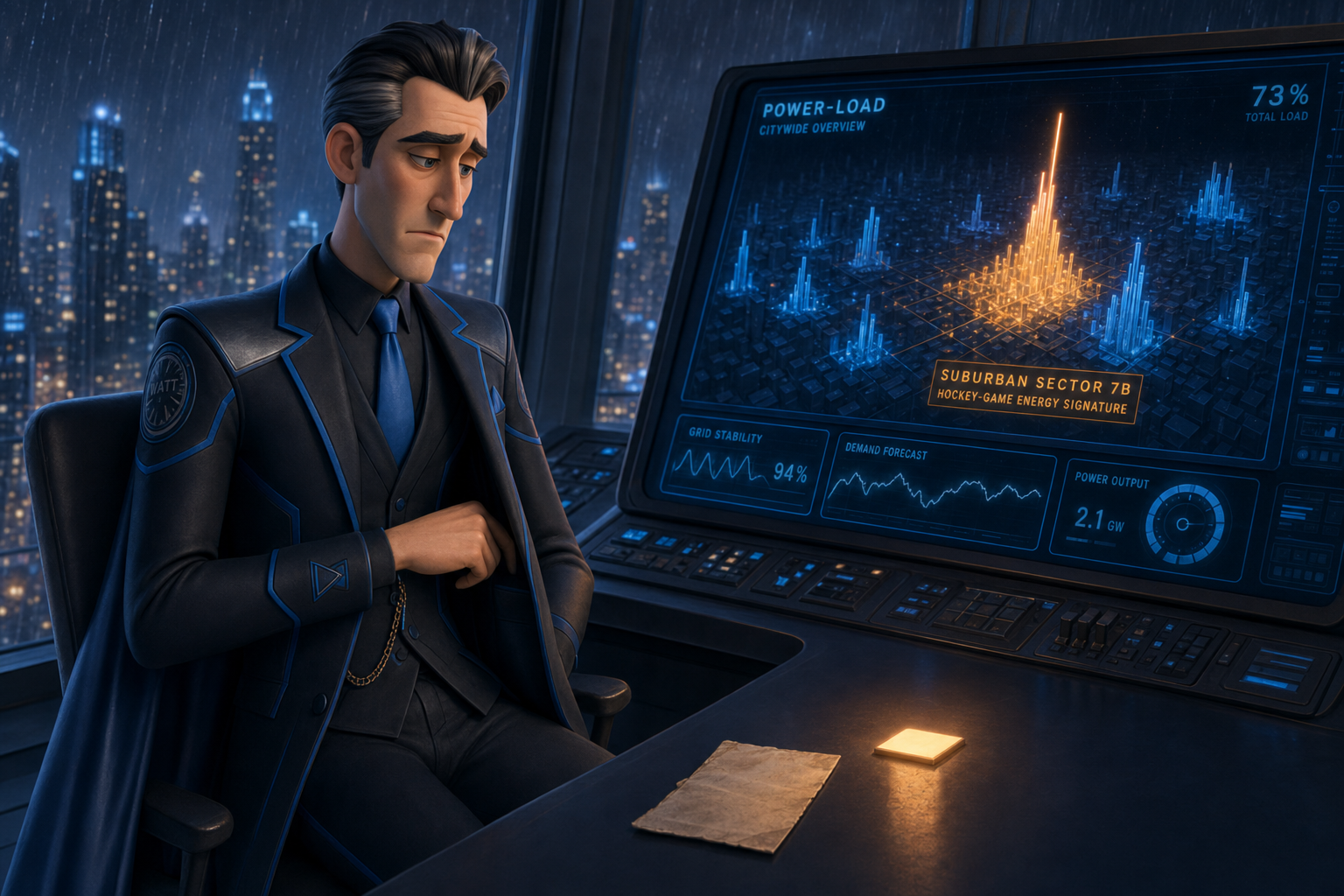
On the main map: relay stations blinking out, one by one. A red line of failures, spreading. VICTOR WATT stands in front of it. Jacket on. Composed. He is not angry. He is doing math.
A TECHNICIAN works a console nearby, nervous in the way people are around Watt — not because he yells. Because he doesn't.
Watt reaches into his jacket. For one beat the audience expects the photograph — but his hand comes out with a BUSINESS CARD. Creased now, like the photo. ROB LAVOIE — VP, GRID ARCHITECTURE, WATT DYNAMICS. The card from the restaurant. The one Rob never took. Watt kept it.
He looks at it.
He sets the card down on the console. Face up. Deliberate.
He studies the map. His eyes move past the downtown core, past the hospital sector — and settle on a quiet residential grid square. Unremarkable. Low draw. Porch lights and refrigerators.
The technician pulls it up. Hesitates.
A sub-window blooms on the monitor: the COMMUNITY ICE CENTRE, two grid squares over. Its power-draw history graphed across the week — flat, flat, flat, then a bright spike every game night. Family life, visible to Watt only as a load pattern. He reads the spike the way other men read a calendar.
His hand drifts toward his jacket pocket — the other pocket, the photograph — and stops. He pulls it back. Smooths his lapel instead.
The technician keys it in. On the map, the quiet residential square begins to pulse a soft, patient amber. Armed.
He stops at the door. The wall of monitors lights his face from behind — a man silhouetted by a city that belongs to him and contains no one.
He's gone. HOLD on the console: the creased business card lying next to the pulsing amber square. Two small rectangles. An offer and a threat. To Watt, the same thing.
Director's Notes
Register: This scene sits inside The Silence, and it obeys the register. No supervillain rendering — Watt is a man in a suit on a control floor. When Max's belief dies, everyone loses their spectacle, including the villain. The plain version of Watt should be scarier than the imaginary one. That's the scene's job.
The Card, Not the Photo: The fake-out — hand into jacket, audience primed for the photograph, card instead — tells us Watt kept Rob's card, rhymes the two creased objects he carries close, and keeps the photo unspent for the rooftop.
Why the Neighborhood: The attack at ~65:00 is not random villain escalation — it is a demonstration, targeted at Rob, timed to a game night Watt read off a power graph. He is not punishing Rob; he is closing a deal. "Nobody gets hurt. That's the point." He believes it. Watt's menace is that his cruelty is indistinguishable, to him, from persuasion.
"Then he says yes.": Watt's stated goal is not destruction — it's recruitment. He still wants Rob beside him, because if Rob joins him, Rob's life stops being a rebuke. Every move he makes is an attempt to prove his own sacrifice was correct.
"The Hockey Game"
The sky is turning orange. Golden hour.
INTERCUT BETWEEN:
The small community arena is PACKED. Parents in the stands. Banners. Noise. Kids in gear warming up on the ice.
Max sits on the bench. Full gear. Helmet on. Stick across his knees.
He looks at the stands. Scans the crowd.
Claire is there. She waves. Smiles.
Max waves back.
Two rows up and to the left — visible if you're looking, invisible if you're not — MAPLE sits on a bleacher. Alone. Perfectly upright. Watching the ice with the focused attention of a scout evaluating talent. How he got here is a question nobody will answer and nobody needs to.
Claire spots him. Double-take. She looks at the cat. The cat looks at the ice. She decides not to question it.
But Max's eyes keep moving. Searching.
The seat next to Claire is empty.
Max takes the ice. He plays hard. Fast. Focused. But between shifts, on the bench, he looks at that empty seat.
A GOAL is scored by the other team. The arena lights FLICKER — just once, barely noticeable. A hum in the overhead rigging. The Titan Sports Tech logo is on the arena's power panel by the entrance. Nobody reacts. It's nothing.
But it's not nothing. Somewhere across the city, Watt's machine is probing the grid. The arena runs on Titan tech. The attack is reaching into Max's world.
Storm clouds gather over the city. Unnatural. Electric blue at the edges.
ROCKET ROB flies between buildings. Cape ripped. Mask cracked at the edge. He's been fighting.
Rob looks toward the arena. Across the city. Miles away.
He looks at the storm.
He closes his eyes. Opens them.
He turns back toward the storm.
Max's team is down by one.
Around him: OTHER DADS stand and cheer for their kids. High fives. Shouts of encouragement.
Max watches them.
CLOSE ON: Max's face. Not sad exactly. Something quieter. Understanding.
He looks at the empty seat one more time.
Then, softly, almost to himself:
HOLD on Max. Tiny. In his oversized gear. On the bench. Alone with that thought.
Rob makes a final desperate move. He SHUTS IT DOWN. Absorbs the power surge. The city goes dark for a moment.
Then: lights return. One block at a time. Like a wave.
Rob falls to his knees on a rooftop. Exhausted.
He looks toward the arena.
Gets up. Starts running.
The game is close. Max is on the ice. He's playing harder now — not angry, not desperate. Determined. Like someone taught him you don't quit just because the stands are empty.
Claire watches. Her hand rests on the empty seat beside her.
The seat stays empty.
The game ends. The buzzer sounds. Kids pile onto the ice. Parents stand and cheer. The arena fills with noise.
Claire sits for one more moment. Her hand still on the seat.
Then she stands. Claps. Smiles for Max.
Max comes through the locker room door. Still in gear. Helmet off. Hair sweaty and wild.
Claire is there. Standing. Waiting.
Max crosses to her. She hugs him. Tight.
He looks past her. At the lobby doors. At the parking lot beyond.
Nobody else is coming.
Claire sees him look. She puts her hand on his shoulder.
Max nods. Picks up his gear bag. It's too big for him.
They walk out together. The arena lights buzz behind them.
HOLD on the empty lobby. The sound of the Zamboni starting up. The empty seat, visible through the lobby window, glows faintly in the overhead light.
Director's Notes
The Empty Seat: Every time Max looks at it, the audience feels the weight. Claire's hand resting on it is the detail that breaks hearts. The seat never fills. That's the devastation.
"My dad saves bigger things": The line that destroys parents. Max isn't angry. He's proud — and that's worse. A kid who understands too much is more devastating than a kid who's upset.
Rob Does NOT Arrive: Critical. Rob does not make it to this game. Not for the last period. Not for the last minute. The audience needs to feel the full weight of absence so that when Rob finally arrives at the arena AFTER the final battle (~82 min), it lands as true redemption.
The Two-Tap Is Withheld: The stick-tap / knee-tap ritual does NOT happen here. Rob isn't in the stands. There's no one to tap back. The ritual returns at 82:00 — at the arena, after the battle — and that's what makes it devastating.
No Score Shown: The game's result is never stated. It doesn't matter. Leaving it ambiguous keeps the focus on presence, not outcome.
The Confrontation
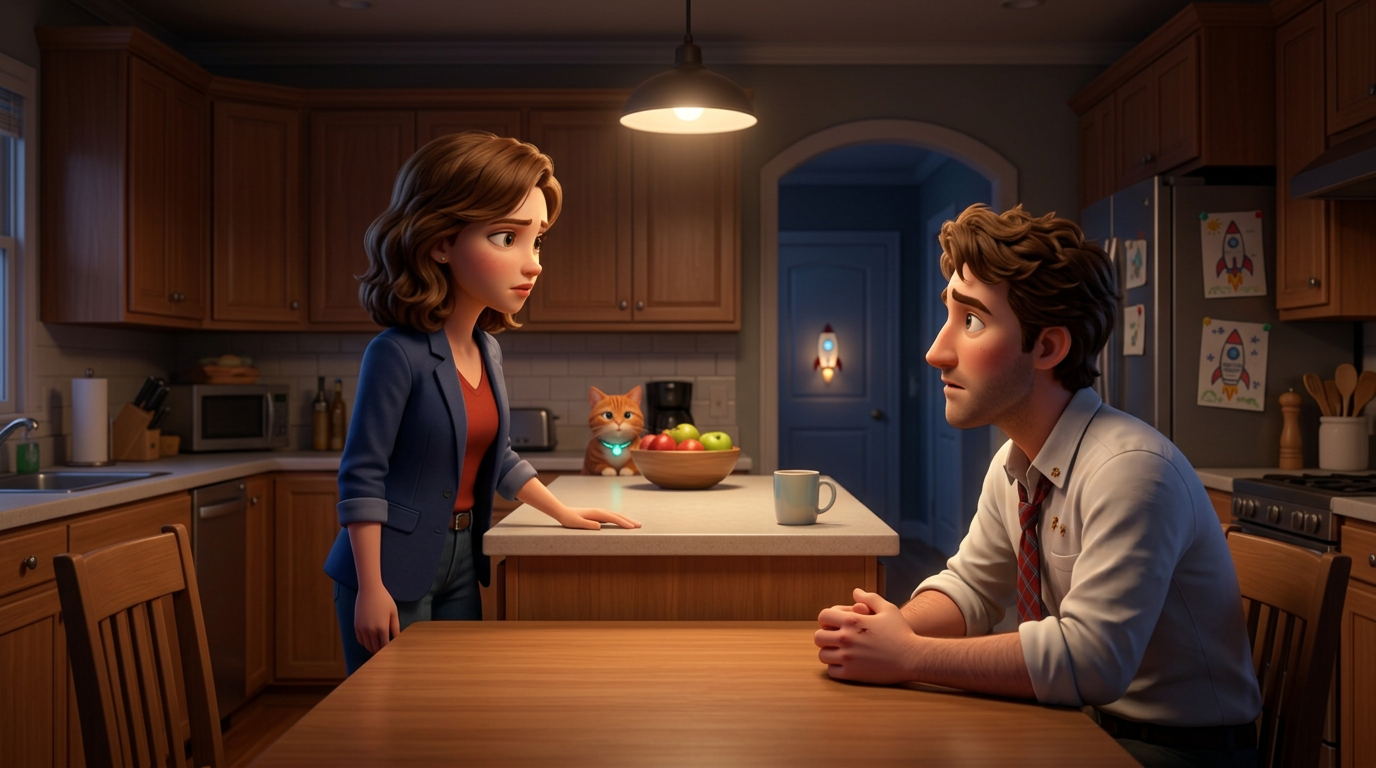
Before the confrontation — the morning after Shadow Dad.
Rob is at the kitchen table. Coffee. Untouched. He's staring at nothing. The scratch on his hand. The crumbs still on his tie from yesterday. He hasn't changed.
Max walks in. Backpack on. Gets cereal from the cabinet. Pours it. Sits down.
No narration. No "Rocket Rob fuels up for his next mission." No sound effects. No whispered commentary.
Just a kid eating cereal. And a dad sitting across from him with nothing to say.
The silence between them is specific — not hostile, not cold. Just empty. Two people who used to fill every room with stories, sitting in a kitchen with none.
Max finishes. Puts his bowl in the sink. Grabs his bag.
He's gone. The front door closes. Rob sits alone. Maple is on the counter, watching him with steady eyes. Not his usual confident pose — curled slightly smaller. Waiting for something to happen. The house ticks. The fridge hums.
Rob comes through the back door. Wrinkled shirt, scratch on his hand, granola bar crumbs on his tie. The kitchen is too clean — the way a room looks when someone has been cleaning to keep from thinking. Claire is at the counter with a cold mug she's been holding for a while.
She sets the mug down. Turns to face him fully. This is different from The Couch. On the couch, she was tired. Here, she's decided.
The line lands. Rob doesn't understand. For a half-second, she almost tells him everything. The breath she takes, the way her jaw sets — the muscle memory of a decision she made years ago.
Another line Rob doesn't understand. He thinks she means the house, the schedule. She means something else entirely.
She says it simply. For Claire — who has listened to Max's whispered hero commentary since he was four — this is the worst sentence in the world.
She walks past him. Her hand brushes his shoulder — not warmth, exhaustion. Rob sits alone. The scratch. The crumbs. The wedding ring.
Maple appears on the counter. He's been there the whole time — behind the fruit bowl, completely still. Watching. He's not in his usual confident pose. He's low — belly to the counter, paws tucked under, ears slightly back. The posture of a cat who senses something wrong in the house but can't name it. Uncertain. Waiting.
Director's Notes
"I've done it" / "Neither did I": Claire is speaking from her experience as Vela. She has literally tried to save the world while protecting her family. Every line has a surface reading (domestic) and a Vela reading (heroic). On first viewing, the audience hears the surface. On rewatch, the scene changes meaning without changing a word.
"Max stopped narrating": Claire doesn't have the audience's meta-language. But she's noticed her son stopped whispering about heroes. For her, this is the measurable symptom of something she can feel but not name.
Escalation from The Couch: The Couch was quiet distance. This is quiet ultimatum. Claire has stopped waiting for Rob to figure it out.
I Was Vela
It's game day. Max's last game of the season starts at seven. His gear bag is packed by the front door. His stick leans against the wall. The house has the specific energy of a family getting ready to go somewhere.
Rob is home early. For the first time in weeks. Claire's words from last night — "Either come home, or tell me what's keeping you away" — did something. He's here. Trying.
Then the lights go out. Not just the lights — the power. Every light. The hum of the fridge is gone. The clock on the microwave is dead. Through the windows, the sky flashes electric blue. Not lightning. Watt's machine, probing the grid.
A MASSIVE pulse ripples through the street. Claire is already moving. She catches Max. Positions herself between him and the window in a single fluid motion. She crosses to the electrical panel, reroutes three circuits in rapid succession — isolating the surge, protecting the house. The whine dies. The house is still dark, but the crackling in the walls stops.
Rob stares at her. The way she's standing. Weight balanced. Eyes tracking three threat vectors in a glance. This isn't a worried mother's posture. This is training.
The longest beat in the film.
Max goes. Claire moves him out the side door — the Barretts' house is two doors down. Max's teammate, the kid he plays street hockey with. The Barrett family is already loading their car — gear bags, sticks, the familiar chaos of a hockey family heading to the rink.
Rob's face: confusion, then recognition, then a cascade of memories replaying behind his eyes. Her calm. Her competence. The too-fast catches. She wasn't learning. She was remembering.
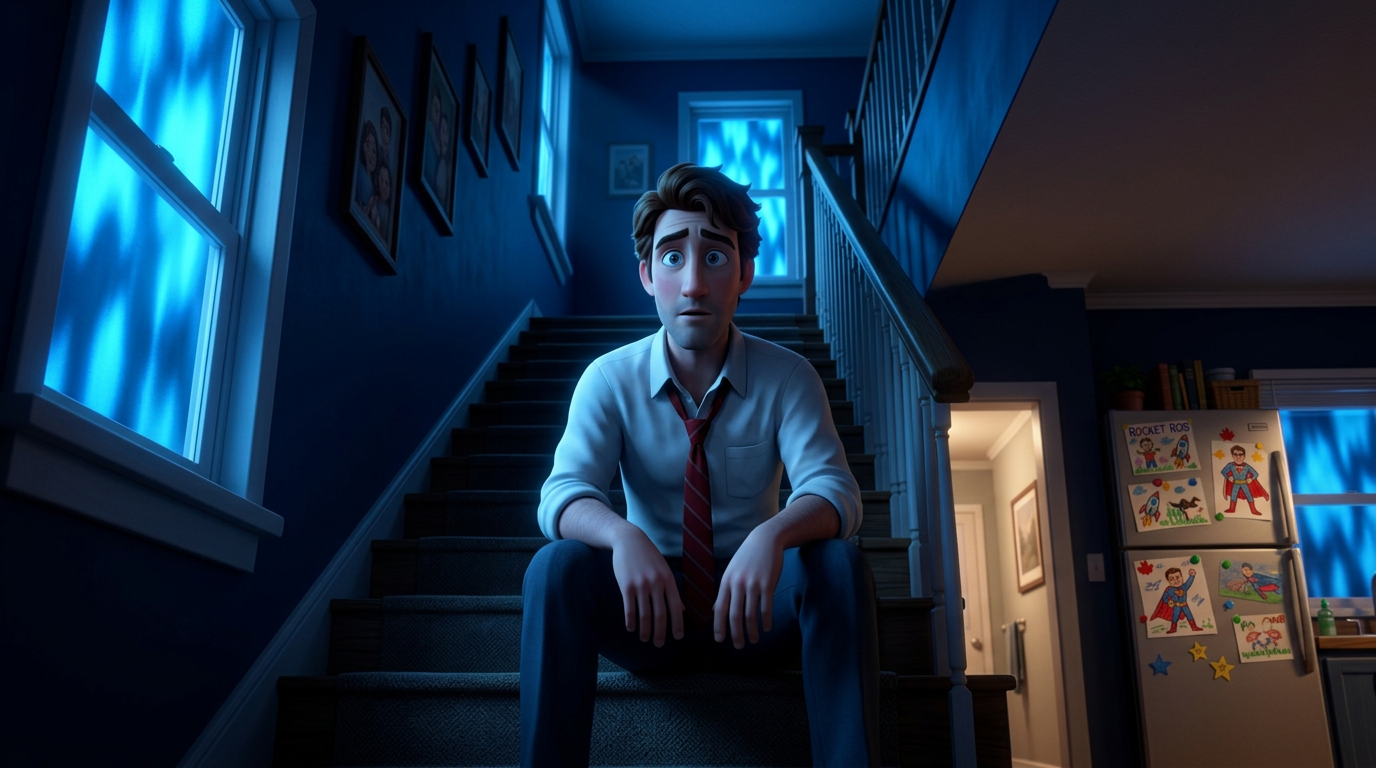
Rob sits on the stairs. Alone in the dark house. The fridge drawings glow faintly through the kitchen doorway. The blue light from outside pulses against the walls.
He's rewriting his own memory.
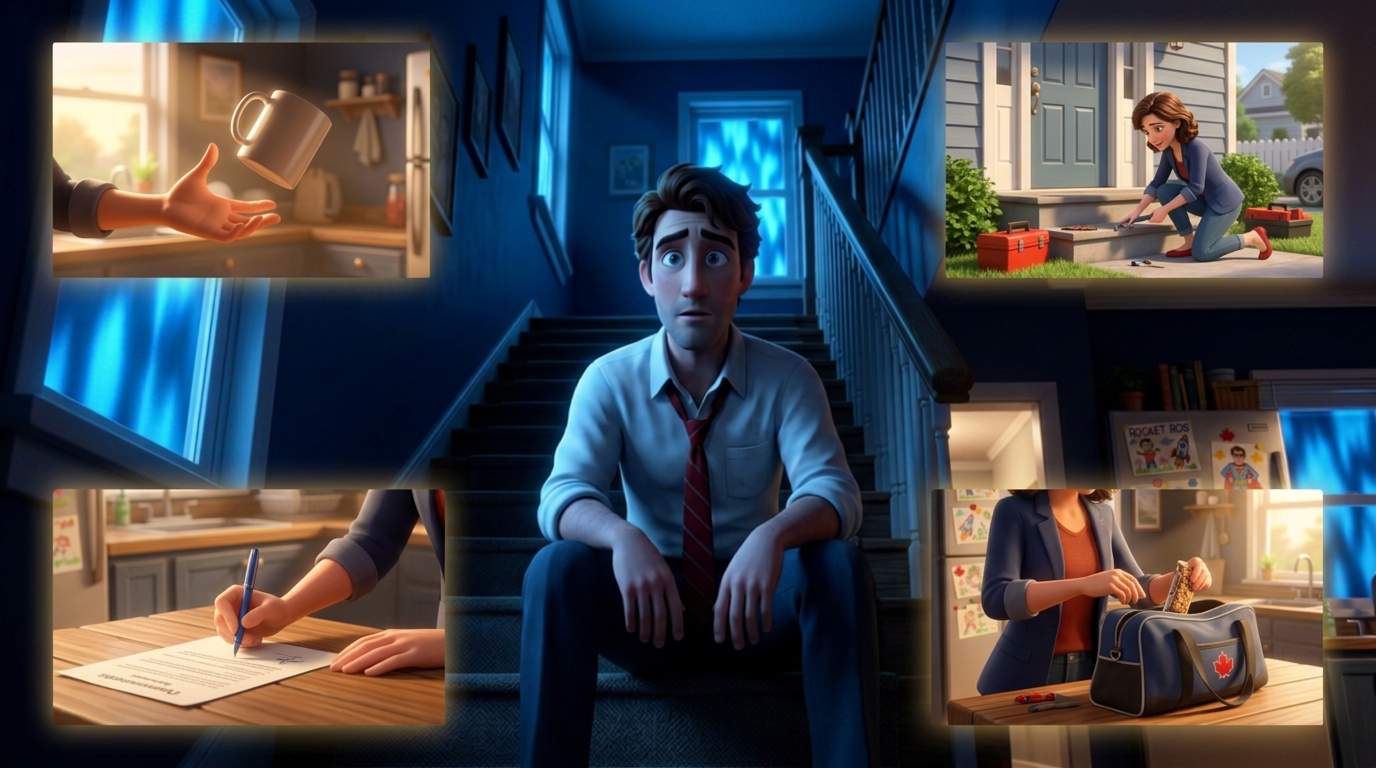
QUICK FLASHES — not fantasy, not imagination. Just moments from the film, replaying behind Rob's eyes:
Claire catching the mug. Too fast. Claire signing the permission slip without looking. Already done. Claire at the electrical panel tonight — her hands moving across breakers she shouldn't know. The way she ran the house like an operation. Precise. Anticipating. Never surprised. "I'll handle bedtime." Every night. For years. Her face when he described something strange at work — not curious. Recognizing.
He wasn't looking. She was right there. The whole time.
Rob's face: not anger. Not betrayal. Awe. And grief for the years he didn't see.
He stands. Goes to the garage. For his suit.
Director's Notes
The Recontextualization: This is where the audience rewatches the entire film in their head. Every Claire beat — the speed, the catching, the buckle plant, "I'll handle bedtime" — all snaps into focus.
"Something harder": Claire's B-arc thesis. Being Vela was hard. Choosing to put the suit away for the family — that was harder. And she did it without acknowledgment.
"Don't do it alone": Her whole arc has been carrying everything alone. This line is her asking Rob not to make the same mistake.
Before the Storm
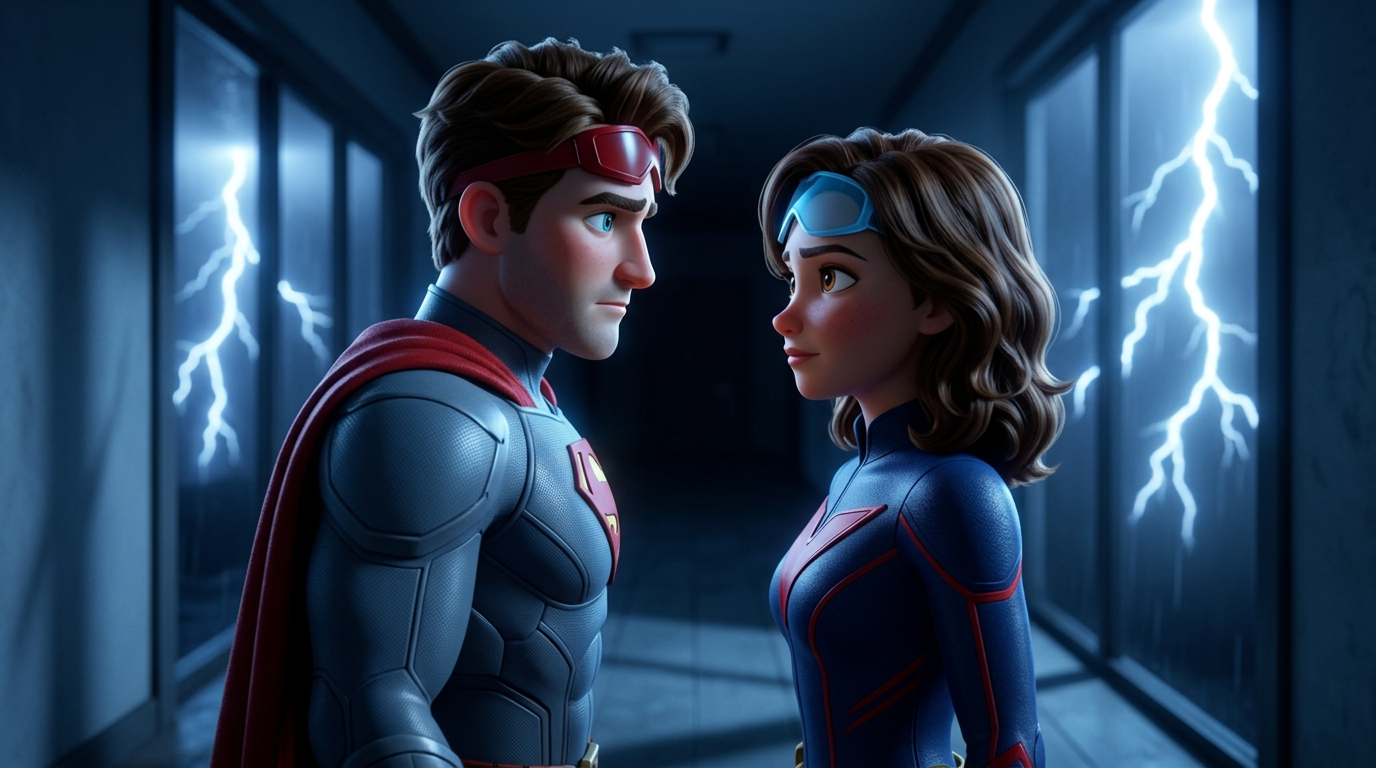
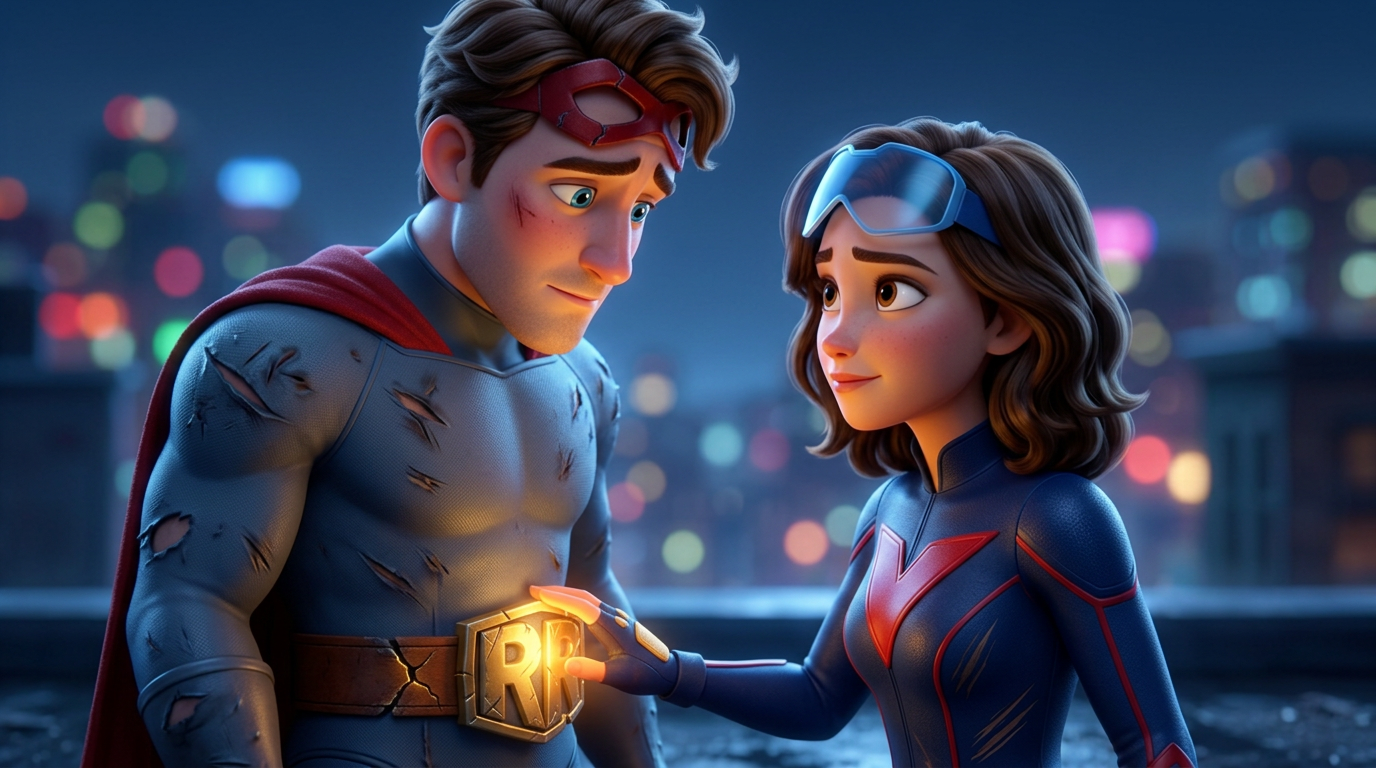
The house is dark. Power is out — Watt's attack on the neighborhood killed the grid. Emergency sirens in the distance. The sky through the windows pulses with unnatural blue light.
Max is safe — Claire got him to the Barretts' house, his teammate's family two doors down, already heading to the arena for the seven o'clock game. Max will be on the ice. He won't be alone.
Rob and Claire stand in the hallway in their suits. Masks pushed up. Real faces showing.
Claire reaches out. Touches his belt buckle. Her fingers press the back edge, feeling for the folded paper. It's still there. She put it there months ago. She's checking.
They go separate directions — she to the ground, he to the sky.
On the kitchen counter, visible through the hallway: Maple sits. He watched the whole thing. He jumps off the counter. Lands silently. Walks to the front door with purpose — not his usual unhurried saunter. Head up. Ears forward. Moving the way he moved in the backyard when something mattered. He follows Claire out the front door. The dish-rag cape catches on the doorframe. He doesn't break stride. He is a professional.
Director's Notes
45 Seconds of Honesty: The only scene where Rob and Claire are fully honest with each other. Every other scene has at least one layer of omission. That's why it's short — the honesty is so rare it should feel startling.
The Buckle Touch: She put the drawing there during the montage. Now she's checking it survived. On rewatch, it's a callback to a shot the audience didn't register, and it's devastating.
"About time": Carries years of weight. She's been waiting for him to be ready. It's not resentment. It's relief.
"What Makes a Hero"
The worst storm the city has ever seen. Not natural — the clouds pulse with electric blue energy. VICTOR WATT's machine, now at full power, sits atop the Titan Sports Tech tower, cables running into the city grid like veins.
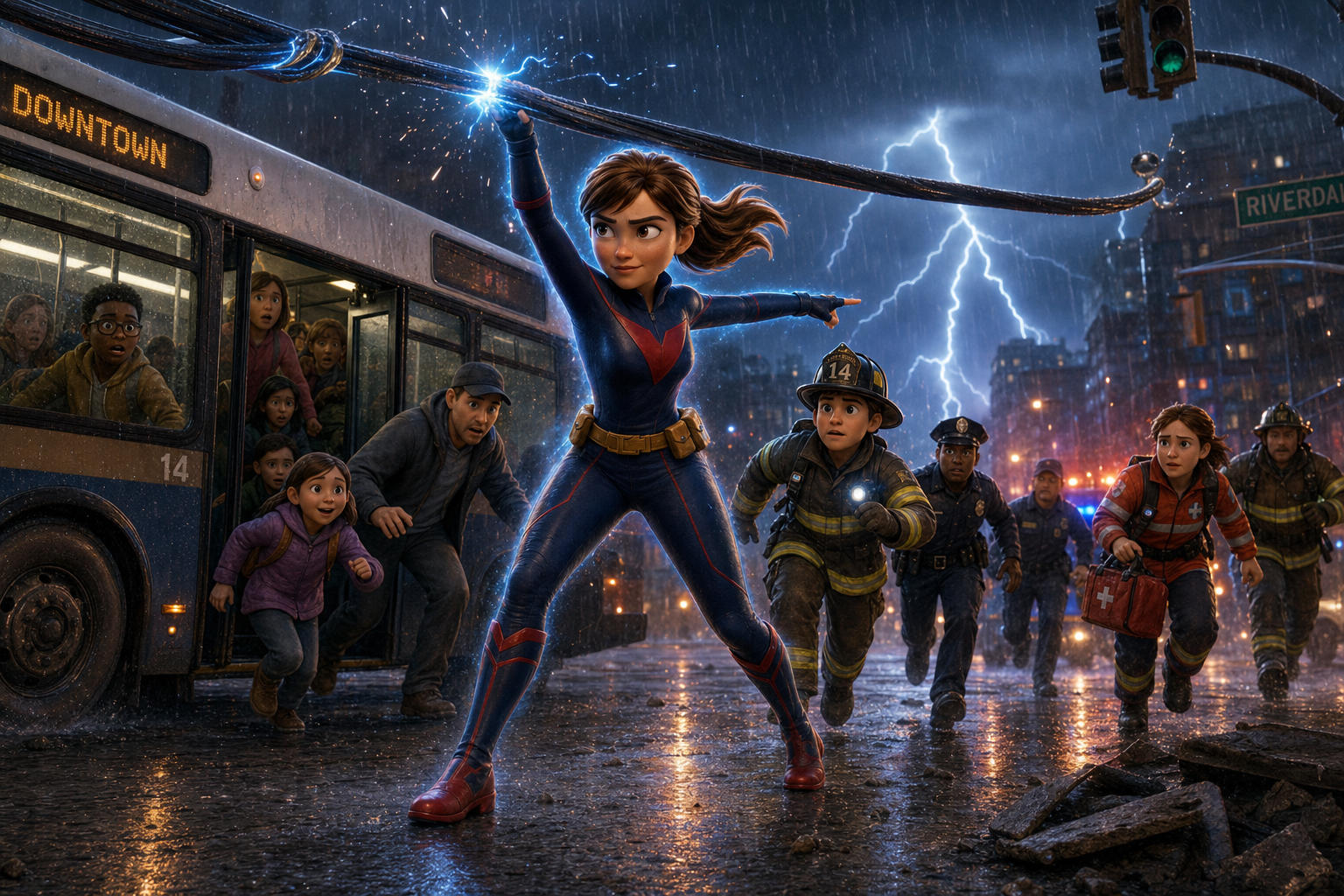
VELA moves through the streets below. Sleek suit. No cape. She's fast. Faster than fast. She's done this before.
She directs civilians to shelter. Reroutes a downed power line with a move that looks practiced. Shouts coordinates to emergency crews like someone who's run an evacuation before.
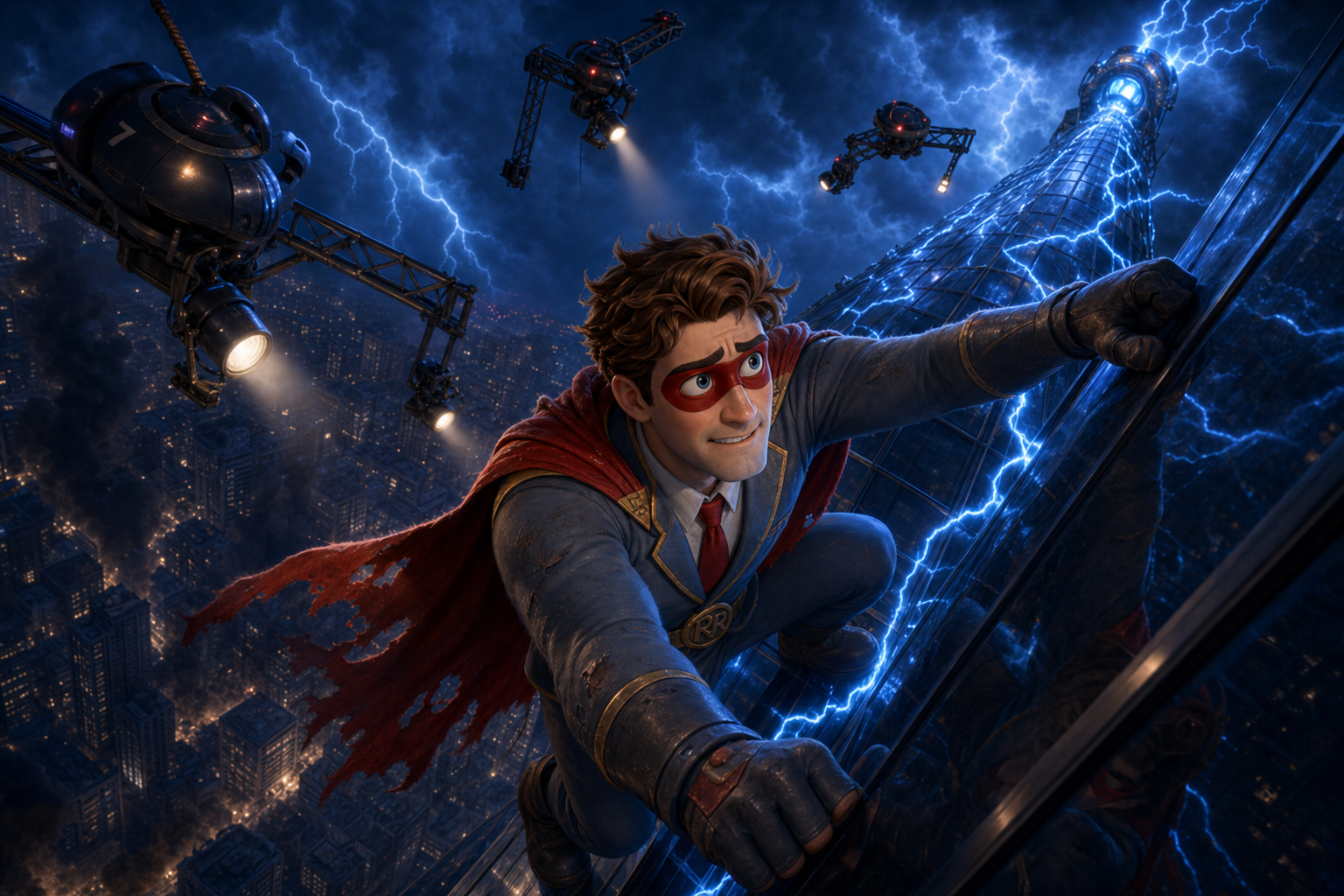
ROCKET ROB hauls himself over the parapet. Spent. Cape ripped. Mask cracked. The RR belt buckle is scratched but intact. He didn't fly up here — he climbed.
Watt steps closer. His voice drops. Personal now.
Watt FIRES. A massive bolt of electricity.
They fight. It's not elegant — Rob is outmatched in raw power. Watt is stronger, more advanced, more rested. Rob takes hits. Gets back up. Takes more.
Watt pins Rob against a railing.
Rob slides across the rooftop. Stops near the machine.
He looks at the cables. The power readings. The interlocking rings — Titan's arena architecture, the same framework he spent years designing, scaled to something monstrous. He knows this machine. He helped build the system it's based on.
He could destroy it — one big hit, one dramatic hero moment. But the surge would black out the city for hours. Hospitals. Traffic. People.
So Rob does the thing Max taught him without either of them ever calling it a lesson: he looks at the impossible and talks it down to a size he can handle. Not in Max's voice. In his own. Quiet. An engineer's.
His hands are already moving while he says it — finding the load, the conduit, the path. The way he'd shut down an overloaded arena grid. Carefully. Methodically. Absorb the overload himself, stabilize the grid the way he was trained to. No big explosion. No hero pose. A man who finally has a voice of his own, using it to do the thing he actually knows how to do.
CLOSE ON: Rob's belt buckle. Scratched. Dented. Something visible — tucked behind the buckle, a tiny folded piece of paper.
Rob pulls it out.
INSERT — MAX'S DRAWING: Rocket Rob flying through the sky with a hockey stick. "My Dad Saves The World."
Rob stares at it.
And he understands. Max never believed in Rocket Rob because he saved the city. Max believed in him because he showed up.
Rob grabs the machine's core. Energy SURGES into him. It's agonizing. His suit crackles. His cape shreds.
The machine dies. The city grid STABILIZES. Block by block, lights return. Steady. Safe.
Rob falls to his knees. Smoking. Barely conscious.
Watt stands in the sudden silence. His machine — his power, his purpose — is gone.
Rob looks up at him. Exhausted. Barely able to speak. He looks at the drawing still in his hand. Doesn't need to say it. But he does — barely a whisper:
Watt stares at him. For the first time, the mask slips. Not anger. Not contempt. Loneliness.
He turns. Walks to the edge of the roof. Reaches into his coat — the same pocket his hand has drifted to every time he talked about family. Pulls out something small — a photograph, creased and soft from years of carrying. The last real thing about him. We never see what's in it.
He looks at it for a long moment. His thumb finds the worn crease — the exact spot it always finds, the one he touches when he thinks no one's watching. Then he looks up, at the drawing in Rob's hand. Two pieces of paper. Two different choices.
He doesn't say anything. He doesn't need to. His face finishes it — not pain, not anger, just a man looking straight at the thing he traded away and understanding, too late, what it was worth.
Then Victor dissolves. Particles of golden-white light drifting upward like embers. His cape fragmenting into ribbons. The photograph goes last, breaking apart into light in his dissolving hand — and we still never see it. The storm clears behind him. Stars come through.
Below, the grid steadies — block by block, the city lights come back on. The fight is over. What he does next isn't a victory lap.
Director's Notes
The Fight Is the "No": For kids, the climax is an action sequence — Rob fighting his way to the top of a tower to stop a machine. For adults, it's Rob's final answer to Watt's offer: the deal that would have traded his time and his presence for "more." Beating the machine and making the game are the same act. That's why there's no victory lap — the very next beat (in "You Showed Up") is two parents running to make a kids' hockey game.
Claire in the Battle: Claire is Vela throughout Act Three — ground while Rob takes the sky. Her arc resolves moments later not in a speech but in a question — the first thing she says once the city is safe is "What time is it?" Two people, bruised over a city they just saved, and both their minds go straight to a kids' hockey game. The win was never the point. Getting to Max is.
The Dissolution: Victor Watt doesn't get arrested or destroyed. He dissolves — particles of golden-white light, his cape fragmenting into ribbons. The photo he carries is the last real thing about him. He became irrelevant when Rob chose differently. The audience feels melancholy, not satisfaction.
The Drawing: Established earlier (montage) so the audience recognizes it. The power comes from recognition, not surprise.
The Quiet Choice: Rob doesn't win with a punch. He wins by absorbing the damage to protect the city. No explosion. No hero moment. Just the right choice. That's the thesis in action.
You Showed Up
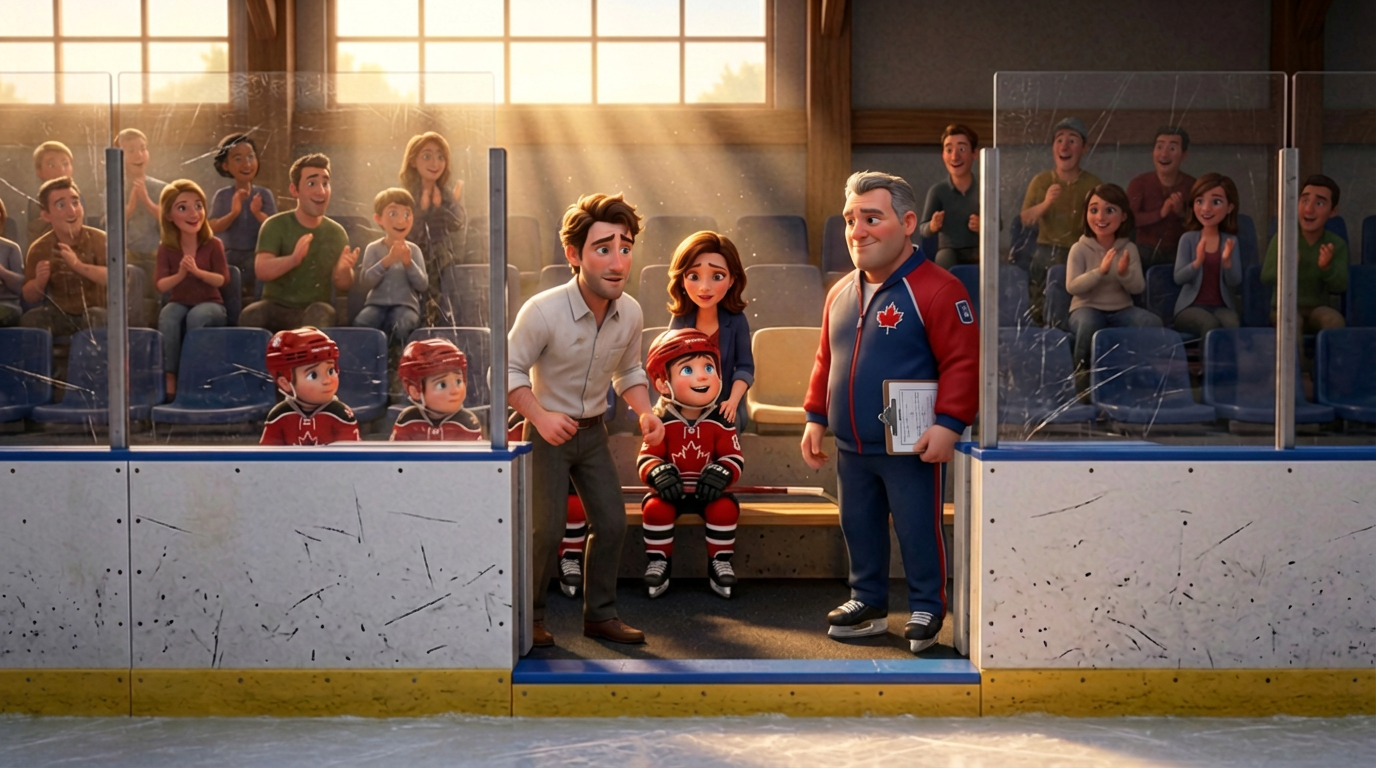
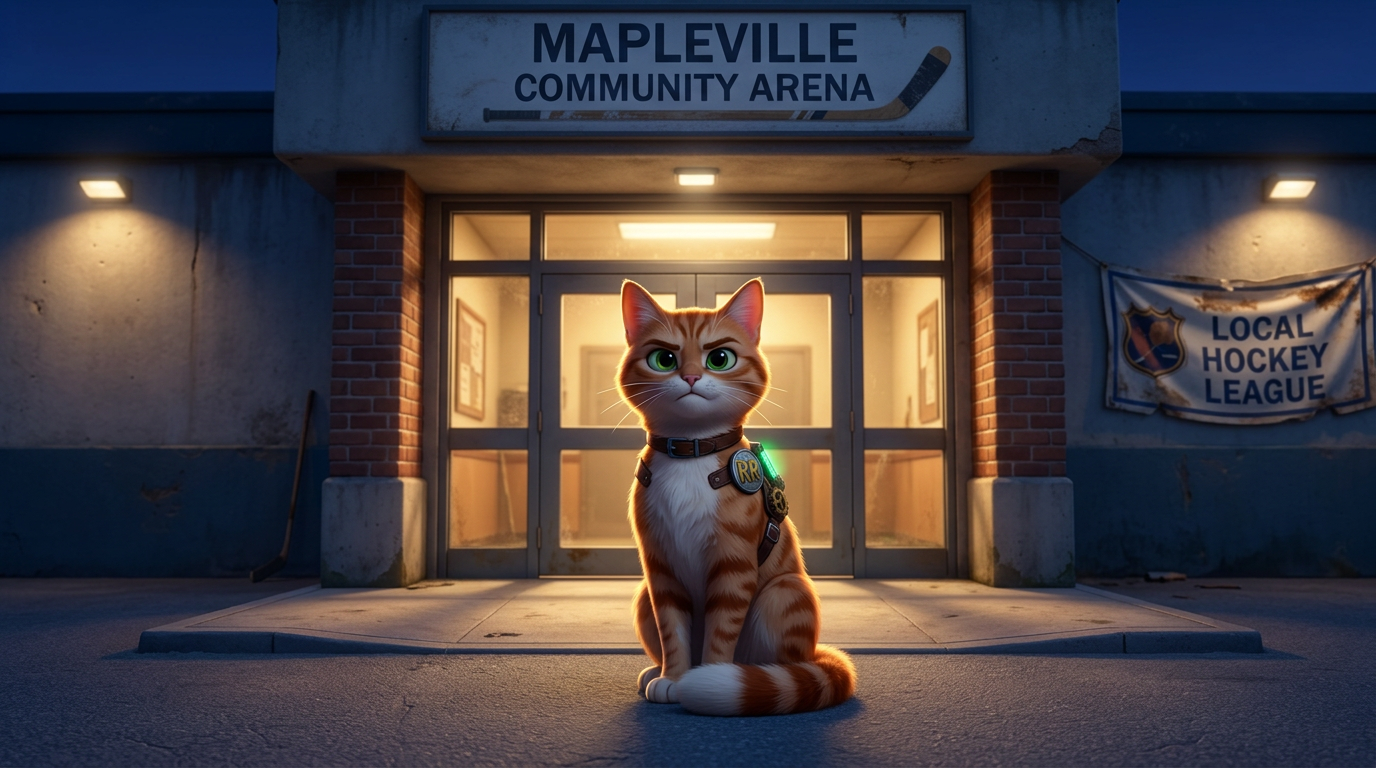
The machine is dead. The storm is gone. Stars visible. Rob and Claire on the rooftop, exhausted.
Beat. They run.
No dialogue. The montage melody building. Two people changing in the car. Pulling jackets over bruised arms. Running across a parking lot. Not heroes. Parents.
They push through the doors during the second period. Find seats in the bleachers. Claire sits first. Then Rob slides in beside her. The golden seat — the one that was empty on that regular Tuesday — fills.
Max is on the bench. He got here with his teammate's family — the Barretts, two doors down. Walked into the arena with someone else's dad carrying the extra sticks. Sat on the bench alone while other kids pointed at their parents in the stands.
He glances at the stands. The way he always does now — a habit, even though he stopped expecting anything a long time ago. A quick look. Checking the same spot.
He sees his dad. Then his mom. His face changes — quiet certainty. Pulls his helmet down. Plays the best shift of the season.
MAPLE at the entrance door. Harness dark. He showed up. He always shows up.
COACH HANK catches Rob near the exit.
Max comes out. The two-tap. The hug.
At the exit, Max sees Maple on the welcome mat.
Maple's eyes close. Open slowly. The feline shrug.
He carries Maple out. Rob and Claire follow. The arena lights dim behind them.
Director's Notes
Coach Hank's Final Beat: The theme of the movie stated by the character with most authority to say it. Four beats across the whole film, resolved in one line.
The Two-Tap: Established in the montage. Returns here. The ritual is unchanged — what's changed is the weight behind it. In the montage it was play. Here it's a promise.
Maple at the Arena: No explanation. The cat shows up. He always shows up. Max's "You came too?" is the last Maple comedy beat of the main film — and it lands as both funny and devastating.
The Final Image
The house is quiet. Max is in bed. Asleep. His hockey stick leans against the wall.
The bedroom door opens. A sliver of hallway light.
Rob leans in the doorway. No suit. No cape. Just Rob in a t-shirt and jeans. A bandage on his hand. Tired eyes.
He's asleep again. Rob pulls the blanket up. Stays sitting for a moment longer than he needs to.
Rob walks to the kitchen. Opens the fridge. The light illuminates his face — and the dozens of drawings covering the fridge door. Rocket Rob in every one.
CLAIRE appears in the doorway. Robe. Hair down. She takes one look at him and knows.
She crosses to him. Leans against his shoulder. Doesn't ask. Doesn't need to.
They stand in the kitchen. Quiet. The fridge hums. Max's drawings surround them — Rocket Rob in every one. Flying. Saving. Smiling. And one, near the bottom, newer than the rest: two superhero parents side by side.
The drawings say everything neither of them needs to.
PULL BACK through the kitchen window. The warm light inside. Two figures standing close.
WIDER: the house on its street. Porch light on. Hockey net in the driveway.
WIDER: the neighborhood. The city beyond. Lights steady. Safe.
WIDER: the skyline. The bridge. The Titan tower dark now. Stars above.
And then — Max's voice.
For the first time since the Silence began. The narration that disappeared mid-film. The voice that gave this movie its soul and then went quiet.
It's back. But different.
Not dramatic. Not excited. Not playing pretend.
This isn't a kid narrating a superhero movie anymore. This is a child who outgrew the fantasy, sat in the silence, and chose to believe anyway. "Family" — not city. "Heroes" — not hero. "Ones" — not one. He sees both parents now.
HOLD on the city. Quiet. Safe. Ordinary.
TITLE CARD: ROCKET ROB
FADE TO BLACK.
Director's Notes
"Something like that" — Once: Rob says this only here, in the bedroom (to "Did you save the world?"). It's quiet and honest — a confession disguised as a deflection. The arena exchange is different: "You were there" / "Mom too." Max doesn't ask about winning. He only cares about presence.
The Kitchen Silence: Claire doesn't ask. She doesn't need to. The drawings on the fridge say it all — including the new one with two superhero parents. The thesis is delivered through visuals, not dialogue.
Max's Returned Voice: The narration has been silent for ~30 minutes of screen time. When it returns — soft, sleepy, changed — the relief should be overwhelming. "Every family has heroes. Ours has the best ones." Not city — family. Not hero — heroes. He sees both parents now. A choice is more powerful than faith.
The Pull-Back: The audience is being gently let go. Kitchen, house, street, city, sky. Everything is okay. Not perfect. Not dramatic. Just okay. And that's enough.
Rocket Maple
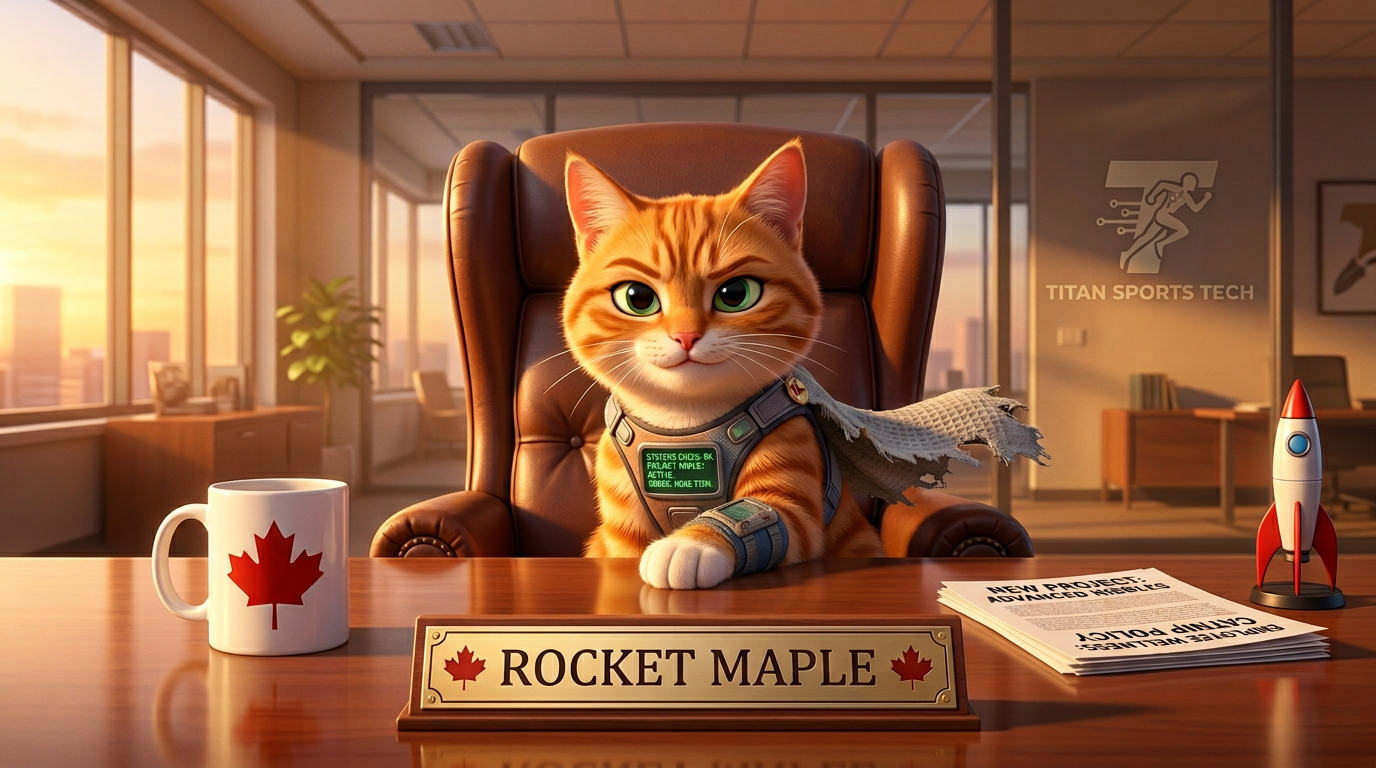
The office is empty. Dark. One desk is occupied.
MAPLE sits in Rob's desk chair. Cape on (a dish rag). Harness glowing. A tiny nameplate reads: ROCKET MAPLE.
He surveys the empty office. Slowly. Deliberately. The way a general surveys conquered territory.
He turns to the window. The city skyline below — the same rooftops Rob flies over. Maple looks at it all like it belongs to him.
A notification pops up on the harness. Green text, steady glow:
[WORLD: SAVED]
Maple blinks. Considers this. Then — with the unhurried confidence of someone who was never in any doubt — he lifts one paw and begins to lick it.
The heroic music swells.
CUT TO BLACK.
Director's Notes
The Nameplate: Handmade — Max's handwriting, marker on cardboard, taped to Rob's real nameplate. Max included the cat in the story. The belief extends to everyone.
Rocket Rob: The dish rag has appeared throughout the film — on Max's shoulders, on the kitchen counter, over the couch arm. Its appearance here closes the loop. Every member of this family has worn the cape.
Maple's Arc: Throughout the film, Maple's behavior tells a parallel story — from confident hunter (Act One), to uncertain sentinel (Act Two), to purposeful operative (Act Three). His harness readouts surface only at the quietest beats — [STILL HERE] on the rooftop, [ALL UNITS: HOME] on the couch, [MISSION: COMPLETE] at bedtime — building to the post-credits [WORLD: SAVED], the final and biggest payoff of the behavioral arc.